
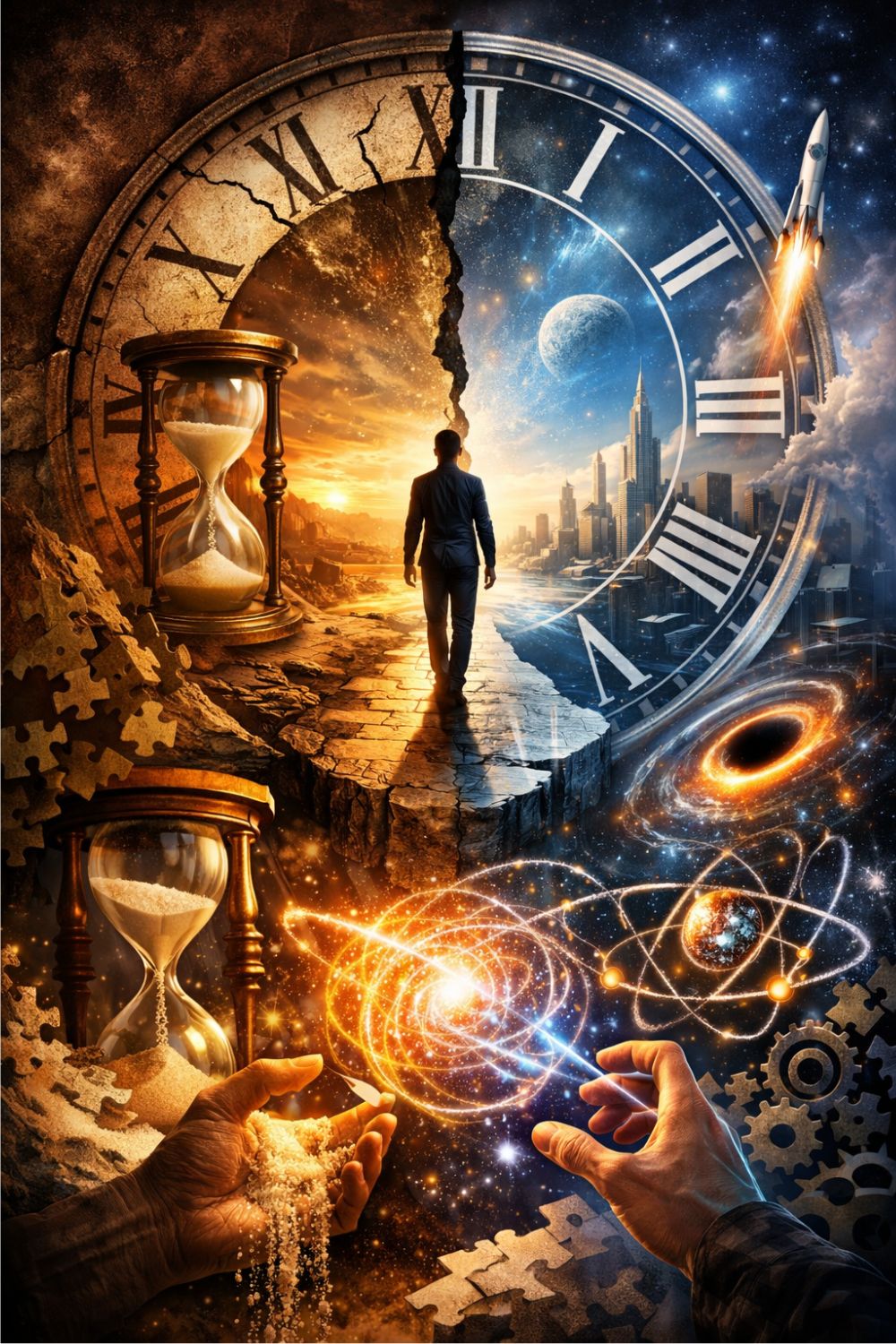
Series: Time, Consciousness, and New Science
By JJ Simon — Perspectives with JJ Simon
author of Humans Actuators of Time
Time feels obvious—until you actually look at it.
We divide our lives into seconds and years. We plan futures, revisit memories, measure progress, regret delays. Time feels so immediate, so ever-present, that questioning it can seem almost unnecessary.
And yet, the deeper science looks, the less obvious time becomes.
When physicists strip away intuition and examine reality at its foundations, time stops behaving like a steady background and starts acting more like a condition—something dependent, contextual, shaped by relationships rather than imposed universally.
That realization is one of the quiet sparks behind Humans Actuators of Time.
Because once time stops being absolute, the role of human agency can no longer be treated as incidental.
Time as Measurement, Not Master
At its most practical level, time is a tool.
We measure change. We track cycles. Atomic clocks count oscillations in atoms with extraordinary precision. This gives us consistency, coordination—and the impression of uniform flow.
But measurement is not the same as essence.
In modern physics, time is not just something we count. It is part of structure.
Einstein showed us that time and space are inseparable. Together they form spacetime—a four-dimensional fabric in which motion, gravity, and causality are intertwined. Time does not tick at the same rate everywhere. It slows near massive objects. It stretches with velocity.
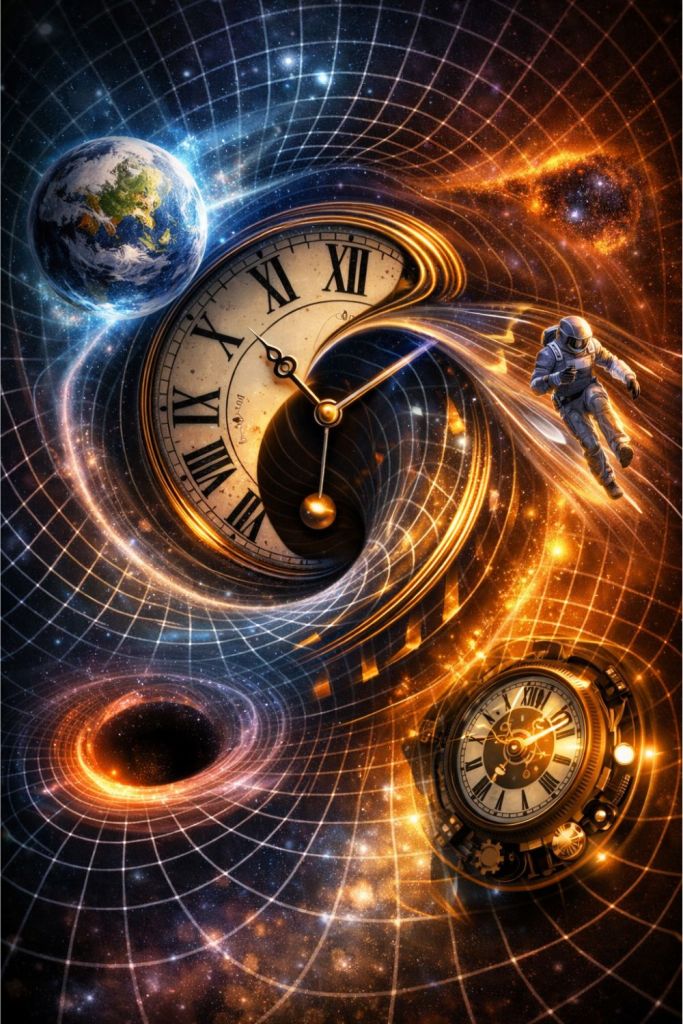
Two clocks can disagree—and both be correct.
This alone unsettles the idea that time exists independently of everything else.
Time depends on conditions.
Space and Time Are Not Separate Stories
Before relativity, time was assumed to be universal. One now. One past. One future. Everyone, everywhere, sharing the same cosmic rhythm.
That idea did not survive contact with reality.
In spacetime, events are defined by where and when together. Motion changes time. Gravity reshapes duration. Cause and effect themselves depend on geometry.
Time is no longer the stage.
It is part of the set.
And once that shift happens, the idea that humans merely exist inside time starts to feel incomplete.
The Arrow That Isn’t in the Equations
One of the strangest facts about time is that its direction does not appear in most fundamental laws of physics. Many equations work just as well forward as backward.
And yet, our lives are saturated with irreversibility.
We remember the past, not the future. Glass shatters but does not reassemble. Choices close doors. Stories accumulate.
Physics often explains this arrow of time through entropy. Systems tend toward disorder. Lower entropy states are rare. Higher entropy states are common.

This statistical tendency gives time its apparent direction.
But entropy alone does not explain experience.
It does not explain meaning.
Where Humans Enter the Picture
This is where Humans Actuators of Time deliberately steps in.
Physics can describe clocks, spacetime, and entropy with precision. What it cannot do is account for how time becomes lived.
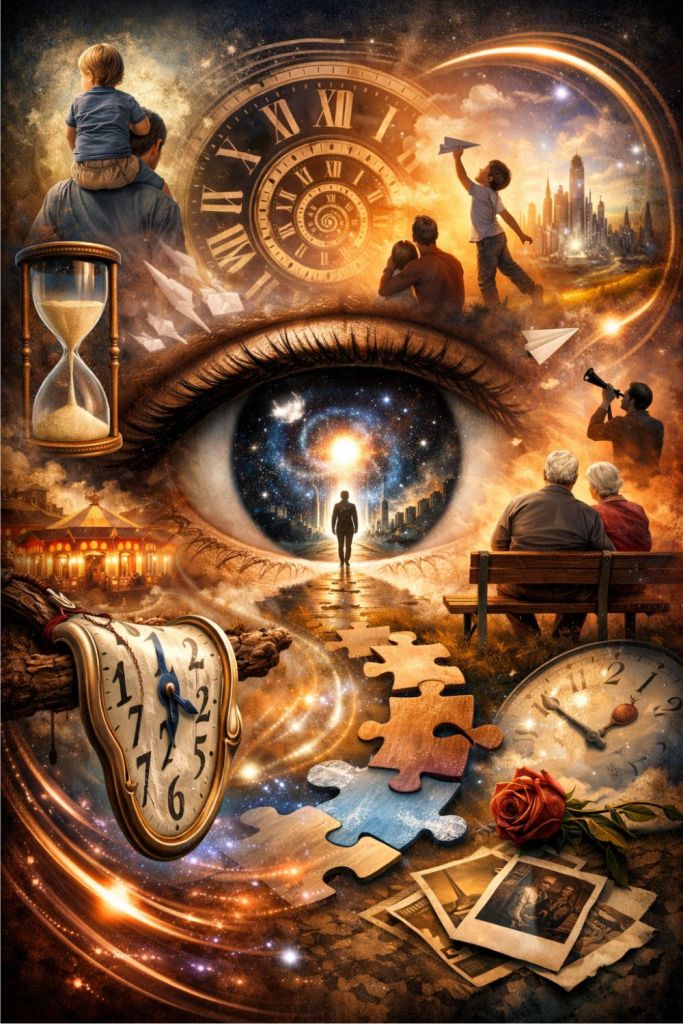
Humans do not simply observe sequences—we interpret them.
We compress years into moments of memory.
We stretch moments into lifetimes of meaning.
We project futures that do not yet exist and act as if they do.
A joyful moment expands.
Repetition collapses into blur.
Attention alters duration.
Purpose reorganizes sequence.
These are not errors in perception.
They are structures of experience.
And if time emerges from relationships, then beings capable of memory, intention, and narrative are not spectators.
They are participants.
Time as a Shared Construction
The argument is not that humans override physics.
It is that physics alone does not finish the story.
The universe provides the framework. Spacetime establishes what is possible. Entropy gives direction.
But human agency instantiates time in lived form.
Decisions leave records.
Memories preserve pasts.
Narratives stabilize meaning.
Cultures transmit temporal structure across generations.
Time becomes navigable through participation.
In this sense, time is neither purely objective nor purely subjective.
It is relational.

Two Perspectives, One Deeper Truth
Physics shows us that time depends on motion, gravity, and geometry.
Experience shows us that time depends on attention, memory, and purpose.
These are not competing explanations.
They are complementary.
Humans Actuators of Time suggests that time is woven from both cosmic structure and conscious engagement—
from atoms and clocks, yes, but also from stories, choices, and meaning.
Time is not simply something we move through.
It is something we help shape.
From the Publisher
If this way of seeing time feels intuitive, unsettling, or strangely familiar, you’re not alone.
At Dare I Say Publishing, we explore ideas like this through essays, blogs, videos, and perspectives that question the default frame.
Humans Actuators of Time reflects that same spirit—offering not a fixed conclusion, but an invitation into deeper inquiry.
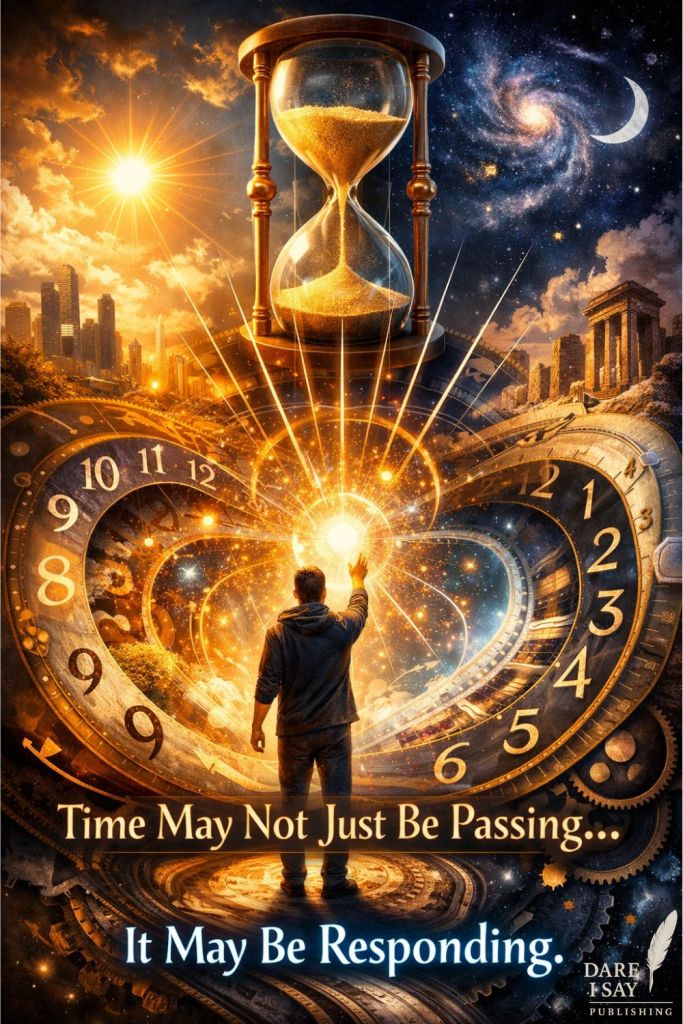
Because time may not just be passing.
It may be responding.

Leave a comment