
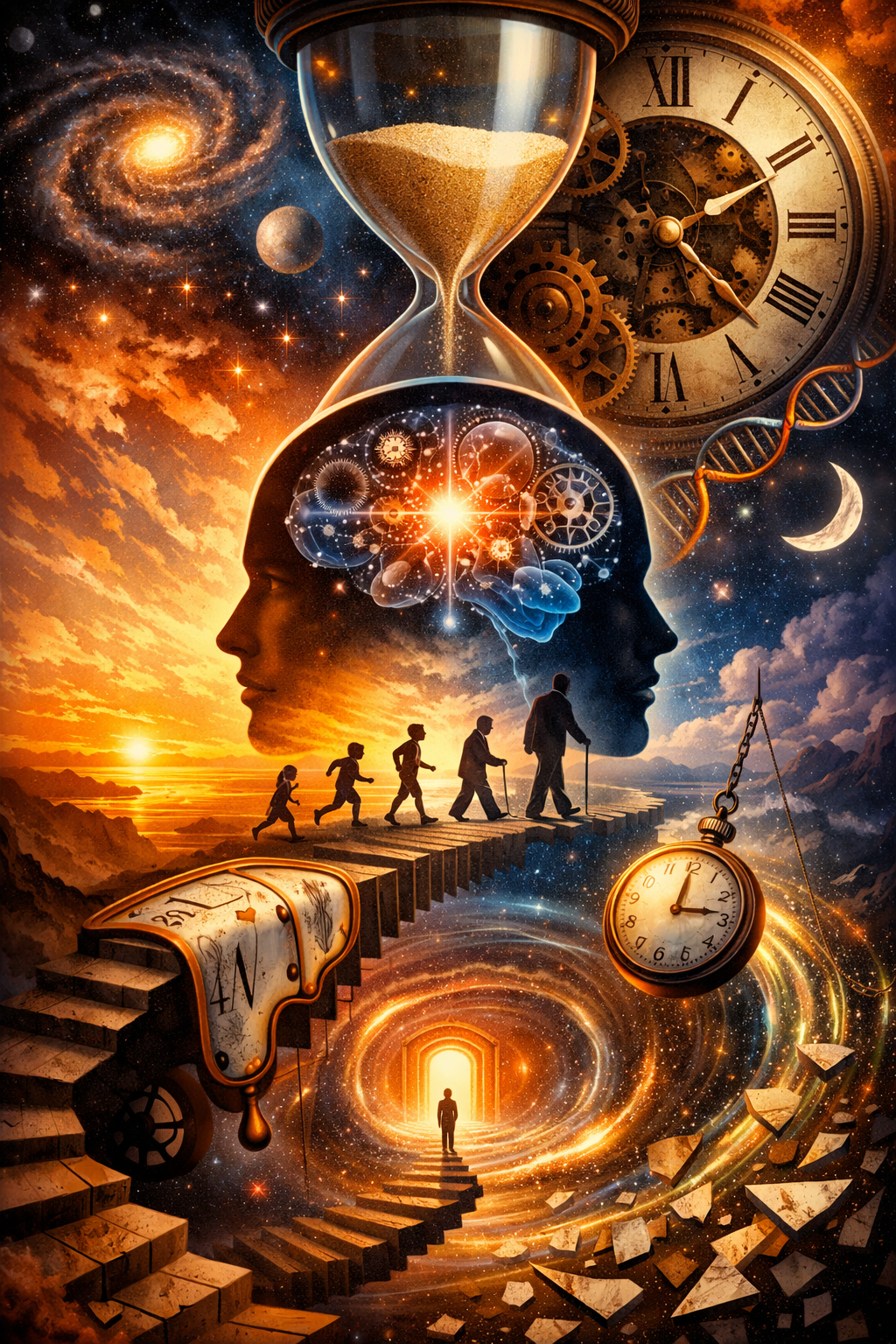
The Science of Time and the Human Experience
Series: Time, Consciousness, and New Science
By JJ Simon — Perspectives with JJ Simon
author of Humans Actuators of Time
Time feels like it moves.
Not abstractly. Not conceptually.
But directly, almost physically—like something carrying us from one moment to the next.
We feel it in urgency. In anticipation. In memory.
We speak of it as if it flows—forward, continuously, irreversibly.
And yet, when we look more closely, that sense of flow becomes difficult to locate.
Physics does not describe time as something that moves.
Clocks do not detect a current.
Equations do not contain a direction.
So where does this feeling come from?
To understand why time feels like it flows, we have to look at time not as a single concept—but as a layered phenomenon, emerging across physics, biology, and human experience.
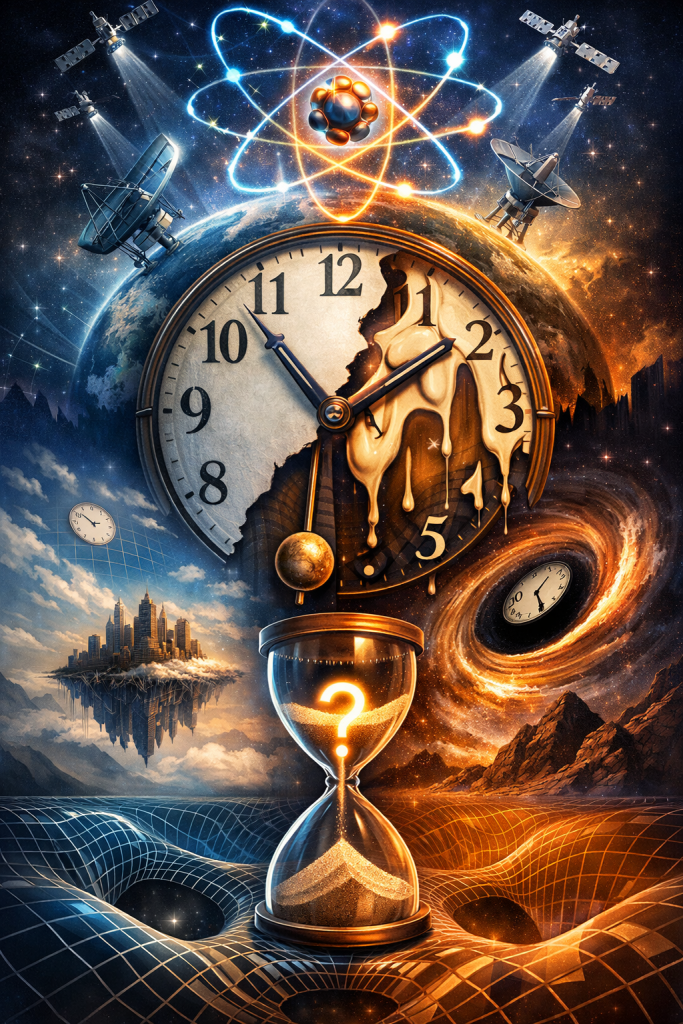
Time in Physics: Structure Without Flow
In modern physics, time is not a river. It is a coordinate.
Since Theory of Relativity, time has been understood as part of a four-dimensional structure known as spacetime. Events are located not just in space, but in time—linked together in a geometric framework.
Within this framework:
- Time does not pass—it orders events
- There is no universal “now” shared across the universe
- The rate at which time is measured depends on motion and gravity
Clocks in orbit tick differently than clocks on Earth. Objects moving at high speeds experience time differently than those at rest.
These effects are not theoretical curiosities—they are measured, tested, and essential to technologies like GPS.
But none of this introduces a “flow.”
Physics describes relationships between events. It allows us to say what comes before or after. It gives structure.
But it does not explain why time feels like it is moving.
Measurement Without Essence
Clocks give time precision.
Atomic clocks, for example, define the second based on the oscillation of atoms such as cesium. These oscillations are extraordinarily stable, allowing us to measure time with remarkable accuracy.
But what clocks measure are repeating processes.
They count cycles. They track intervals.
They do not detect time itself as a substance.
This distinction matters.
Because once we separate measurement from essence, a deeper question emerges:
If time is not something flowing independently, why does it feel like it is?
The Arrow of Time: Direction Without Motion
One place where physics does approach the idea of flow is through entropy.
In thermodynamics, entropy measures the number of possible configurations a system can take—often simplified as disorder.
The second law of thermodynamics states that entropy tends to increase in closed systems.
This gives time a direction:
- Eggs break, but do not unbreak
- Heat disperses, but does not spontaneously concentrate
- Systems evolve from less probable to more probable states
This directional tendency is often called the arrow of time.
But even here, there is no actual movement of time itself.
Entropy explains why processes unfold in one direction, not why time flows as an experience.
It gives us asymmetry—but not sensation.
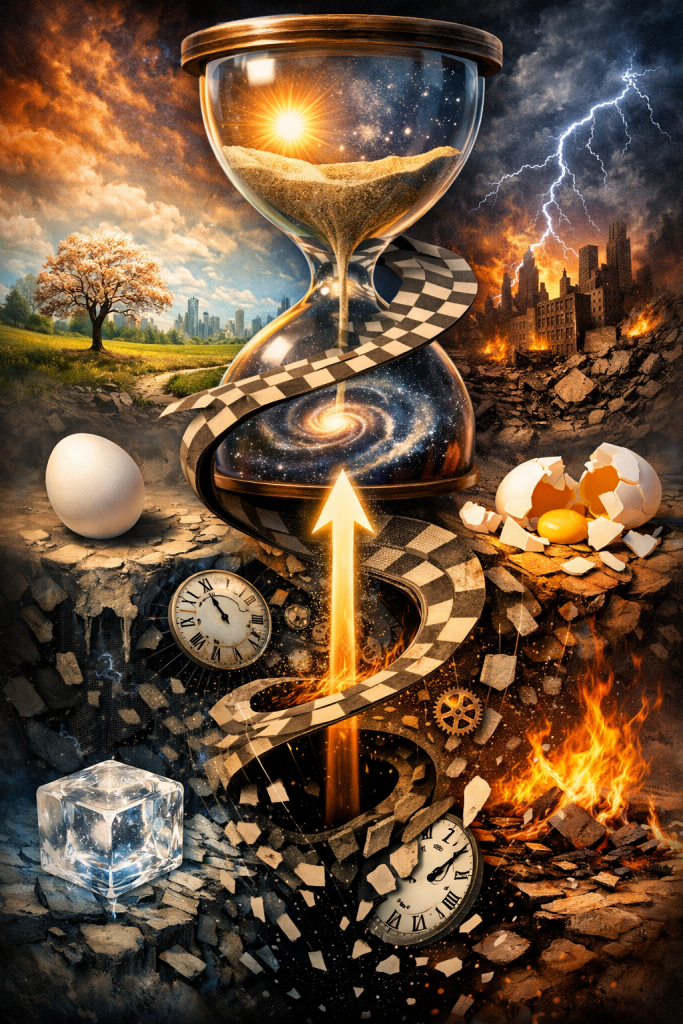
The Brain and the Construction of Flow
The feeling of time passing emerges not from physics—but from the way the brain processes change.
Human experience is not a static snapshot. It is a continuous integration of:
- sensory input
- memory
- prediction
- attention
The brain is constantly updating a model of the world, stitching together what just happened, what is happening now, and what might happen next.
This creates continuity.
And continuity creates the impression of flow.
Neuroscience suggests that:
- Memory anchors events into sequence
- Attention determines the density of experience
- Prediction pulls awareness forward into anticipated outcomes
- Emotion marks moments with significance
The result is not just awareness of change—but a structured experience of it.
Time feels like it moves because the brain is constantly reorganizing experience into a directional narrative.
The Present Moment: A Functional Illusion
One of the most compelling aspects of time is the sense of “now.”
It feels immediate. Singular. Real.
But in physics, there is no privileged present moment. All events exist within spacetime without a universal “current.”
This suggests something profound:
The present is not an external feature of reality.
It is a construct.
The brain creates a window of integration—sometimes called the “specious present”—that blends recent past input with immediate perception.
This allows us to:
- react
- decide
- coordinate action
But it also creates the sensation that we are moving through a stream of moments.
In reality, what we experience as “now” is a continuously updated interpretation.
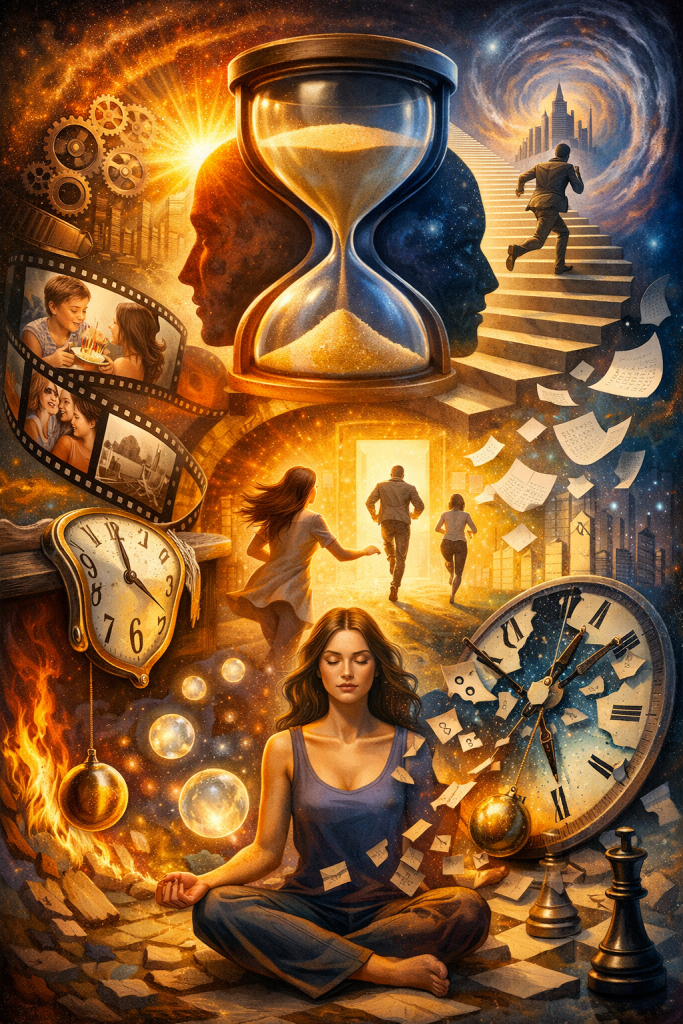
From Change to Experience
At this point, a pattern begins to emerge.
- Physics describes time as structure
- Clocks measure time as intervals
- Entropy gives time direction
- The brain gives time flow
None of these are contradictions.
They are layers.
And when these layers interact, time becomes something more than a variable.
It becomes experience.
Humans as Participants in Time
This is where the perspective explored in Humans Actuators of Time becomes especially relevant.
Humans do not simply move through time.
They structure it.
Through:
- memory, which shapes the past
- attention, which defines the present
- anticipation, which organizes the future
We convert sequences into narratives.
We assign meaning.
We create continuity.
In doing so, we do not alter physical time—but we shape how time is lived.
The “flow” of time is not something we passively observe.
It is something we actively participate in.
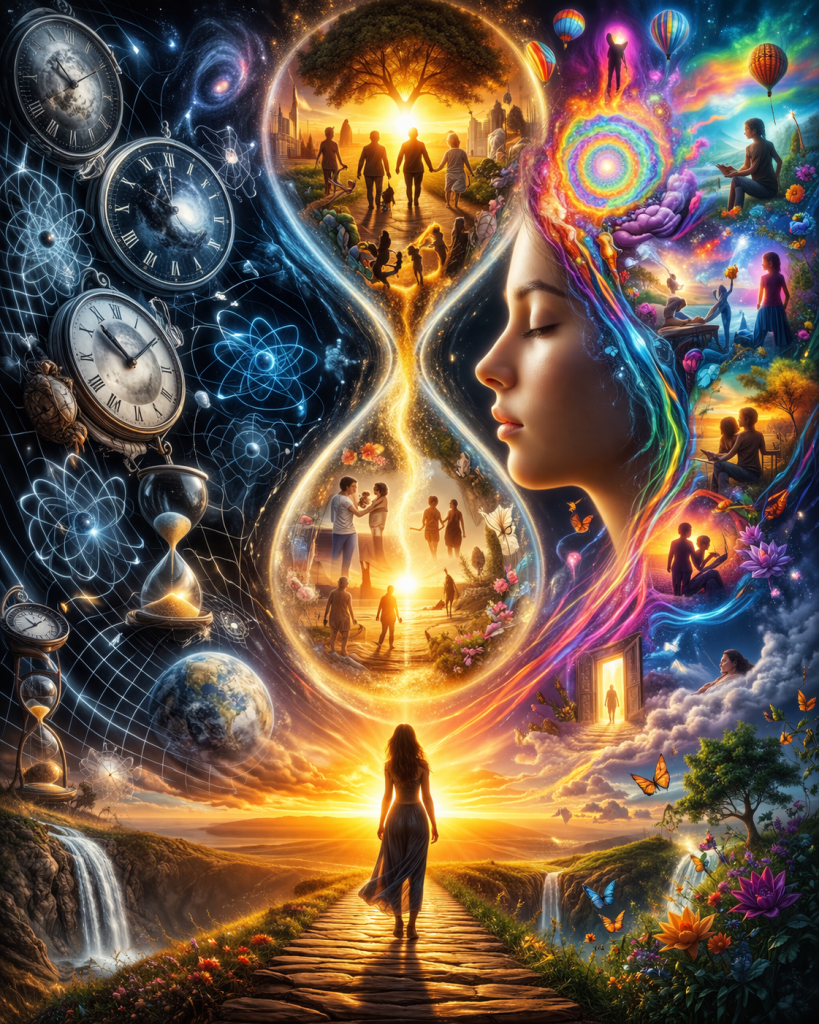
Time’s Two Faces
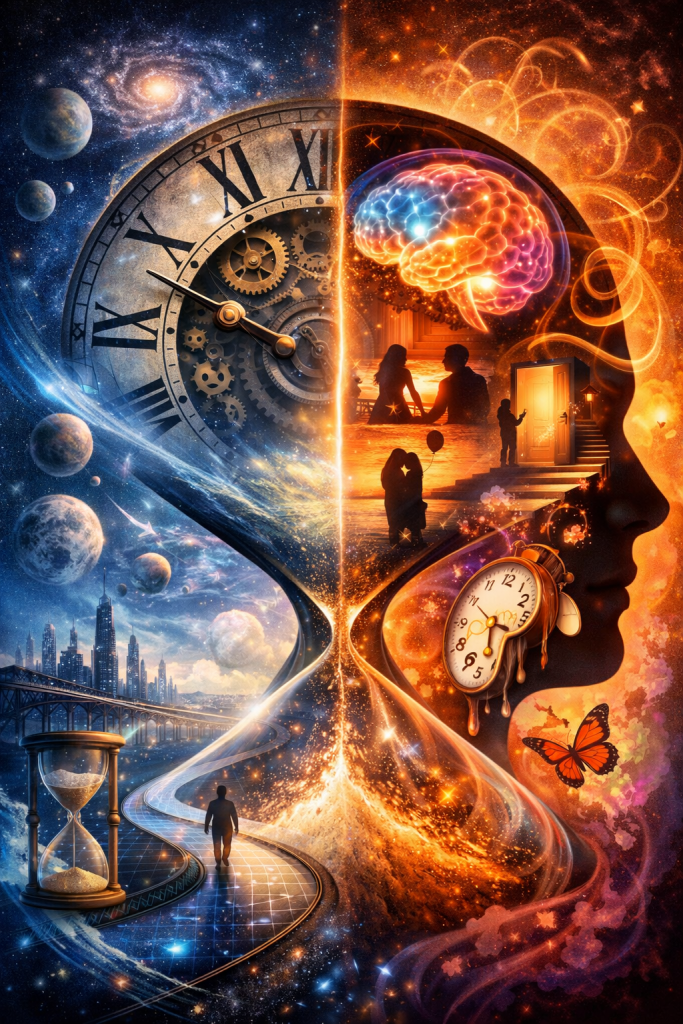
To understand time fully, we have to hold two perspectives at once:
External Time
- Defined by physics
- Measured by clocks
- Structured by spacetime
Internal Time
- Created by the brain
- Shaped by perception and memory
- Experienced as flow, sequence, and meaning
Neither replaces the other.
They describe different aspects of the same reality.
Why Time Feels Like It Flows
Time feels like it flows because:
- Change is directional (entropy)
- Experience is continuous (neuroscience)
- Memory creates sequence
- Anticipation creates momentum
- Awareness binds it all together
What we experience as flow is not time itself moving—but our perception organizing change into a coherent, forward-moving structure.
Conclusion: Time as Relationship
Time is not a river carrying us forward.
It is a relationship.
Between:
- change and structure
- memory and anticipation
- measurement and meaning
- physics and experience
Time exists in equations.
But it also exists in minds.
And it is at that intersection that time becomes something more than measurable.
It becomes meaningful.
From the Publisher
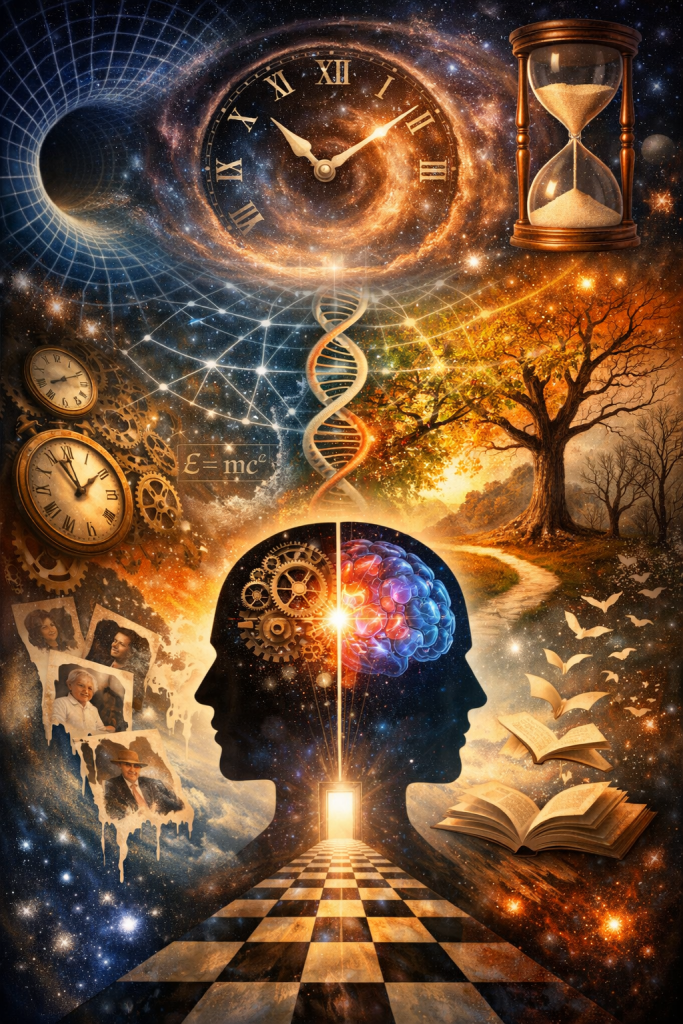
At Dare I Say Publishing, we are interested in the space where different ways of understanding reality begin to overlap.
Time is one of those rare ideas that sits at the intersection of physics, biology, psychology, and lived experience.
What makes it compelling is not just that it can be measured—but that it can be questioned.
Across this series, a pattern has begun to emerge:
Time is not only something we track.
It is something we interpret, structure, and live.
And when those layers are considered together, the question of time becomes less about definition—and more about relationship.

Leave a comment