
Series: Time, Consciousness, and New Science
By JJ Simon — Perspectives with JJ Simon
For most of my life, I accepted the same quiet assumption almost everyone does.
Time is just there.
It flows.
We move through it.
End of story.
But the longer I sat with physics, philosophy, and lived experience, the more that story started to feel… incomplete. Too neat. Too passive. Too convenient.
And now, interestingly enough, physics itself seems to be arriving at the same discomfort.
In recent years, some of the most serious minds in science have begun questioning whether time is even fundamental at all. Not how fast it moves. Not whether it bends. But whether it exists as a basic ingredient of reality in the first place.
That question is not academic. It’s existential.
Because if time isn’t fundamental, then something else is doing the heavy lifting.
And that “something else” may involve us far more than we were ever told.
When the Clock Starts Cracking
Classical time feels obvious. Seconds tick. Days pass. Causes precede effects. We plan, we age, we remember.
But physics has been quietly poking holes in that picture for over a century.
Relativity showed that time stretches and compresses depending on speed and gravity. Quantum theory treats time as an external parameter rather than something it can explain. And when researchers attempt to unify these frameworks, something strange keeps happening.
At the deepest levels of the math, time vanishes.
Not slows down.
Not warps.
Disappears.
That’s not a minor glitch. That’s a clue.
It suggests that the flowing, directional time we experience may not be baked into the universe at all. It may be something that emerges.
And emergence always raises a dangerous follow-up question:
Emerges from what?
From Emergence to Participation
One of the most important shifts in modern physics is the realization that information is physical. Not metaphorical. Not bookkeeping. Physical.
Information must be stored. Transmitted. Preserved. And crucially, once recorded, it cannot always be undone.
From this perspective, time doesn’t flow because some cosmic clock says so. Time appears to flow because interactions leave irreversible records. The universe remembers.
This is where the conversation stops being abstract.
If time arises from irreversible interactions, then beings capable of intention, choice, memory, culture, and meaning are not passengers in the system.
They are engines.
Every decision collapses possibilities.
Every action selects one path and excludes countless others.
Every memory preserves a past and reshapes a future.
This is not poetic language. This is thermodynamics, information theory, and lived experience converging.
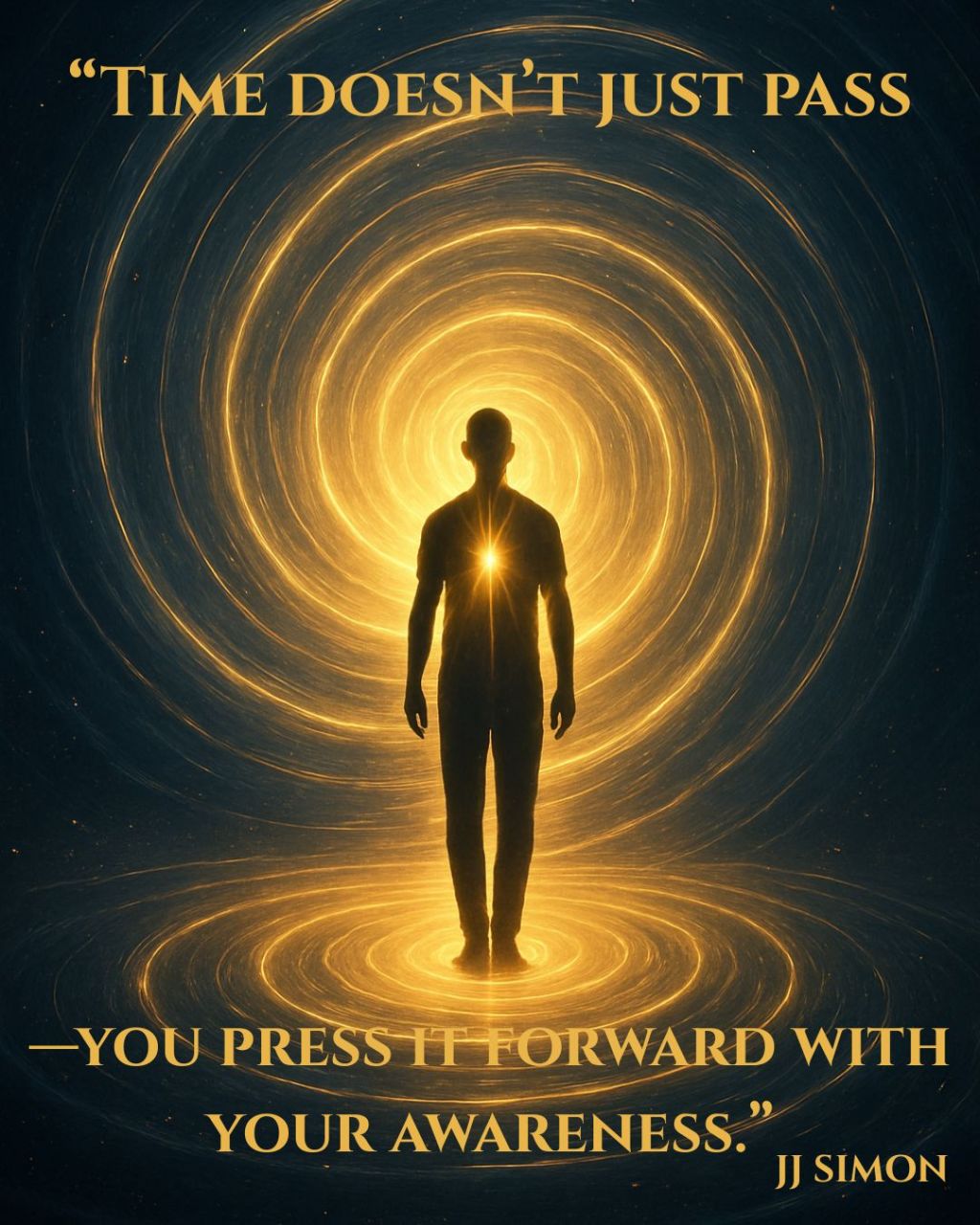
Humans are not drifting downstream in time.
We are helping define its direction.
Meaning Is Not Decoration. It’s Structure.
One of the most misunderstood ideas in science is meaning. It’s often treated as subjective fluff, something layered on top of a mechanical universe.
That view is too small. I don’t buy it.
Meaning organizes experience. It determines what is remembered, what is ignored, what is acted upon, and what is allowed to fade. A moment saturated with meaning carries more temporal weight than one forgotten an hour later. A choice made with intention restructures what follows.
Physics tells us the universe remembers through information.
Humans Actuators of Time extends that insight inward.
Consciousness does not merely witness time.
It structures it.
Navigates it.
Stabilizes it.
Time is not only written into spacetime.
It is written into experience.
Beyond the Observer Myth
Science often speaks of the observer as if observation was always neutral. Someone who watches reality unfold without altering its deeper structure.
But lived reality says otherwise. Anyone who has chosen, failed, built, or loved knows better.
Measurement changes systems.
Awareness changes behavior.
Participation changes outcomes.
Both quantum physics and daily life agree on this, even if the language differs.
Humans are not neutral spectators inside a ticking universe. We shape informational landscapes. Culture leaves records. Technology extends memory. Stories outlive bodies. Civilizations imprint time itself.
From this view, the future is not something we simply approach.
It is something we construct.
Consider This
What makes this moment unique is not that physics is borrowing from philosophy, or philosophy from physics. It’s that both are arriving at the same unsettling realization from opposite directions.
Time may not be fundamental.
Agency may be far more central than we were taught.
Here’s a deeper, more uncomfortable question.
If time is emergent…
then emergent from what?
And through whom?
The answer is both humbling and empowering.
The universe may not simply exist in time.
Time may be something the universe — and its conscious participants — continuously bring into being.
From the Publisher
If this way of seeing resonates with you, you’ll feel at home with us.
At Dare I Say Publishing, we don’t just publish books. We build conversations. We explore ideas that sit at the edge of science, philosophy, consciousness, and culture. We share essays, blogs, videos, visual work, and voices from authors who aren’t afraid to question the frame itself and expand perspective.
If you’re curious, skeptical, thoughtful, or just tired of being told you’re only along for the ride, we invite you to join us.
Read. Linger. Question. Explore.
And if you feel called to go deeper, pick up the book.
Not as a conclusion.
As a beginning.


Leave a reply to thoroughlyconnoisseur33c16bf163 Cancel reply