
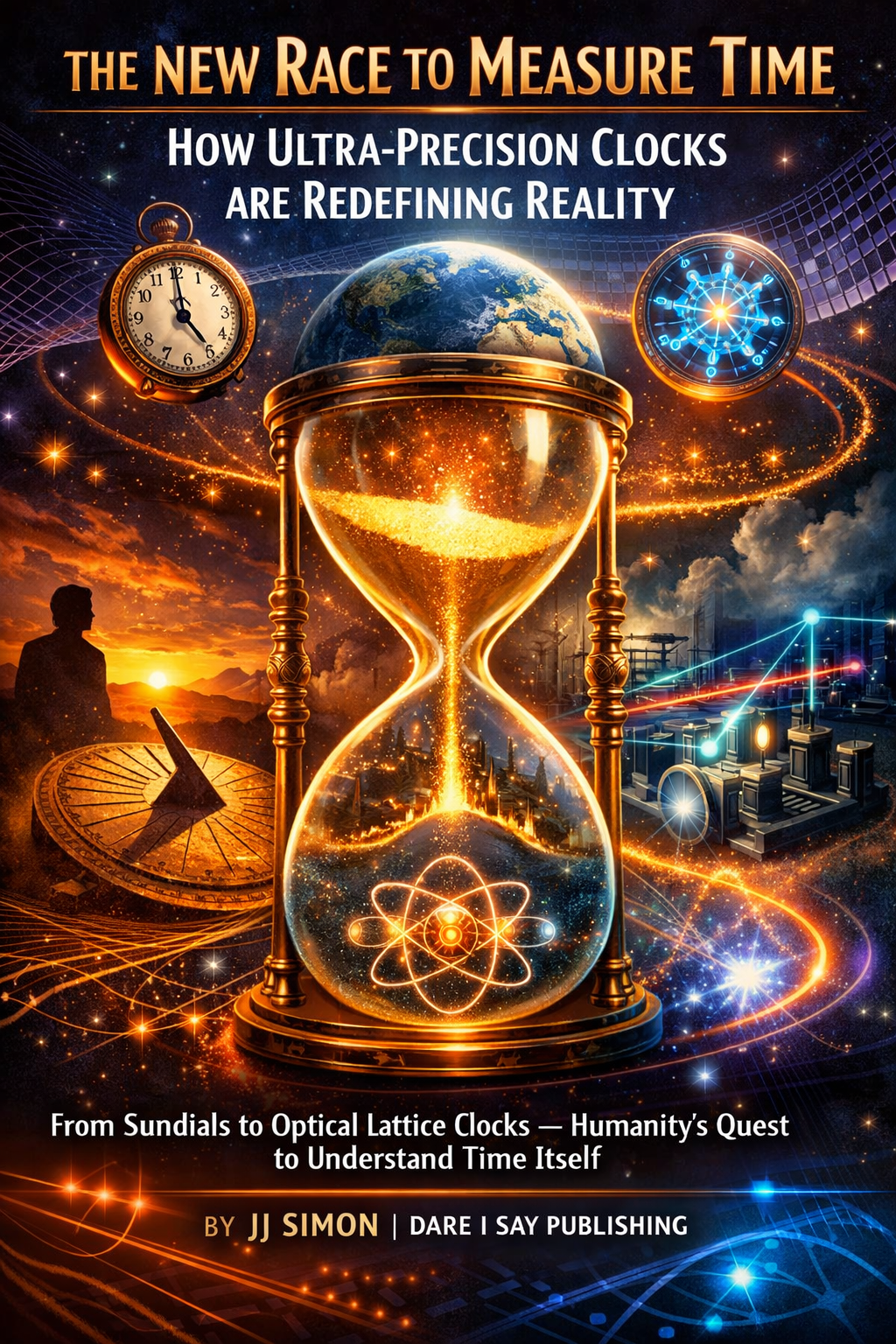
From Sundials to Optical Lattice Clocks — Humanity’s Quest to Understand Time Itself
Series: Time, Consciousness, and New Science
By JJ Simon — Perspectives with JJ Simon
I still find it astonishing that something as ordinary as a “second” is not a simple thing at all.
It isn’t something we can hold.
It isn’t something we can see directly.
It isn’t even something that exists independently in the way we often imagine.
A second is something we define.
And right now, humanity is redefining it again.
Not because our clocks stopped working.
But because our ability to measure reality itself is evolving.
In recent discussions of time crystals, physicists have explored how matter itself can organize into rhythmic patterns that behave like clocks. But the human quest to understand time has followed another path as well — building ever more precise instruments capable of measuring change with extraordinary accuracy.
Together, these two directions reveal something profound: our understanding of time deepens as our ability to detect patterns of change improves.
From Shadows to Atoms: Humanity’s Long Journey of Timekeeping
For most of human history, measuring time meant watching the sky.
Ancient civilizations tracked shadows across sundials. The movement of the sun provided the earliest large-scale clock, tying daily life directly to celestial motion.
Later came mechanical clocks, whose swinging pendulums transformed timekeeping into a reliable technology. The industrial world that followed depended on this regularity.
The twentieth century introduced an even more stable reference: the quartz crystal oscillator. Quartz clocks used the natural vibration of crystals under electrical charge to keep time far more precisely than mechanical systems.
But the real revolution arrived with atomic clocks.
Instead of relying on mechanical motion, atomic clocks measure the natural vibrations of atoms themselves. In particular, cesium atomic clocks track the frequency of radiation associated with transitions between energy states of cesium atoms.
These oscillations are astonishingly stable.
So stable, in fact, that cesium clocks would drift by only about one second over tens of millions of years.
For decades, this became the global standard for defining the second.
Yet modern science now demands even greater precision.

Counting Time with Light: The Optical Lattice Clock
A new generation of clocks is pushing time measurement to unprecedented levels.
These devices are known as optical lattice clocks.
Instead of measuring atomic vibrations with microwave frequencies, optical clocks use visible or near-visible light. Because light oscillates far faster than microwaves, it allows scientists to measure time with dramatically finer resolution.
Atoms are trapped in a lattice formed by laser light — an optical “grid” that holds them nearly motionless. Scientists then measure extremely rapid optical transitions within those atoms.
The result is almost unimaginable precision.
Modern optical lattice clocks are accurate enough that their error would amount to roughly one second over tens of billions of years — on the order of the age of the universe itself.
This is not simply a better clock.
It represents a fundamental expansion in humanity’s ability to measure reality.
A Global Network Defining Time
Today, no single clock defines time for the world.
Instead, time is established through a coordinated network of the most accurate clocks on Earth.
Together, they determine what we know as Coordinated Universal Time (UTC).
Each new ultra-precise clock added to this network improves the global standard.
Recently, China’s optical lattice clock technology reached a milestone by contributing to international timekeeping systems. This marks a new stage in what might be described as a quiet global race.
Not a race for territory.
But a race to measure reality with ever greater precision.
Why Ultra-Precise Time Matters
At first glance, measuring time with billion-year accuracy may seem unnecessary.
But ultra-precise clocks unlock remarkable scientific capabilities.
Because gravity slightly alters the passage of time — a consequence of general relativity — extremely sensitive clocks can detect minute gravitational differences.
In effect, clocks become sensors.
Two clocks placed at slightly different elevations will tick at measurably different rates.
With sufficient precision, these differences can reveal height variations as small as a few centimeters.
This ability opens new possibilities for Earth science.
Ultra-precise clocks could help monitor tectonic activity, track volcanic systems, map underground structures, and detect subtle changes in Earth’s crust.
In space science, they allow physicists to test fundamental theories with extraordinary sensitivity — potentially even detecting tiny variations in the fundamental constants of nature.
Toward Redefining the Second
Optical lattice clocks have become so precise that scientists are now considering redefining the official International System of Units (SI) second based on their measurements.
Such a change would represent the first major update to the definition of the second since cesium atomic clocks became the global standard.
This would not simply be a technical adjustment.
It would reflect a deeper shift in humanity’s ability to describe the universe with precision.
The Hidden Truth About Clocks
Beneath all of this technology lies a surprisingly simple insight.
Clocks do not measure time itself.
They measure change.
Every clock — from a sundial to an atomic oscillator — works by counting a repeating process.
A shadow moves.
A pendulum swings.
A crystal vibrates.
An atom transitions between energy states.
Time, as we experience and define it, emerges from these patterns.
The more precisely we measure change, the more precisely we describe time.
A Perspective from Humans Actuators of Time
This evolving story of timekeeping connects closely to a core idea explored in Humans Actuators of Time.
Human beings do not merely observe time.
We actively construct systems that make it measurable.
We build instruments that translate invisible processes into intervals.
We create shared units that synchronize societies, technologies, and scientific inquiry.
In doing so, we participate in shaping how time is understood.
Each new clock is not simply a device.
It is a new lens through which reality becomes more clearly structured.
Measuring Time Is Measuring Reality
As clocks grow more precise, their role expands far beyond scheduling daily life.
They become instruments of discovery.
They reveal subtle gravitational differences.
They probe the curvature of spacetime.
They test the foundations of physical law.
In this sense, the race to build better clocks is not really about timekeeping.
It is about understanding the structure of reality itself.

A Closing Reflection
It is remarkable that something so familiar — time — remains one of the deepest mysteries in existence.
We cannot see it directly.
We cannot touch it.
We can only observe change and infer its structure.
Yet with each new generation of clocks, we come closer to understanding its nature.
What we call time may ultimately be our most precise description of change itself.
In that pursuit lies one of humanity’s most profound achievements:
Turning the invisible flow of existence into something measurable.
And in doing so, revealing that time is not merely something we track.
It is something we continually redefine as our understanding of the universe deepens — one vibration at a time.
From the Publisher
At Dare I Say Publishing, we are fascinated by ideas that challenge the boundaries between science, philosophy, and human understanding.
JJ Simon’s exploration of time sits precisely at that intersection. Advances in ultra-precise clocks may seem like technical achievements at first glance, yet they reveal something far more profound: the deeper we probe reality, the more mysterious the nature of time becomes.
Articles in the Time, Consciousness & New Science series examine discoveries like these not only for what they tell us about physics, but for what they suggest about the structure of reality itself.
If the science of time continues to evolve as rapidly as it has in recent years, the most surprising discoveries may still lie ahead.


Leave a comment