
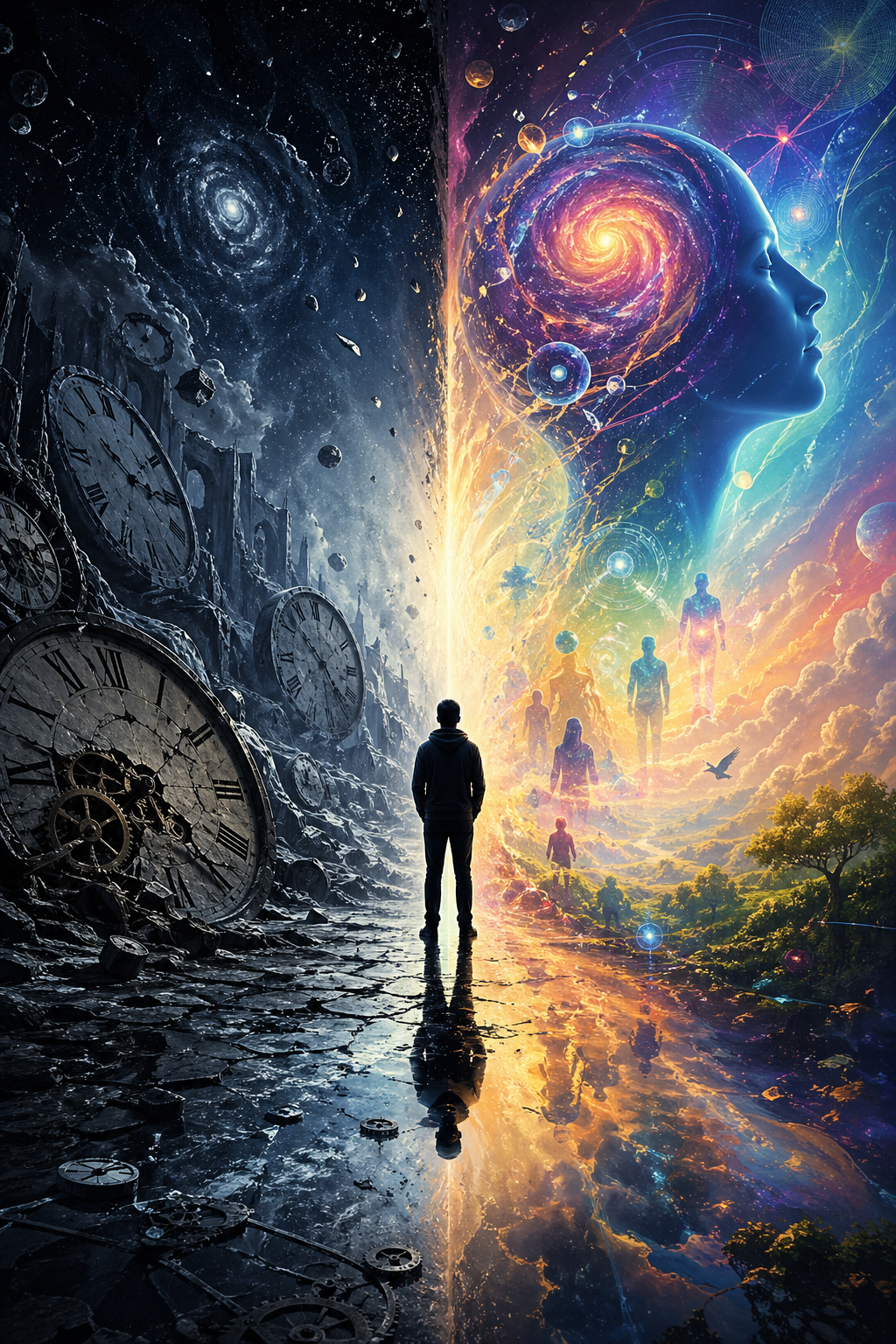
Exploring Whether Time Is a Feature of Reality or a Product of Awareness
Series: Time, Consciousness, and New Science
By JJ Simon — Perspectives with JJ Simon
author of Humans Actuators of Time
Reading Time: approx. 9 minutes
There are certain questions that feel abstract, until they suddenly become personal.
This is one of them.
I remember the moment this question first stopped me completely:
If every conscious being vanished tomorrow… would time continue to exist?

At first, the answer feels obvious.
Of course it would.
Stars would still burn. Galaxies would still drift. Atoms would still vibrate. Physical processes would continue whether anyone observed them or not.
But the deeper we look—through physics, neuroscience, philosophy, and the nature of consciousness itself—the less straightforward (and far more fascinating) the answer becomes.
Because it turns out that whether time exists without observers depends entirely on what we mean by time.
Two Very Different Meanings of Time

One of the greatest sources of confusion in discussions about time is that we often treat it as though it were a single thing.
It is not.
At minimum, time appears to exist in two fundamentally different forms.
Physical time
This refers to the ordering of events in the universe.
It includes:
- motion
- causality
- change
- measurable duration
- the relationships between physical processes
This is the kind of time described by physics and measured by clocks.
Experienced time
This refers to the subjective human experience of temporality.
It includes:
- memory
- anticipation
- the sensation of duration
- the feeling of “now”
- the perception that moments move from past to future
This distinction matters enormously.
Because observers are clearly necessary for experienced time.
Without awareness:
- there is no perception of duration
- no remembered past
- no anticipated future
- no sense of the “present”
- no felt movement of moments
But does the universe require observers for physical time itself to exist?
That is where the question becomes far more profound.
The Classical Assumption: Time Exists Independently

For most of scientific history, the answer seemed obvious.
In classical physics, time was treated as absolute.
Isaac Newton described time as a universal flow that existed independently of observers, objects, or events.
In this framework:
- time progresses uniformly everywhere
- events unfold within it
- observers merely measure it
The universe, in other words, does not need consciousness in order for time to exist.
Time simply is…
and would exist even in an empty universe.
This view aligned naturally with human intuition because measured time appears constant and external in everyday experience.
But modern physics would eventually complicate that certainty.
Einstein and the Collapse of Universal Time

The first major fracture came through Albert Einstein and the development of Theory of Relativity.
Relativity revealed something astonishing:
Time is not universal.
Its rate depends on:
- motion
- gravity
- perspective
Two observers moving differently can measure different durations between the same events.
A clock near a massive gravitational field ticks more slowly than one farther away.
A clock traveling near the speed of light slows relative to one at rest.
These are not illusions.
They are built into the structure of reality itself.
Yet despite this radical shift, relativity still treats time as an objective feature of spacetime.
Even without observers:
- spacetime geometry would still exist
- physical interactions would still occur
- entropy would still evolve
- sequences of events would still unfold
Relativity therefore weakens the idea of universal time—but it does not eliminate physical time altogether.
At least not yet.
Quantum Mechanics Changes the Conversation

The deeper challenge emerges through Quantum Mechanics.
Quantum theory introduced a strange and deeply unsettling possibility:
Observation appears to matter.
In some interpretations of quantum mechanics, systems exist in multiple possible states until interaction or measurement occurs.
This does not necessarily mean consciousness creates reality.
But it does reveal something important:
Information and interaction play central roles in how physical states become definite.
And once information enters the discussion, time becomes far more mysterious.
Because what is time, ultimately, if not the ordering of information about change?
Time as an Emergent Property

Increasingly, some areas of modern theoretical physics suggest that time may not be fundamental at all.
Instead, it may emerge from deeper processes.
Possible candidates include:
- entropy increase
- quantum entanglement
- information exchange
- irreversible interactions
- causal relationships between states
In this view, time is not a universal background flowing independently through reality.
It is something that arises whenever systems record differences between states.
That idea changes the question entirely.
Because if time emerges from relationships and information, then perhaps the universe does not require observers for time to exist—but it does require interactions.
Temporal order may arise whenever reality leaves traces of change within itself.
A star collapsing records information.
A particle interaction records information.
Entropy itself becomes a form of memory embedded within physical systems.
Time, in this sense, may emerge from the universe continually registering change.
Where Observers Become Essential
And yet something crucial still remains missing.
Experience.
A universe without observers may still contain:
- sequence
- causality
- entropy
- physical transformation
But would it contain felt time?
Would there be:
- a present moment?
- anticipation?
- nostalgia?
- urgency?
- waiting?
- the sensation of passing?
Almost certainly not.
Because these belong not to physics alone, but to consciousness.
The arrow of time—the distinction between past and future—becomes psychologically meaningful through memory.
Without systems capable of remembering prior states, there is no subjective continuity.
No story.
No lived movement through moments.
This reveals a subtle but profound distinction:
Physical time may not require observers.
Experienced time almost certainly does.
Imagining a Universe Without Awareness

Imagine a universe containing matter, energy, gravity, and physical law—but no conscious beings whatsoever.
Galaxies would still rotate.
Stars would still ignite and collapse.
Quantum fields would still fluctuate.
Entropy would still increase.
The universe would continue changing.
But there would be no awareness of change.
No perception of duration.
No “before” or “after” as experience.
No present moment being inhabited by anything.
Time, in that universe, would exist only as structure.
Not as lived reality.
This may be one of the most important distinctions modern science and philosophy can offer:
The universe may contain temporal order independently.
But awareness transforms temporal order into meaningful time.
The Radical Possibility of a Timeless Foundation

Some approaches to quantum gravity push this even further.
At the deepest level of reality, time itself may disappear entirely.
Certain theoretical models suggest the universe may be fundamentally timeless, with time emerging only at larger scales through relationships between interacting systems.
If true, this creates a remarkable possibility:
The flow of time may not exist fundamentally at all.
Instead, what we experience as time could emerge from:
- information processing
- memory formation
- causal structure
- conscious continuity
This does not mean observers create the universe.
But it may mean observers participate in creating the experience of temporal reality.
And that distinction matters deeply.
Humans as Actuators of Time

This perspective connects directly to one of the central ideas explored in Humans Actuators of Time.
Human beings do not create physical processes.
But we transform physical change into lived meaning.
We:
- remember
- anticipate
- interpret
- sequence
- narrate
- assign significance
Through these processes, raw change becomes experienced time.
Without memory, continuity collapses.
Without anticipation, the future disappears psychologically.
Without awareness, there may still be events—but no experience of temporality itself.
This places human consciousness in a far more active role than we often assume.
We are not merely watching time pass.
We are participating in how time becomes meaningful.
The Deeper Implication

The question is no longer simply:
Does time exist without observers?
It becomes:
What kind of time are we talking about?
Physics strongly suggests that change, causality, and temporal structure can exist independently of human awareness.
But the world of experienced time—the flowing reality we actually live within—appears inseparable from consciousness.
This realization changes something fundamental.
It means that the universe may provide sequence…
…but observers provide experience.
Reality may provide change…
…but awareness transforms change into memory, continuity, and meaning.
And in the meeting between change and awareness, time as we know it comes fully alive.

From the Publisher
There is a subtle shift that happens when questions about time become questions about observation.
The discussion stops being merely scientific.
It becomes existential.
Because once we begin separating physical sequence from lived temporality, we are forced to confront something deeper:
Human experience is not passively occurring inside reality.
It is participating in how reality is organized, interpreted, and felt.
This is what makes JJ Simon’s work increasingly compelling within the broader conversation surrounding consciousness, perception, and time.
He does not argue that human beings magically create the universe.
He argues something both more grounded and more profound:
That awareness may play a central role in transforming raw existence into meaningful experience.
And once that possibility is taken seriously, ordinary assumptions begin to shift.
The present moment feels different.
Memory feels different.
Even the simple act of noticing time passing begins to carry new weight.
Because perhaps the deepest mystery is not whether time exists independently of us—
…but how much of the reality we experience depends on the presence of awareness itself.
Leave a Reply