
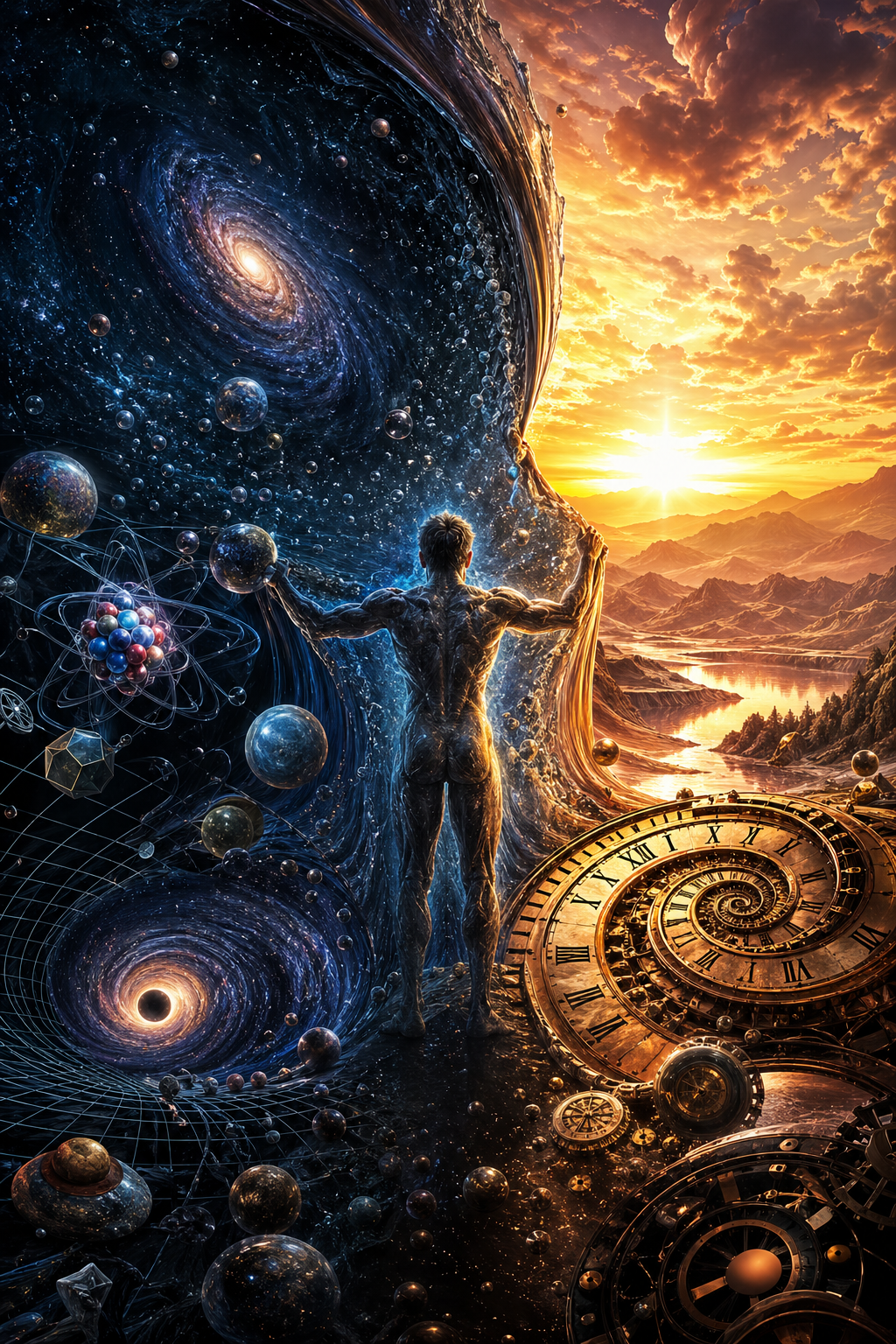
Why Modern Physics Says the Question May Not Even Make Sense
Series: Time, Consciousness, and New Science
By JJ Simon — Perspectives with JJ Simon
author of Humans Actuators of Time
Reading Time: approx. 10 minutes
There are questions that feel impossible to ignore.
Questions so deeply rooted in human intuition that the mind keeps returning to them, even when no fully satisfying answer seems possible.
This is one of them:
What existed before time began?

At first, the question feels perfectly reasonable.
Everything we know unfolds within sequence.
Every event appears connected to another event before it.
Every cause seems to require a prior cause.
So when we hear that the universe had a beginning, the instinctive response is immediate:
What came before it?
Yet modern physics reveals something profoundly unsettling.
The question itself may contain a hidden contradiction.
Because if time truly has an origin, then the concept of “before” may not apply at all.
The Assumption Hidden Inside the Question

The question assumes something so familiar that we rarely notice it.
It assumes time behaves like an endless line stretching backward and forward forever.
From everyday experience, this seems obvious.
We move from:
- yesterday to today
- morning to evening
- birth to death
Everything appears embedded within sequence.
But modern physics suggests that time may not be an eternal backdrop through which reality moves.
Instead, time itself may be part of reality’s structure—something that emerged along with the universe rather than existing before it.
And if that is true, then asking what existed before time may be like asking:
What lies north of the North Pole?
The question sounds meaningful at first.
But north only exists within Earth’s geography.
Beyond the pole, the concept itself stops functioning.
Likewise, “before” only has meaning inside time.
If time has a boundary or point of emergence, then there may be no earlier moment (no “before”) in which anything could occur.
The Big Bang Was Not an Explosion Inside Time

One of the most common misunderstandings about cosmology is imagining the Big Bang as an explosion occurring within preexisting space and time.
Modern physics suggests something far stranger.
According to Albert Einstein and the Theory of Relativity, space and time are woven together into a single structure known as spacetime.
The Big Bang was not an event that happened inside spacetime.
It was the emergence of spacetime itself.
This means both space and time began together.
That distinction can be difficult for the human mind to intuitively grasp because our thinking is built around sequence and causality.
We instinctively imagine every beginning requiring something prior to it.
Instead, time itself came into existence as part of the universe’s formation.
This represents one of the most profound shifts in scientific understanding.
The universe did not begin in time.
Time began with the universe.
When Physics Reaches the Edge of Time

As we trace the universe backward toward its earliest state, our current physical theories begin to fail.
The closer we approach the origin of spacetime:
- densities become extreme
- temperatures become immense
- gravity behaves quantum mechanically
- existing equations break down
This is where physics reaches one of its deepest frontiers.
We do not yet possess a complete theory unifying:
- quantum mechanics
- gravity
- spacetime emergence
And because of this, the true nature of the universe’s origin remains unknown.
But importantly, modern cosmology does not suggest a simple empty void “existing before” creation.
Instead, many models imply that the ordinary structure of time itself dissolves near the beginning.
Not merely hidden.
Absent.
The No-Boundary Proposal

One of the most fascinating attempts to describe this comes from the Hartle–Hawking state, sometimes called the no-boundary proposal.
In this model, time near the universe’s origin behaves differently from the time we experience now.
Rather than existing as a sharp starting point, the early universe may resemble a smooth geometric structure in which time does not abruptly start at a single instant but gradually emerges from a timeless state.
A common analogy is the surface of Earth.
Earth has a northernmost point: the North Pole.
But there is no location north of the North Pole because the concept itself ceases to apply.
You cannot go beyond the pole because there is no “outside” of the surface.
Similarly, the universe may possess an earliest boundary to time without requiring something temporally prior to it.
This idea is not merely philosophical.
It emerges directly from attempts to mathematically describe the universe at its earliest stages.
And it suggests something extraordinary:
Reality may not originate from a moment within time.
Time itself may originate from a deeper timeless condition.
Time May Be Emergent

Increasingly, many physicists suspect that time is not fundamental at all.
Instead, it may emerge from deeper relationships within reality.
Possible candidates include:
- quantum entanglement
- information exchange
- thermodynamic processes
- causal structure
- entropy increase
In such models, what existed before time would not be a temporal state.
It might instead be a timeless structure, a network of relationships without sequence, or a purely informational reality.
In this view, time behaves less like a universal river and more like a large-scale effect emerging from interactions between systems.
Much like temperature emerges from molecular motion, time itself may emerge from informational and relational dynamics.
If so, then asking what existed before time may be asking the wrong kind of question entirely.
Because reality at its deepest level may not operate through sequence at all.
Something could exist without existing within time.
That possibility fundamentally alters how we imagine existence itself.
Ancient Philosophy and Modern Physics Begin to Converge

Long before modern cosmology, many philosophical and contemplative traditions proposed that ultimate reality was timeless.
Across cultures and eras, thinkers repeatedly arrived at a similar intuition:
The deepest foundation of existence may lie beyond past, present, and future.
It is a state beyond change and sequence.
Time, in this perspective, belongs to the manifested universe—not to the ultimate ground from which the universe emerges.
What is striking is that some modern physical theories now point toward surprisingly compatible possibilities.
Not because physics became mystical.
But because pushing scientific inquiry toward the origin of spacetime forces us into domains where ordinary intuitions about sequence and causality begin to fail.
And when that happens, timelessness becomes scientifically conceivable in ways earlier generations could scarcely imagine.
What Science Can Honestly Say
There is enormous value in intellectual humility here.
Despite astonishing advances in cosmology, several realities remain clear.
We do not currently know:
- what ultimately caused the universe
- whether time truly had an absolute beginning
- what underlies spacetime itself
- whether deeper timeless structures exist
We cannot directly observe anything “before” the Planck epoch (earliest definable moment).
Our equations remain incomplete.
And many competing models still exist.
What science can say with confidence is this:
Time is far stranger than human intuition once assumed.
It is:
- relative
- connected to change
- linked to entropy
- inseparable from spacetime
- possibly emergent rather than fundamental
And because of this, the idea of “before time” may not function in the ordinary sense at all.
A Simple Analogy for Understanding the Problem

One helpful way to imagine this is through the structure of a story.
Inside a novel, events unfold sequentially.
Chapter two follows chapter one.
Characters remember previous events and anticipate future ones.
Time exists internally within the narrative.
But asking:
What happened before chapter one?
may misunderstand how the story itself functions.
The timeline begins with the story itself.
Likewise, the universe may define its own temporal structure internally rather than existing inside some larger cosmic clock.
And if that is true, reality may not sit within time.
Time may instead be one of reality’s emergent properties.
Humans as Actuators of Time

This possibility connects deeply to the ideas explored throughout Humans Actuators of Time.
If time emerges from relationships, change, and informational structure, then conscious beings occupy a remarkable position within reality.
Humans do not create the universe.
And they do not generate physical laws.
But through:
- memory
- perception
- anticipation
- narrative
- meaning-making
they transform raw change into lived temporality.
A universe of events becomes:
- history
- continuity
- identity
- experience
In this sense, human awareness does not merely exist inside time.
It participates in organizing temporal reality as it is consciously lived.
And perhaps that is one reason questions about time feel so deeply personal.
Because to question time is, in many ways, to question the structure of experience itself.
The Deepest Mystery

The deeper science investigates reality, the stranger the universe becomes.
Time may not be the permanent stage upon which existence unfolds.
It may instead be something reality continuously generates.
And if that is true, then the universe may emerge not from empty space and flowing time…
…but from something far more difficult to imagine:
A timeless foundation beyond sequence altogether.
This possibility does not eliminate mystery.
It expands it.
Because once time itself becomes uncertain, even our most basic assumptions about beginnings, causality, and existence begin to shift.
And perhaps that is the most profound realization of all:
The universe may not exist within time.
Time may be one of the ways the universe expresses itself.

From the Publisher
There is something uniquely powerful about questions that push human thought to its conceptual limits.
“What existed before time?” is one of those questions.
Not because it offers easy answers—but because it reveals where ordinary intuition begins to fail.
This is part of what makes JJ Simon’s work increasingly compelling within the broader exploration of time, consciousness, and reality.
He approaches these subjects not through sensationalism or certainty, but through disciplined curiosity.
And that distinction matters.
Because the deeper modern science investigates reality, the more it encounters boundaries where:
- language weakens
- intuition collapses
- sequence becomes uncertain
- even time itself loses its familiar meaning
Yet rather than reducing wonder, this expands it.
The possibility that time emerged from a deeper timeless foundation reshapes how we think about:
- existence
- awareness
- causality
- beginnings
- and the role conscious beings play in interpreting reality
Perhaps the greatest insight is not that science has solved the mystery of time.
It is that the mystery has become far deeper, stranger, and larger than we once imagined.
Leave a Reply