
Physics, Experience, and Human Agency
Series: Time, Consciousness, and New Science
By JJ Simon — Perspectives with JJ Simon
author of Humans Actuators of Time
Reading Time: approx. 9 minutes
Six weeks ago, we asked a question that unsettled one of humanity’s deepest assumptions:
Does time actually exist?
Then we pushed further:
Could time exist without observers?
And finally, we arrived at perhaps the most disorienting possibility of all:
What if time itself emerged from something beyond time?
Those questions led us to the edge of cosmology, where spacetime, quantum theory, and the origin of the universe begin to blur into mystery.
But now the inquiry turns inward.
Because even if time emerges from deeper structures within reality, another question remains:
What role do observers play in making time meaningful?

At first, the answer seems obvious.
Observers measure time.
They experience it.
They keep track of it.
Yet a growing body of thought across physics, information theory, neuroscience, and philosophy suggests something far more provocative.
What if observers do more than merely observe time?
What if the distinction between “before” and “after” only becomes meaningful when change is registered, remembered, and compared?
What if time, as we understand it, emerges not simply from the universe—but from the relationship between the universe and systems capable of noticing change?
The implications reach far beyond physics.
They reach into identity, agency, consciousness, and what it means to be human.
The Shift Away from Absolute Time

For centuries, time was treated as a universal backdrop.
In Isaac Newton’s framework, time flowed uniformly everywhere.
Whether anyone observed it or not, time continued forward at the same steady rate.
Reality unfolded against an invisible cosmic clock.
This view felt natural because it aligned with everyday experience.
Yesterday becomes today.
Today becomes tomorrow.
The sequence appears universal and self-evident.
Then Einstein changed everything.
Relativity revealed that time is not absolute.
The passage of time depends on motion, gravity, and perspective.
Two observers moving differently can measure different durations between the same events.
Time became relational rather than universal.
And once that door opened, a deeper question emerged.
If time depends on relationships, how deep does that dependence go?
The Observer Problem

Modern physics contains an unusual tension.
Many of our most successful equations describe systems mathematically.
Yet the act of observation often occupies a strangely important role.
In quantum mechanics especially, measurement appears inseparable from what can be meaningfully said about reality.
Physicists disagree about exactly how observation should be interpreted.
But one theme repeatedly appears:
Information matters.
Registration matters.
Interaction matters.
A state that leaves no trace is difficult to distinguish from a state that never occurred at all.
This has led some researchers to explore an intriguing possibility.
Perhaps temporal order itself depends upon the existence of systems capable of recording differences.
Not necessarily human minds.
Not necessarily consciousness.
But systems that can register change.
Because without registered differences, what exactly distinguishes one moment from another?
Time Requires Difference

Imagine a universe frozen in perfect uniformity.
Nothing changes.
Nothing moves.
Nothing interacts.
Nothing records anything.
Could time meaningfully pass in such a universe?
The question reveals something important.
When we speak about time, we are almost always speaking about change.
A clock advances because physical states change.
A planet orbits because positions change.
A memory exists because information changes and persists.
Without change, the concept of duration becomes difficult to define.
Without distinguishable states, sequence becomes impossible to identify.
This is why many modern approaches increasingly link time to relationships rather than to an independent cosmic flow.
Time may not be a thing moving through reality.
Time may be the structure that emerges when differences become observable.
Information as the Foundation of Time

One reason this perspective has gained attention is the growing importance of information in modern physics.
Increasingly, fundamental theories focus not only on matter and energy but also on how information is stored, transferred, and preserved.
Physical systems leave records.
Interactions generate correlations.
States become distinguishable because traces remain.
From this viewpoint, time may be less about motion through a dimension and more about the persistence of informational differences.
Where records accumulate, temporal order emerges.
Where information can be compared, duration becomes meaningful.
Where traces persist, history becomes possible.
This does not mean observers create the universe.
Nor does it mean that galaxies vanish when nobody looks at them.
Rather, it suggests that the meaningful organization of events into past, present, and future depends upon systems capable of registering and preserving differences.
Time emerges where information sticks.
Observers Beyond Humans

At this point, it is important to avoid a common misunderstanding.
When physicists discuss observers, they are not always referring to conscious human beings.
An observer can be any system capable of interacting with another system and preserving information about that interaction.
A measuring device can function as an observer.
A detector can function as an observer.
Even physical systems that record state changes may act as observer-like structures.
The universe does not require humans to exist.
Stars formed long before minds evolved.
Galaxies collided long before anyone could witness them.
But the question is not whether reality exists without humans.
The question is whether temporal order becomes meaningful only when changes can be registered.
This distinction is subtle but crucial.
Reality may exist independently.
Meaningful time may require relationship.
Where Human Consciousness Becomes Unique

This is where the discussion moves beyond physics and into lived experience.
Human beings are extraordinary temporal processors.
We do not simply record information.
We weave it into continuity.
We transform isolated events into stories.
We connect memory to anticipation.
We build identity across years and decades.
Every moment of conscious experience depends on comparing what was, what is, and what might be.
The brain constantly integrates:
- memory
- perception
- prediction
- attention
From these processes emerges the feeling of temporal flow.
The sensation that life is moving forward.
The awareness of becoming.
Physics may explain changing states.
But consciousness transforms those states into experience.
And that transformation is where time becomes personal.
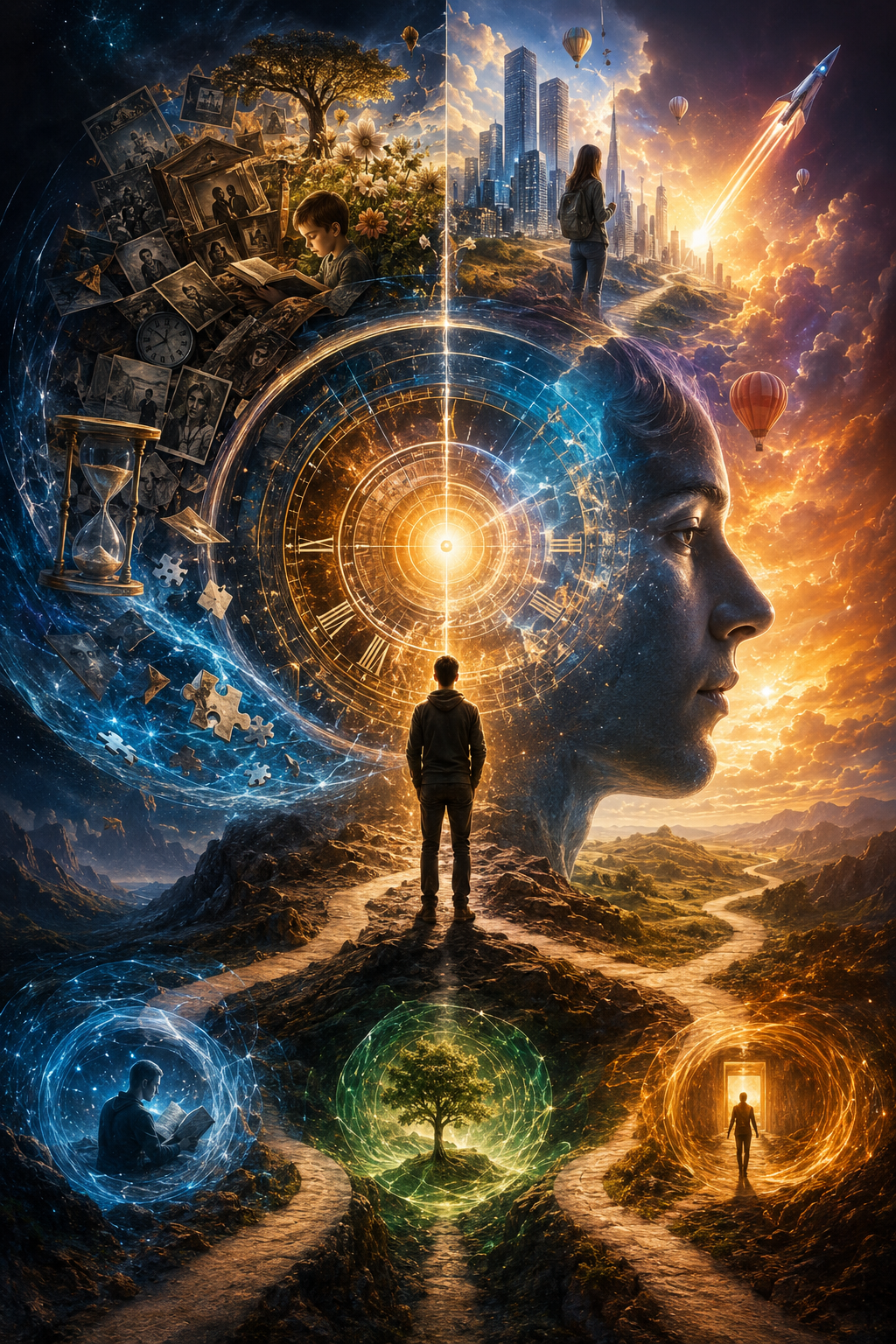
Humans as Actuators of Time

This perspective sits at the heart of Humans Actuators of Time.
Human beings do not create physical law.
They do not generate spacetime.
They do not cause the universe to exist.
But they do participate in constructing temporal reality as it is lived.
Through memory, we create continuity.
Through attention, we create significance.
Through anticipation, we create possibility.
Through choice, we transform potential futures into actual histories.
This is not a passive process.
Every decision reorganizes what comes next.
Every act of remembrance reshapes the past as it is understood.
Every moment of focus determines what becomes meaningful.
In this sense, human beings do not merely travel through time.
They actively participate in its organization.
The universe provides change.
Consciousness provides interpretation.
Together they create the reality we experience as time.
Agency in a Relational Universe

If time is relational rather than absolute, agency takes on new significance.
The future is no longer simply a destination toward which we are carried.
It becomes a field of possibility continually shaped through participation.
What we notice influences what matters.
What we remember influences who we become.
What we choose influences what history ultimately contains.
This does not grant unlimited control.
Physical reality still imposes constraints.
But it does place responsibility back into human hands.
Time is not merely something happening to us.
It is something we continuously help structure through awareness and action.
That realization transforms time from a background condition into an active relationship.
The Deeper Insight
Perhaps the most important lesson is not that observers create reality.
It is that reality becomes meaningful through relationship.
A universe without observers may still contain change.
It may still contain stars, gravity, energy, and physical processes.
But time as lived experience requires something more.
It requires registration.
Comparison.
Memory.
Interpretation.
The deeper science investigates time, the more difficult it becomes to separate the universe from the systems that make sense of it.
Perhaps time is neither entirely objective nor entirely subjective.
Perhaps it emerges in the meeting point between change and awareness.
Between event and memory.
Between possibility and choice.
And perhaps that is why questions about time inevitably become questions about ourselves.
Because time does not merely pass.
It appears—where something remembers, compares, and chooses.

From the Publisher
One of the most interesting developments in modern discussions about time is the gradual shift away from viewing human beings as passive spectators of reality.
For centuries, science excelled by removing the observer from the equation.
That approach produced extraordinary discoveries.
But as inquiry pushes deeper into questions of information, measurement, consciousness, and temporal experience, the observer keeps reappearing.
Not as the center of the universe.
But as an essential part of understanding how reality becomes meaningful.
This is one of the defining themes running through JJ Simon’s work.
The goal is not to claim that consciousness magically creates the cosmos.
The goal is to explore how awareness participates in organizing experience within a universe that may be far more relational than previously imagined.
If the last few Time, Consciousness, and New Science series blogs by JJ Simon challenged our assumptions about time itself, this next phase begins asking a different question:
What role do we play in the reality we experience?
That question sits at the intersection of physics, philosophy, cognition, and lived experience.
And the deeper we investigate it, the more difficult it becomes to separate understanding time from understanding ourselves.
Leave a Reply