
Why Human Experience of Time Is Not Fixed
Series: Time, Consciousness, and New Science
By JJ Simon — Perspectives with JJ Simon
author of Humans Actuators of Time
Reading Time: approx. 8 minutes
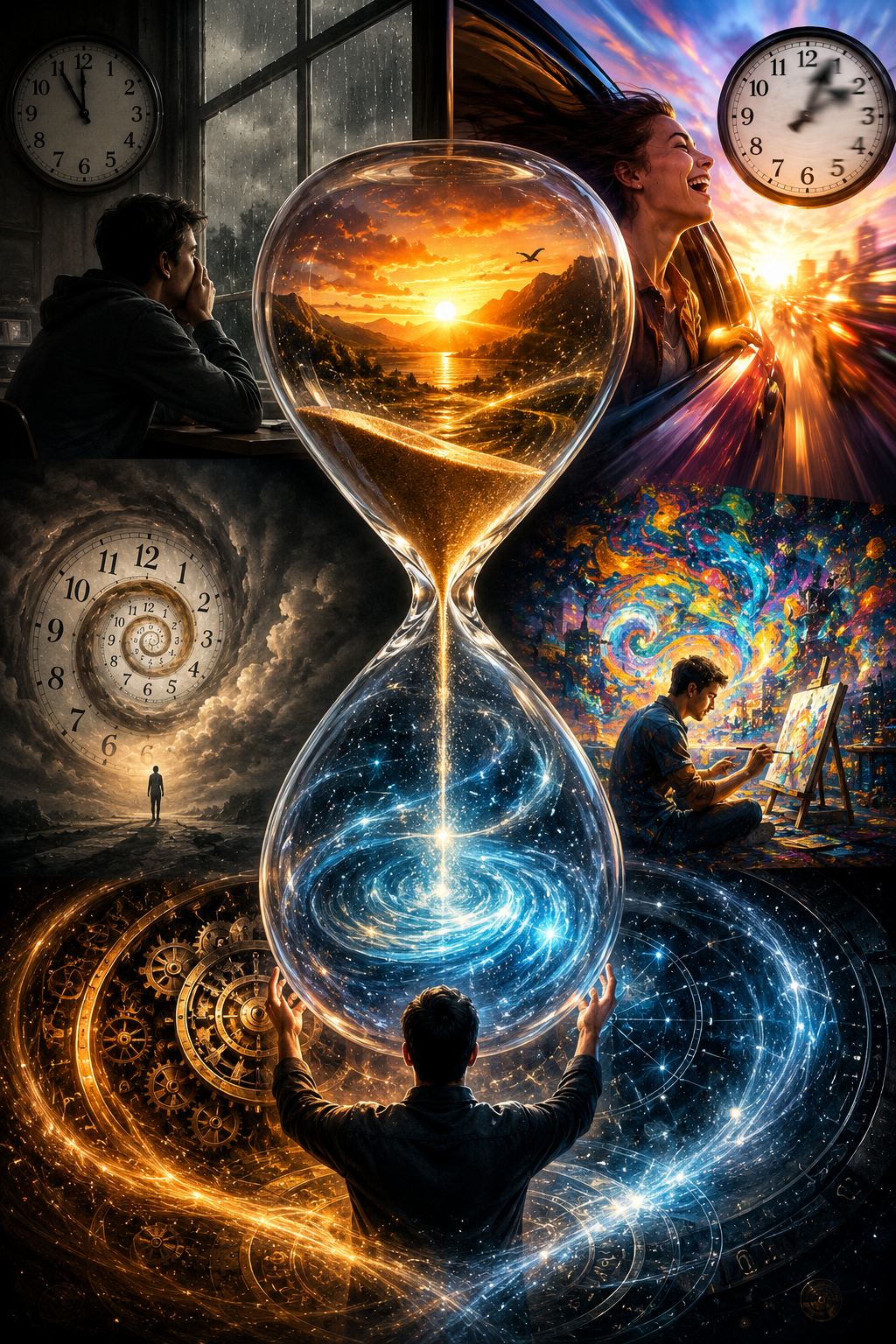
One of the strangest things about time is that we all experience it differently.
Five minutes in a waiting room can feel endless.
Five minutes with someone you love can disappear almost instantly.
A difficult year may feel unbearably long while it is unfolding, yet seem surprisingly brief when remembered years later.
The clock remains unchanged.
The experience does not.
Most of us spend our lives assuming time is a fixed quantity moving steadily forward. We organize our days by schedules, calendars, deadlines, and clocks. We measure our lives in hours, weeks, years, and decades.
Yet beneath this seemingly stable structure lies a remarkable reality.
The time we live is not experienced as a fixed quantity at all.
It stretches.
It compresses.
It accelerates.
It slows.
It changes shape depending on where attention rests, what emotions arise, what memories are formed, and how meaning is constructed.
In other words, time is far more fluid than it first appears.
And understanding that fluidity may reveal something profound about consciousness itself.
The Difference Between Clock Time and Lived Time
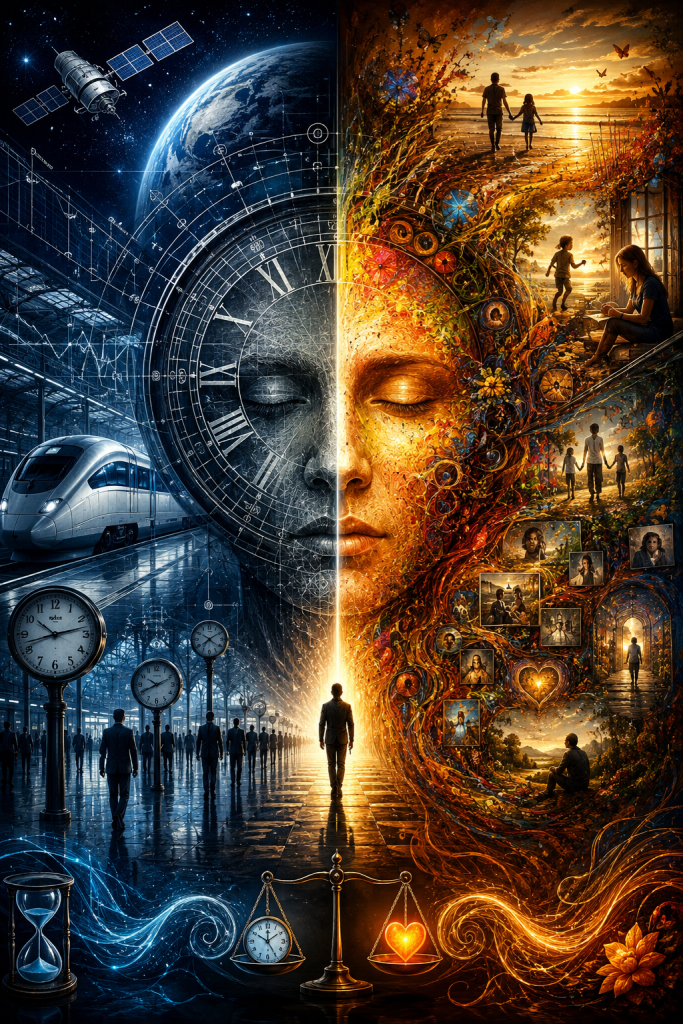
Modern society runs on clock time.
Trains depart according to schedules.
Computers synchronize across continents.
Satellites depend upon precise measurements of duration.
In these contexts, sixty seconds remain sixty seconds.
Objective time is extraordinarily useful.
But human experience operates according to a different logic.
Psychologists have long recognized that subjective time behaves very differently from measured time.
The same interval can feel dramatically different depending on circumstance.
An hour spent waiting for important news may feel longer than an entire afternoon spent absorbed in meaningful work.
A child experiences summer vacations as seemingly endless.
Adults often wonder where entire years have gone.
The clock records duration.
The mind experiences it.
And those are not always the same thing.
This distinction becomes increasingly important as we deepen our understanding of time itself.
Earlier in this series, we explored the possibility that time may not be a simple universal flow. We examined whether observers contribute to temporal reality and whether time itself may emerge from deeper structures.
Now we arrive at a more personal question:
If observers matter, how does observation shape the experience of time?
Why Time Feels Elastic
Research in psychology and neuroscience consistently demonstrates that time perception changes according to cognitive and emotional conditions.
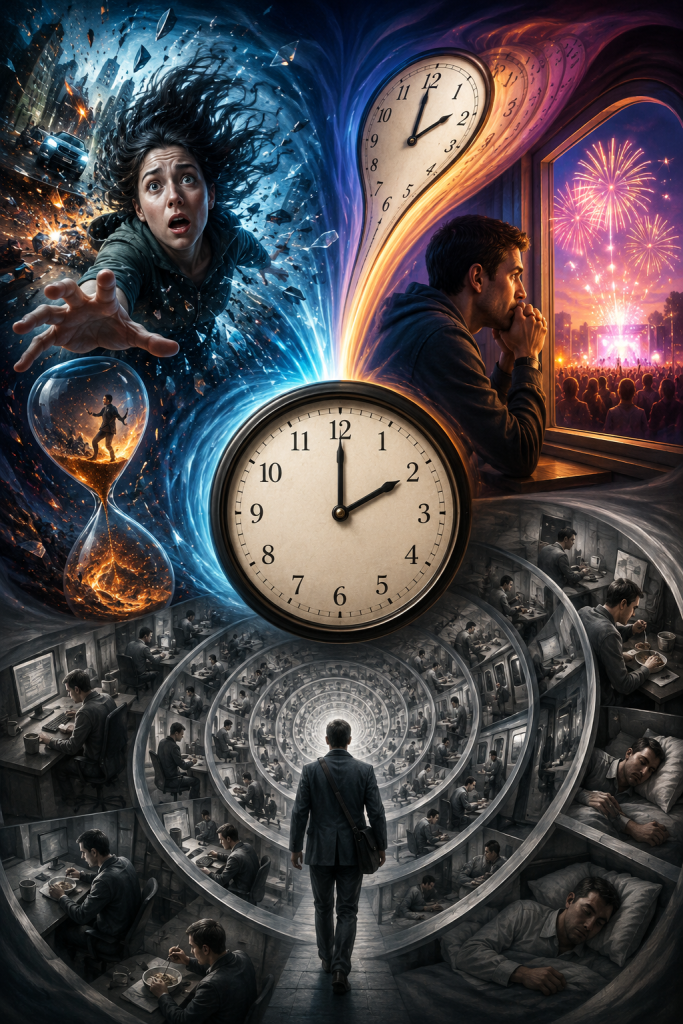
Emotional intensity often expands time.
Moments of danger, surprise, or uncertainty frequently feel longer than they objectively are. Many people report that accidents or emergencies seem to unfold in slow motion.
The clock has not slowed.
Attention has intensified.
The brain processes information more densely, creating the impression of expanded duration.
Anticipation produces a similar effect.
Waiting often feels longer than experiencing.
A child waiting for a birthday.
A student waiting for exam results.
A traveler waiting for a long-anticipated journey.
Expectation stretches subjective time.
By contrast, highly engaging activities often compress it.
Hours disappear while reading a fascinating book, creating art, solving a problem, or sharing meaningful conversation.
When attention becomes fully absorbed, time often seems to vanish.
These experiences reveal something important.
The passage of time is not experienced directly.
It is mediated through awareness.
Memory and the Architecture of Duration
Memory plays an equally important role.
Many people have noticed a curious phenomenon.
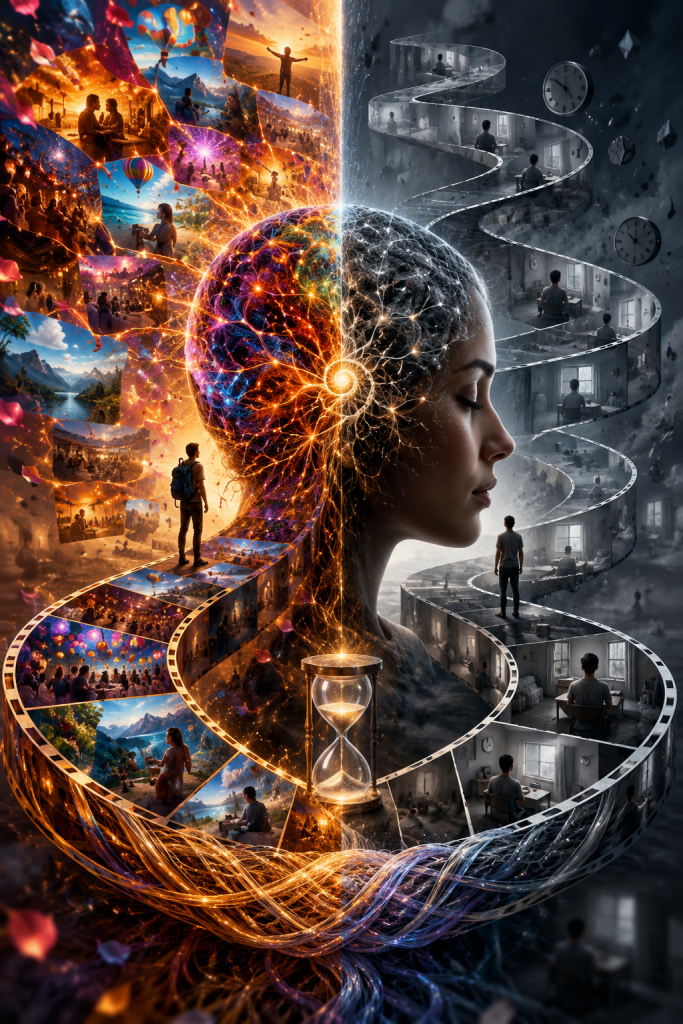
Novel experiences seem long in retrospect.
Routine periods seem short.
A week spent exploring a new city often feels expansive when remembered.
A week of repetitive routines may feel compressed and indistinguishable from countless others.
This occurs because memory does not store time itself.
It stores informational richness.
Novel experiences create numerous memory markers.
Repetition creates fewer.
When we look backward, we reconstruct duration using those markers.
More markers create the impression of greater temporal depth.
Fewer markers create compression.
The result is fascinating.
A year filled with growth, learning, and new experiences often feels longer in hindsight than a year dominated by repetition.
The clock measured both equally.
Memory did not.
This suggests that time is not merely counted.
It is woven from experience.
Attention Creates Temporal Texture
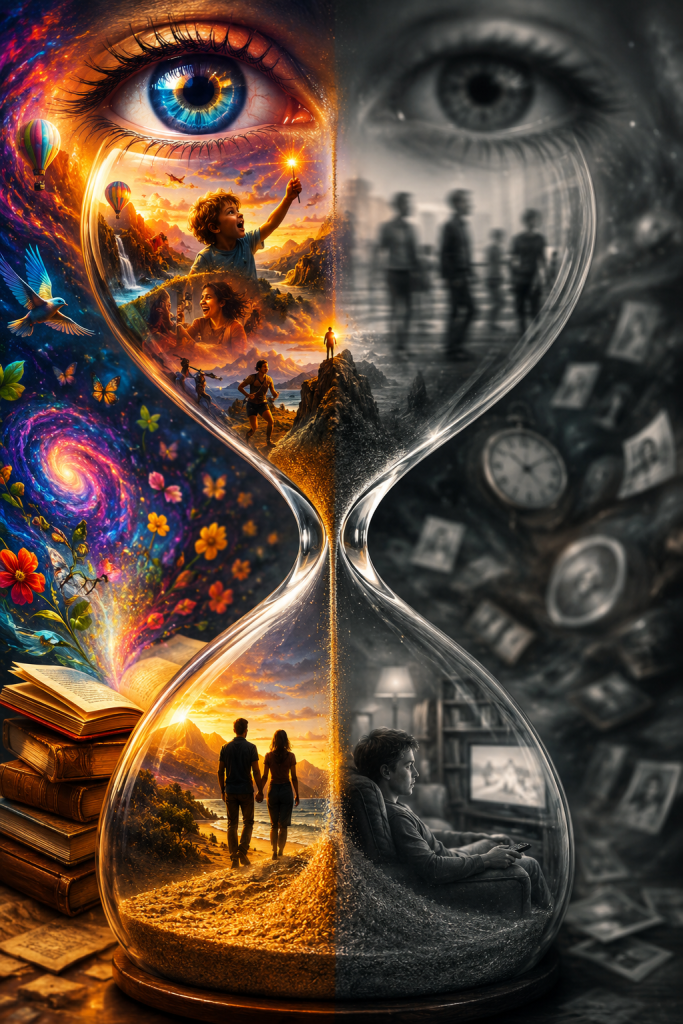
If memory shapes the past, attention shapes the present.
Attention determines what enters awareness.
It influences what becomes meaningful.
It affects what will later become memory.
Moments receiving intense attention often feel substantial and vivid.
Moments receiving little attention often seem to disappear almost immediately.
In this sense, attention functions like a spotlight.
Where it shines, experience becomes denser.
Where it wanders, time becomes thinner.
This observation carries significant implications.
The quality of our experience may depend less on how much time we possess and more on how deeply we inhabit it.
Two people may live through identical hours.
One remembers them vividly.
The other barely notices them.
The difference is not time itself.
It is awareness.
Narrative and the Construction of Self
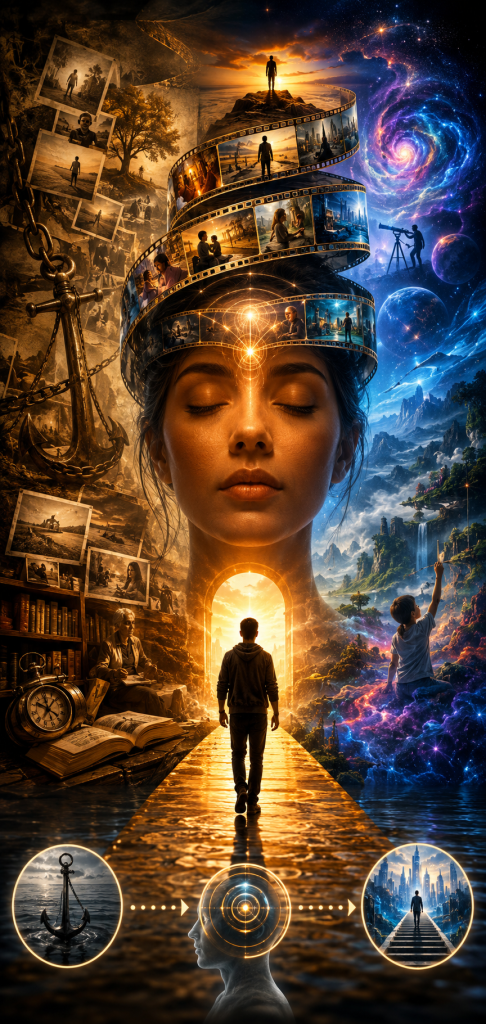
Human beings possess another extraordinary ability.
We transform experiences into stories.
We do not simply remember events.
We organize them.
We connect them.
We interpret them.
We create continuity between past, present, and future.
This narrative process is fundamental to identity.
Without it, the self becomes fragmented.
Memory anchors the past.
Attention situates the present.
Imagination projects possible futures.
Narrative links them together.
The result is the experience of being a continuous person moving through time.
Yet that continuity is not simply discovered.
It is actively constructed.
We are constantly editing, revising, and reinterpreting our personal histories.
The stories we tell ourselves shape how we experience time.
And the stories we tell ourselves about the future shape the choices we make in the present.
The Observer’s Role in Temporal Reality
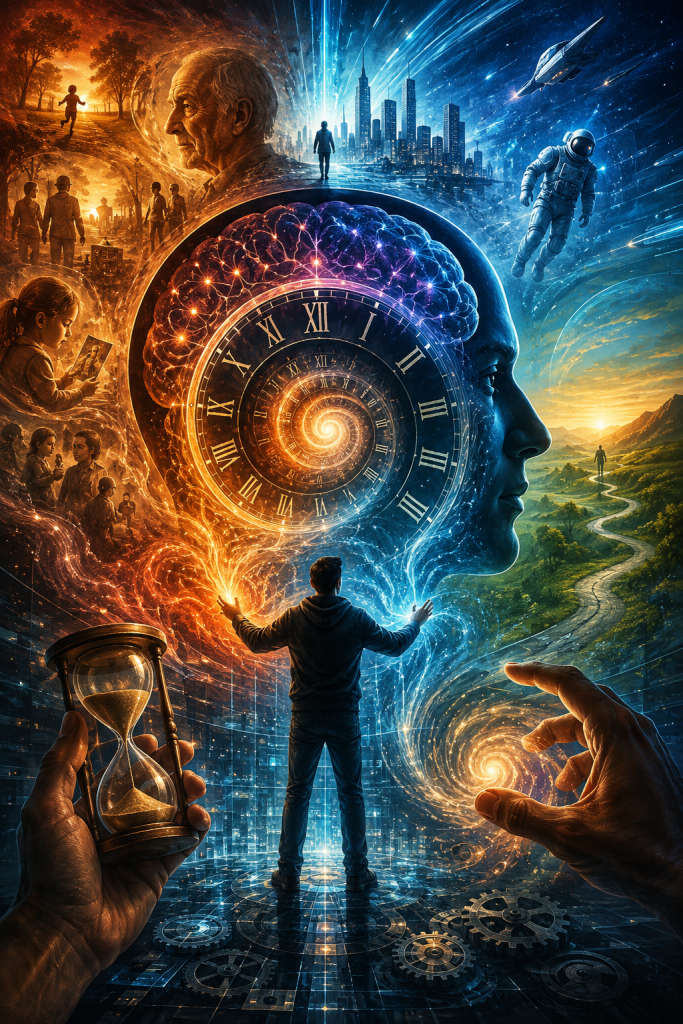
The previous essay explored a provocative possibility:
What if time becomes meaningful through observation?
The fluidity of time offers powerful support for that idea.
If human experience of duration changes according to attention, memory, and interpretation, then observers are doing far more than measuring time.
They are helping organize it.
Not physical time.
Not spacetime itself.
But lived time.
The time of meaning.
The time of identity.
The time of experience.
This distinction matters.
Clocks provide intervals.
Observers provide significance.
Physics can describe duration.
Consciousness transforms duration into life.
Humans as Actuators of Time
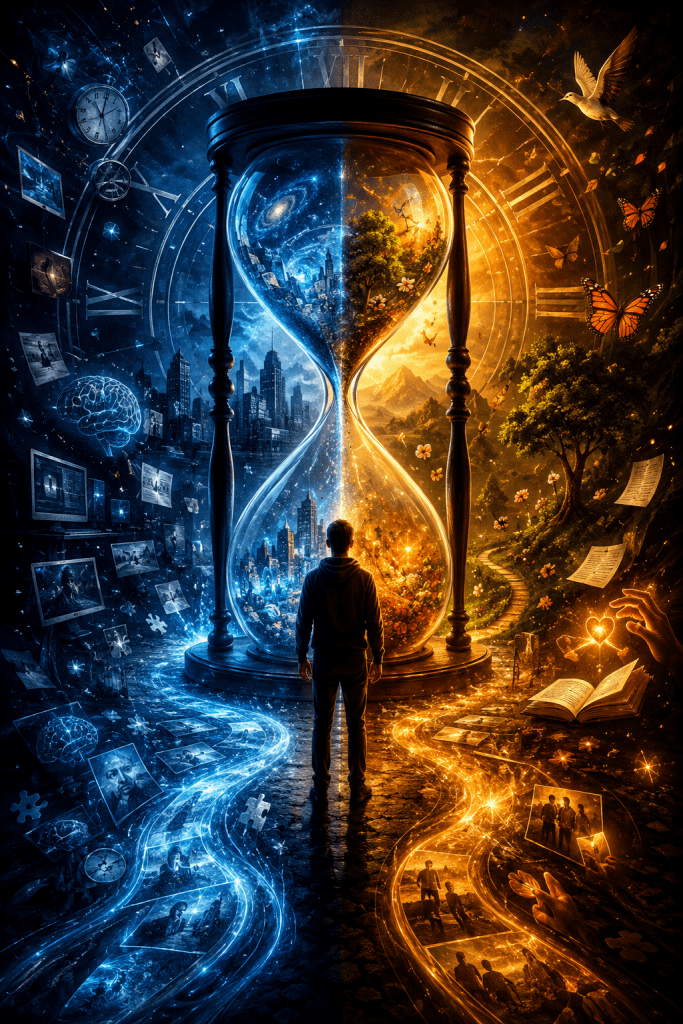
This insight sits at the heart of Humans Actuators of Time.
Human beings are not passive passengers carried along by a temporal current.
They participate in shaping temporal experience through:
- attention
- memory
- interpretation
- imagination
- choice
What we attend to expands.
What we remember deepens.
What we repeatedly think about gains psychological weight.
What we choose influences the futures that become available.
In this sense, time is not merely something that happens to us.
It is also something we help organize.
Not because we control physical reality.
But because we participate in constructing the reality we consciously experience.
A Different Relationship with Time
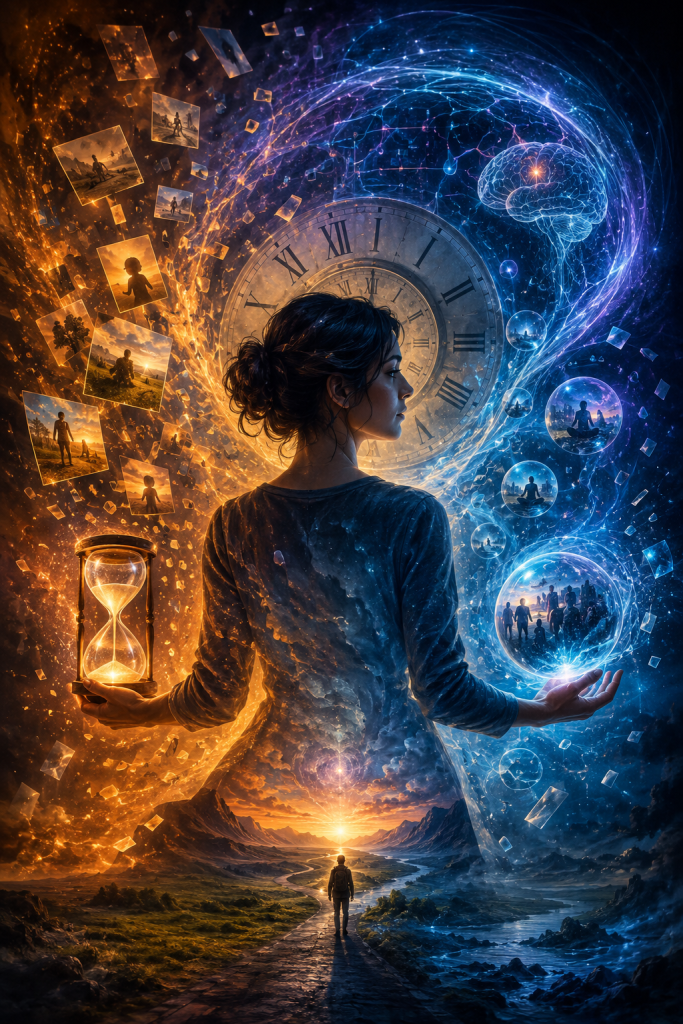
Recognizing time’s fluidity changes how we think about life itself.
Many people spend years wishing for more time.
Yet often the deeper question is not how much time we have.
It is how fully we inhabit it.
A meaningful hour can feel richer than an empty day.
A transformative conversation can outweigh months of routine.
A single insight can reshape years of experience.
The texture of time matters as much as its quantity.
Perhaps even more.
When viewed this way, the question is no longer simply:
How much time do I have?
It becomes:
What kind of time am I creating?
The Deeper Insight
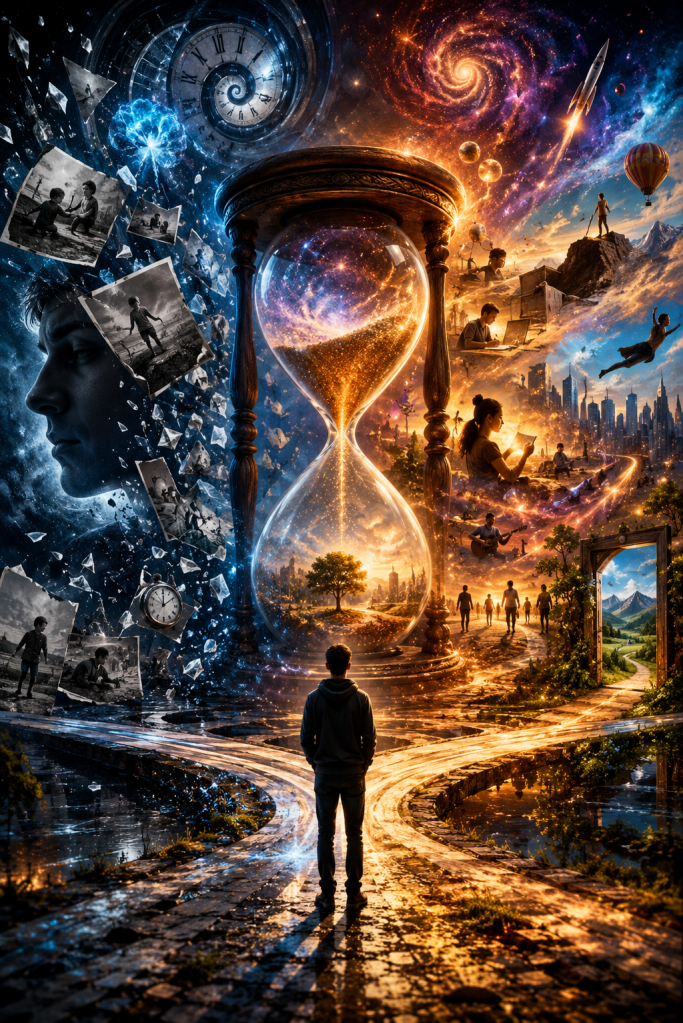
The deeper science investigates time, the less fixed it appears.
Physics reveals that time is relative.
Psychology reveals that time is elastic.
Memory reveals that time is reconstructed.
Consciousness reveals that time is experienced.
Together these perspectives point toward a remarkable conclusion.
The time measured by clocks and the time lived by human beings are not identical phenomena.
One provides structure.
The other provides meaning.
And where structure meets meaning, human life unfolds.
Perhaps that is why time feels so mysterious.
Because time is not only something we measure.
It is something we continually create through awareness.
From the Publisher
One of the most fascinating developments in modern discussions of time is the growing recognition that lived experience cannot be reduced to clocks alone.
Science can measure duration with extraordinary precision.
But meaning, memory, anticipation, and identity emerge through consciousness.
This is where JJ Simon’s work continues to offer a distinctive perspective.
Rather than treating time as merely a physical phenomenon or merely a psychological illusion, he explores the meeting point between the two.
The result is a deeper question:
If human beings help shape the texture of time through attention, memory, and interpretation, what responsibility do we carry for the lives we experience?
Perhaps the most important insight is not that time is fluid.
It is that our relationship with time is fluid.
And once that becomes visible, every moment begins to look a little different.

Leave a comment