
And Why Humans Matter in Time
Series: Time, Consciousness, and New Science
By JJ Simon — Perspectives with JJ Simon
author of Humans Actuators of Time
Reading Time: approx. 10 minutes
There are moments in science when reality reveals itself to be stranger than imagination.
One of those moments occurs when astronomers observe a distant stellar explosion and discover that the universe delivers the same event more than once.
At first, that sounds impossible.
An explosion happens once. Light travels through space. Observers receive the signal. Cause and effect proceed in sequence.
That is how intuition tells us reality should work.
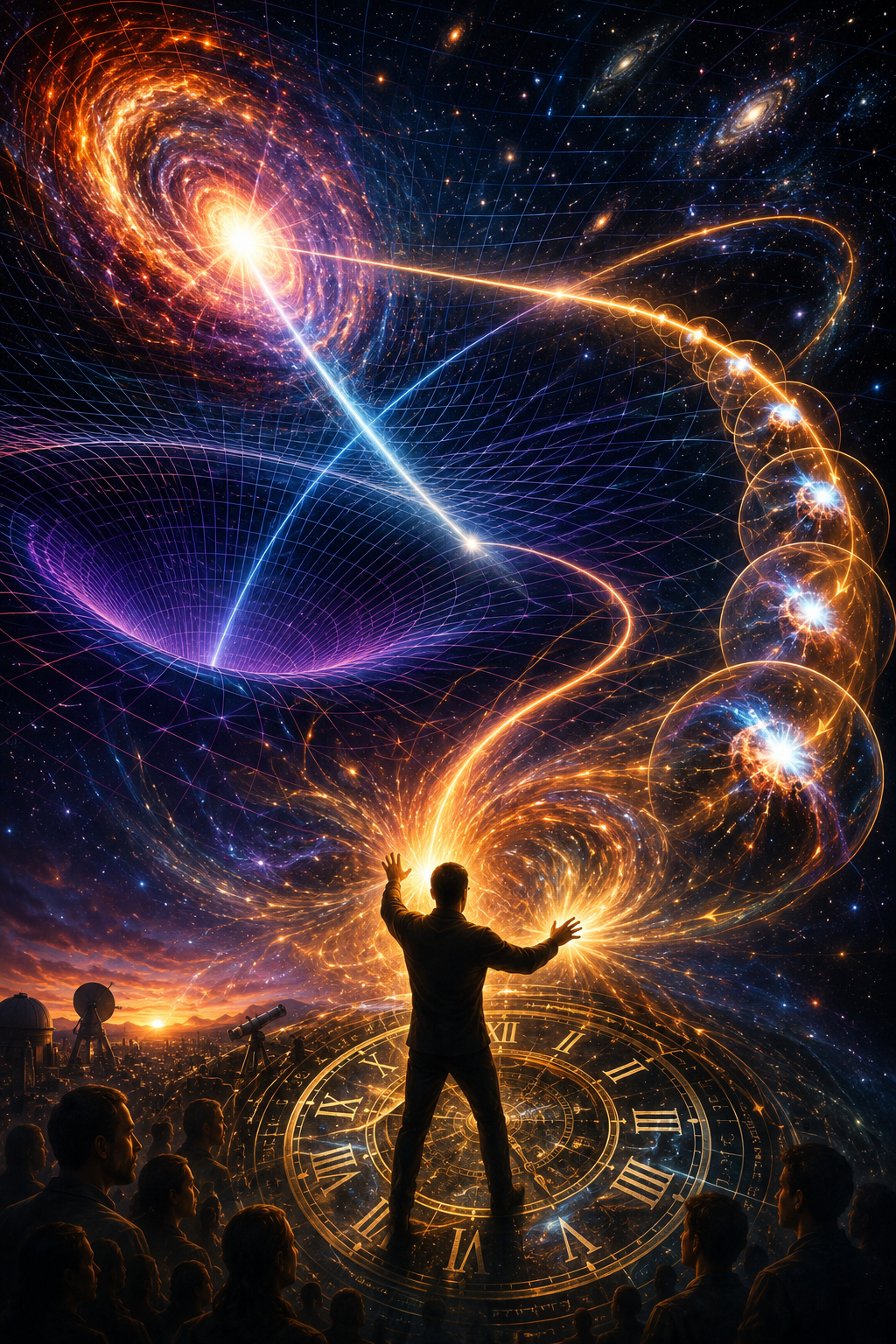
Yet modern astronomy has repeatedly observed something astonishing. Light from the same supernova can arrive at Earth years, decades, or even longer apart. The event itself occurs only once, but massive galaxies positioned between the explosion and Earth warp spacetime so dramatically that the light follows multiple paths through the cosmos.
Some routes are shorter.
Others are longer.
As a result, the universe can deliver the same moment multiple times.
The implications reach far beyond astronomy.
Because once we understand why this happens, we begin to see that time itself is far more flexible, relational, and context-dependent than everyday experience suggests.
And that realization may reveal as much about ourselves as it does about the stars.
Gravity Does Not Merely Bend Space

For centuries, time was imagined as a universal backdrop.
According to Isaac Newton’s view, time flowed uniformly everywhere. Every observer participated in the same cosmic clock. Events unfolded within an objective timeline that existed independently of everything happening inside it.
This picture feels intuitive because it matches ordinary human experience.
But Albert Einstein overturned that understanding.
In Einstein’s theory of general relativity, gravity is not a force acting through space. Instead, gravity emerges from the curvature of spacetime itself.
Massive objects deform the geometry around them.
Planets curve spacetime.
Stars curve spacetime.
Galaxies curve spacetime.
Even light, which travels at the fastest speed possible, follows those curves.
What appears to us as a beam of light moving through empty space is actually traveling along the contours of a cosmic landscape shaped by matter and energy.
The universe is not a flat stage.
It is a dynamic structure whose geometry influences how events unfold.
And once spacetime bends, time bends with it.
One Event, Multiple Arrivals

This becomes especially visible through a phenomenon known as gravitational lensing.
Imagine a supernova exploding billions of light-years away.
The light from that explosion begins traveling toward Earth.
But between the supernova and our planet sits a massive galaxy cluster whose gravity warps spacetime like a bowling ball placed on a stretched sheet.
Instead of taking one direct route, the light can travel along several different curved paths.
Some paths are relatively short.
Others wind through more heavily distorted regions of spacetime.
Although every beam left the supernova at the same moment, they do not all arrive together.
Astronomers may observe the explosion once.
Then again.
And sometimes yet again.
The same event appears repeatedly because spacetime itself has altered the routes through which the light travels.
This is not an illusion.
It is not a measurement error.
It is reality behaving exactly as relativity predicts.
And it forces us to confront an uncomfortable truth.
The timing of events depends on perspective, geometry, and location.
There is no universal cosmic schedule ensuring everyone receives reality simultaneously.
The End of a Universal “Now”

Perhaps the most profound lesson of relativity is the collapse of the idea that the universe shares a single present moment.
Human intuition assumes that “now” is universal.
We imagine that somewhere, hidden beneath appearances, there exists one objective present sweeping across the cosmos.
Modern physics suggests otherwise.
What counts as “now” depends on where you are.
It depends on how you are moving.
It depends on the gravitational environment you occupy.
And it depends on the path information takes to reach you.
Two observers can receive the same event at different times without either observer being mistaken.
Both experiences are valid.
Both are physically real.
The universe does not privilege one perspective over another.
Temporal order is often relational rather than absolute.
This insight can feel deeply counterintuitive because our daily lives occur within a narrow range of speeds, distances, and gravitational conditions. Human experience evolved in a world where relativity effects are usually too small to notice.
But the cosmos operates on scales where those effects become impossible to ignore.
And once seen, they permanently change our understanding of time.
What Physics Can Measure

The remarkable thing is that scientists do not merely observe these effects.
They can calculate them.
Astronomers can map the distribution of mass within galaxy clusters.
They can reconstruct the curved geometry of spacetime.
They can estimate how much delay different light paths will experience.
In some cases, they can even predict when a future image of a previously observed supernova will arrive.
This is one of the great triumphs of modern science.
The universe may be strange, but it is not arbitrary.
Its behavior follows discoverable patterns.
Through mathematics, observation, and experimentation, physics reveals extraordinary details about how time behaves across the cosmos.
Yet there is a boundary to what equations alone can provide.
Because understanding how time works is not the same as understanding what time means.
What Physics Cannot Provide
Physics can explain why light arrives late.
It cannot explain why a memory matters.
Physics can describe temporal intervals.
It cannot tell us why one moment changes a life while another is forgotten.
Physics can model causality.
It cannot explain meaning.
The universe may be filled with events, but events do not automatically become experience.
Something must organize them.
Something must interpret them.
Something must transform raw sequence into significance.
This is where the scientific study of time intersects with the human experience of time.
And the distinction matters.
Because human beings do not live inside equations.
They live inside stories.
Gravity Warps Light. Awareness Warps Time.

At cosmic scales, gravity shapes temporal relationships.
At human scales, attention performs a surprisingly similar role.
Not by altering spacetime itself, but by altering how time is experienced.
Anyone who has waited anxiously for important news understands this.
Minutes stretch.
Moments expand.
Time seems to slow.
Yet those same minutes can disappear almost instantly during meaningful conversation, creative work, or deep engagement.
The clock measures identical intervals.
Experience does not.
Memory also alters time.
Periods filled with novelty often feel expansive in retrospect because they leave behind rich informational traces.
Routine periods frequently compress because fewer memorable markers remain.
Attention thickens some moments.
Memory enlarges others.
Meaning organizes them into coherent narratives.
Just as gravity influences the path of light, awareness influences the path of experience.
Different mechanisms.
Similar consequences.
Both reveal that time is shaped by context.
Many Cosmic Nows, One Human Timeline

Relativity teaches us that there is no single cosmic now shared across the universe.
Human life contains a parallel insight.
Each person inhabits a unique temporal world.
Two people may live through the same year and experience it entirely differently.
One experiences growth, discovery, and transformation.
The other experiences stagnation and repetition.
The calendar remains identical.
The lived reality does not.
Yet despite this variability, humans create continuity.
Memory links past events.
Attention anchors the present.
Anticipation projects possible futures.
Together, these processes create the sense of a coherent timeline.
Without them, life would become a collection of disconnected moments.
Awareness does not merely observe temporal experience.
It helps construct it.
Humans as Actuators of Time

This idea lies at the heart of Humans Actuators of Time.
Humans do not create physical spacetime.
They do not alter the speed of light.
They do not rewrite the laws of relativity.
But they do something equally significant.
They transform events into meaning.
They organize experience into continuity.
They convert sequence into story.
The universe provides change.
Human beings provide interpretation.
The universe generates events.
Human beings generate significance.
This does not place humanity above physics.
It places humanity within a larger process through which reality becomes consciously lived.
Without observers, supernovae still explode.
Galaxies still evolve.
Light still travels.
But awareness introduces memory, narrative, purpose, responsibility, and meaning.
And those elements profoundly shape what time becomes in lived experience.
The Deeper Lesson

The warped light of distant supernovae teaches a lesson far larger than astronomy.
Time is not simply given.
It is shaped by relationships.
At cosmic scales, those relationships emerge through geometry, gravity, motion, and spacetime curvature.
At human scales, they emerge through attention, memory, anticipation, and meaning.
Different mechanisms.
Same insight.
Reality is not organized around a single universal clock.
It is organized around interactions.
The deeper science investigates time, the less it resembles an absolute backdrop and the more it resembles a dynamic network of relationships.
And perhaps that is why questions about time feel so personal.
Because understanding time ultimately requires understanding the systems that experience it.
Including ourselves.
From the Publisher
One of the most fascinating developments in modern science is that the deeper we investigate time, the less fixed it appears to become.
The universe no longer resembles a machine operating according to a single cosmic clock.
Instead, it increasingly appears as a network of relationships in which timing depends on perspective, interaction, and structure.
This is one reason JJ Simon’s work continues to resonate with readers exploring the intersection of science, philosophy, and human experience.
Rather than treating time as merely a physical quantity or merely a psychological phenomenon, he explores the space where both realities meet.
The warped light of distant supernovae reminds us that time is not as straightforward as human intuition once believed.
Einstein showed that gravity bends spacetime.
Modern astronomy confirms it.
And human experience reveals a parallel truth: awareness bends the texture of lived time in ways that shape identity, purpose, and meaning.
As this series continues into deeper explorations of relativity, observation, and the nature of reality itself, one insight becomes increasingly difficult to ignore:
Time may not be a universal stage upon which existence unfolds.
It may be something that emerges through relationships—cosmic, physical, and conscious alike.
And understanding those relationships may ultimately reveal as much about ourselves as it does about the universe.
Continue the Exploration
Want to explore these ideas in a more visual format?
The JJ Simon — Consciousness, Time, Reality & Deep Thought video series expands on many of the questions explored throughout this essay, including the nature of time, consciousness, perception, reality, memory, human agency, and the mysteries at the intersection of science and philosophy.
Each short reflection is designed to spark curiosity, challenge assumptions, and encourage deeper thinking about the world we inhabit and the experiences that shape our lives.
If you enjoy exploring big questions through both science and philosophy, the companion playlist is a natural next step.
Watch the playlist:
Leave a Reply