
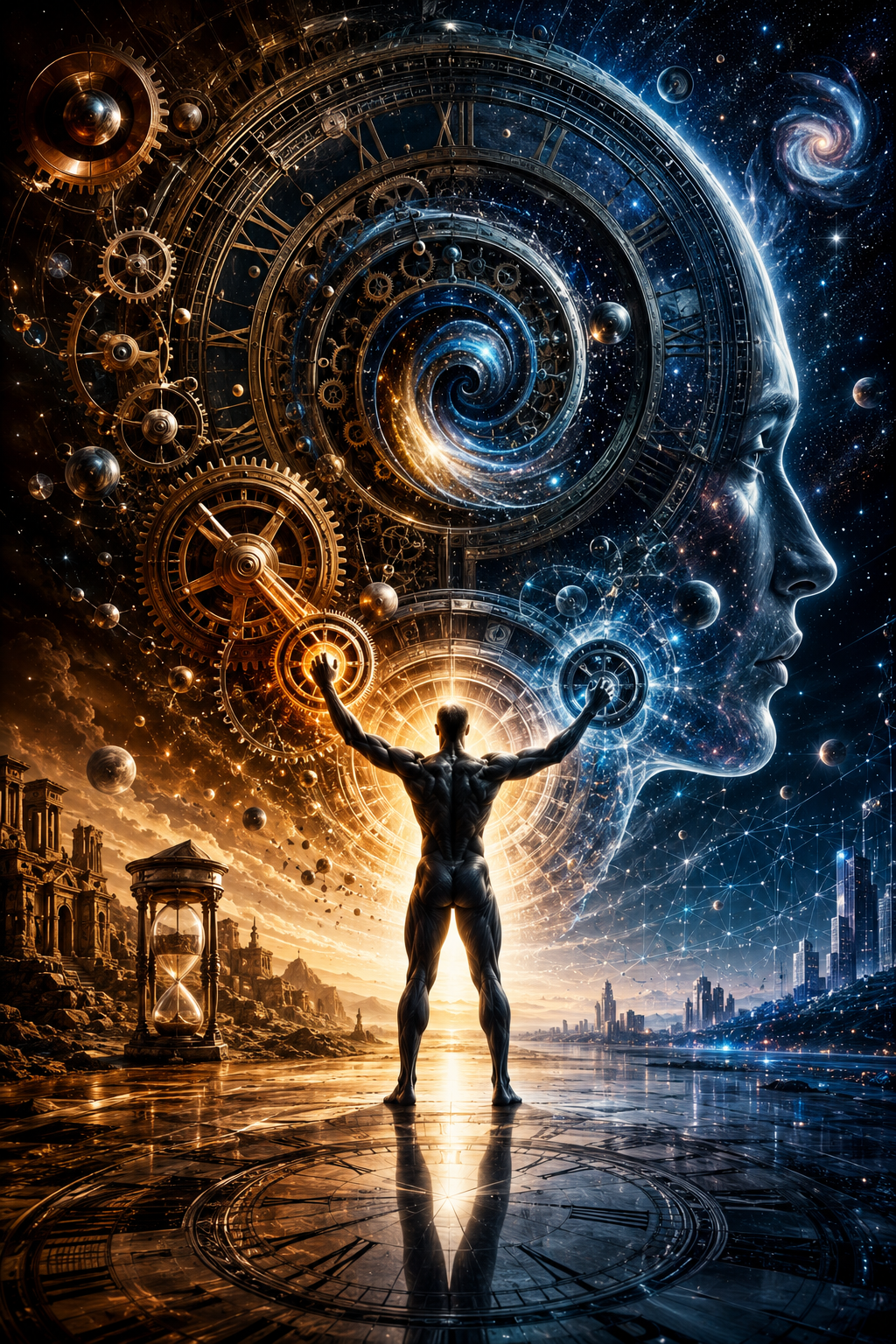
When Physics Lets Go and Human Agency Steps Forward
Series: Time, Consciousness, and New Science
By JJ Simon — Perspectives with JJ Simon
author of Humans Actuators of Time
Reading Time: approx. 14 minutes
There is a particular kind of courage required to challenge an idea so familiar that most people rarely think to question it. We trust the ground beneath our feet without examining it. We assume space exists as a stage upon which everything unfolds. We experience time as a steady current carrying every event from yesterday into tomorrow. These assumptions feel less like theories than simple facts of existence.
Yet throughout the history of science, some of our deepest intuitions have proven incomplete. The Earth is not the center of the cosmos. Solid matter is mostly empty space. Simultaneity depends on the observer. Again and again, reality has turned out to be stranger—and often more beautiful—than our everyday experience suggests.
Few contemporary physicists have explored that strangeness more thoughtfully than Carlo Rovelli.
Across his work in theoretical physics and his books for general readers, Rovelli returns to a conclusion that is both unsettling and liberating: time, as we usually imagine it, may not exist at the deepest level of reality.
The flowing present.
The universal “now.”
The invisible cosmic clock that seems to tick behind every event.
These familiar ideas do not appear in the fundamental equations that describe nature.
At first glance, this can sound almost impossible to accept. If time is not fundamental, then why does it feel so undeniable? Why do we remember yesterday but not tomorrow? Why does life unfold as a sequence instead of existing all at once?
Rather than leaving us with fewer questions, Rovelli’s work opens the door to richer ones.
When Time Disappears at the Foundations

Much of modern physics still relies on time as a practical tool. We measure motion over time. We describe processes unfolding through time. Everyday calculations work remarkably well using clocks as reference points.
But when physicists attempt to reconcile quantum mechanics with general relativity—to understand the universe at its most fundamental scale—something unexpected happens.
Time begins to disappear.
Within Rovelli’s work on quantum gravity, particularly his relational approach, the equations no longer require a universal temporal backdrop against which everything evolves. Instead, they describe relationships between physical quantities. One system changes relative to another. Events are defined by interaction rather than by their position along a single cosmic timeline.
This is a profound shift in perspective.
Rather than imagining the universe as a movie playing frame by frame on an invisible projector, reality begins to resemble an immense web of relationships, where what matters is not an external clock but the changing connections between things.
Nothing stops happening.
Stars still form.
Atoms still interact.
Galaxies continue to evolve.
The universe remains dynamic.
What disappears is the assumption that change must be measured against one universal flow of time shared equally by everything.
For many readers, this is the most disorienting aspect of Rovelli’s work. We are accustomed to asking when something happens, as though “when” exists independently of the event itself.
Relational physics suggests a different possibility.
Perhaps events do not occur inside time.
Perhaps what we call time emerges from the relationships among events themselves.
The End of a Universal “Now”

One of the most intuitive ideas we carry through life is that everyone shares the same present moment.
It certainly feels that way.
We imagine billions of people, every star, every planet, and every distant galaxy all existing together in one enormous cosmic present.
Modern physics has been steadily dismantling that picture for more than a century.
Einstein showed that observers moving differently can disagree about which events occur simultaneously. There is no universal present that every observer can point to. What counts as “now” depends on one’s frame of reference.
Rovelli carries that insight even further.
If there is no privileged perspective from which the universe can be observed, then perhaps there is no master timeline underlying reality either.
Instead of a single clock governing everything, there are countless interacting systems, each relating to others in ways that produce the appearance of temporal order.
Our everyday experience is not an illusion.
It is an emergent description.
Just as temperature emerges from the collective motion of countless microscopic particles, our familiar experience of flowing time may emerge from countless physical relationships that, individually, contain no flowing clock at all.
This distinction is subtle but enormously important.
Emergent does not mean unreal.
A rainbow is emergent. It depends upon the interaction of sunlight, water droplets, and an observer’s position. It is entirely real, even though it is not an object floating independently through space.
Likewise, time may be profoundly real at the human scale without existing as one of the universe’s most fundamental ingredients.
The Arrow of Time as Perspective

If the deepest laws of physics do not distinguish between past and future, where does the direction of time come from?
Why do eggs scramble but never spontaneously unscramble?
Why do memories accumulate toward what we call the past rather than the future?
These questions lead Rovelli toward one of his most elegant ideas.
The arrow of time appears not because the universe itself insists upon a preferred direction, but because of the particular conditions under which observers like us exist.
At microscopic scales, many physical laws are remarkably indifferent to temporal direction. They work equally well whether one imagines processes running forward or backward.
Yet our lived experience is anything but symmetrical.
We remember.
We age.
We anticipate.
We leave traces behind us.
According to Rovelli, this familiar asymmetry arises from thermodynamics, entropy, and the limited information available to systems like ourselves. We perceive a direction because we inhabit irreversible processes. We are beings who constantly exchange energy with our surroundings, build memories, and lose information.
The arrow of time is therefore not imposed upon reality from above.
It emerges from within particular relationships.
Time flows because we occupy a particular perspective inside an evolving universe—not because the universe itself carries an invisible arrow from past to future.
That realization does not diminish our experience.
If anything, it makes our experience even more remarkable.
The flowing world we inhabit is not separate from physics.
It is one of physics’ most extraordinary emergent phenomena.
A Universe Built on Relationships

Running through all of Rovelli’s work is a remarkably consistent philosophical thread: relationships come before absolutes.
Position has meaning only relative to something else.
Motion exists relative to another frame.
Even duration gains meaning only through comparison.
Nothing stands entirely alone.
This relational view extends naturally to clocks themselves.
A clock is often imagined as something that measures an independent quantity called time.
But from a relational perspective, a clock is better understood as one changing system being used to compare itself with another changing system.
The swinging pendulum, the vibration of a cesium atom, the oscillation of a quartz crystal—each provides a regular process against which other processes can be described.
Clocks do not uncover a hidden river called time.
They establish stable relationships between changing phenomena.
That may sound like a small conceptual adjustment.
In reality, it transforms the question entirely.
Instead of asking where time exists, we begin asking how relationships generate the temporal order we experience.
And it is precisely here that philosophy begins to meet physics in a particularly interesting way.
Where Human Agency Enters the Picture

If relationships lie at the heart of reality, then one question naturally follows.
What role do conscious observers play within those relationships?
Physics can describe how systems interact. It can explain how entropy gives rise to an arrow of time, how clocks compare one process with another, and why no universal “now” appears in our best theories of nature.
Those are extraordinary achievements.
But they leave another set of questions largely untouched.
What is it like to inhabit this relational universe?
How do beings capable of memory, anticipation, imagination, and choice transform a world of continual change into the lived experience we call time?
These are not questions that physics alone is designed to answer. They belong equally to philosophy, psychology, neuroscience, and the study of consciousness.
This is where Humans Actuators of Time enters the conversation.
Rather than attempting to replace physics, the book continues where physics naturally pauses. If time is not a universal substance flowing independently through the cosmos, then how does temporal experience become so structured, so meaningful, and so central to human life?
The proposal is not that humans create the universe.
Nor is it that consciousness somehow overrides physical law.
Instead, the suggestion is more modest—and perhaps more profound.
If time emerges through relationships, then conscious beings are not passive spectators standing outside those relationships.
We are among the participants through whom temporal order becomes meaningful.
From Change to Experience

Every moment of human life involves far more than the passive observation of events.
We remember.
We compare.
We anticipate.
We imagine possibilities that have not yet unfolded.
We choose between alternatives.
We organize experience into stories that give coherence to what would otherwise be an endless stream of change.
Without memory, there is no recognizable past.
Without anticipation, there is no meaningful future.
Without attention, there is no privileged present.
These capacities do not manufacture reality, but they profoundly shape how reality is experienced, interpreted, and acted upon.
A sequence of physical events becomes a biography.
A collection of changing conditions becomes a plan.
A chain of causes becomes purpose.
In other words, human beings do not merely observe temporal order.
We continuously participate in constructing the framework through which temporal order becomes usable.
This is not simply psychology.
It is the bridge between physical change and lived experience.
Time as Something We Enact

Imagine trying to navigate a city without memory.
Every street would appear new.
Every intersection would lack context.
There would be movement, certainly—but no meaningful journey.
Now imagine possessing memory but no ability to anticipate.
The future would never become a destination.
Plans would disappear.
Goals would lose their coherence.
Action itself would become difficult to sustain.
Our experience of time depends upon much more than clocks.
It depends upon minds capable of linking what has happened with what might happen next.
Memory transforms change into a past.
Intention transforms possibility into a future.
Decision transforms uncertainty into sequence.
Meaning transforms chronology into narrative.
These are not decorative additions layered onto an objective timeline.
They are among the processes through which a relational universe becomes navigable for conscious beings.
This is the sense in which human agency becomes central to the discussion.
Not as domination over reality.
Not as control over the cosmos.
But as participation in the ongoing organization of experience.
We help convert physical change into lived time.
A Different Kind of Participation

The word “agency” often carries images of control—of imposing one’s will upon the world.
That is not the idea being explored here.
Agency begins with participation.
Every choice redirects attention.
Every decision changes future possibilities.
Every memory reshapes how the present is understood.
Every conversation alters what another person may think, remember, or do.
Human beings continually participate in networks of relationships that extend across families, communities, cultures, and generations.
Our actions become part of other people’s futures just as theirs become part of ours.
Viewed through this lens, agency is not separate from relational physics.
It is another expression of relationship operating at the scale of conscious life.
Physics explains how systems influence one another.
Human experience reveals what those influences become when memory, meaning, and intention enter the picture.
The scales are different.
The questions are different.
But the conversation between them is surprisingly natural.
A Quiet Convergence

One of the most compelling qualities of Carlo Rovelli’s work is that it invites humility.
Rather than replacing old certainties with new dogmas, it encourages us to recognize how much remains mysterious about the universe.
Time may not be fundamental.
The present may not be universal.
The familiar flow of moments may emerge from relationships far deeper than everyday intuition suggests.
These conclusions are not reasons to diminish human experience.
They are invitations to examine it more carefully.
If the universe is relational rather than governed by an invisible master clock, then our lives become more—not less—worthy of philosophical attention.
We are creatures who remember, imagine, choose, learn, and create meaning within a cosmos that appears far more dynamic than earlier generations imagined.
Rovelli shows us why time dissolves at the deepest level of physics.
Humans Actuators of Time explores what that possibility might mean for beings who must still live, decide, hope, and act within an emergent temporal world.
The conversation is not about replacing science with philosophy.
Nor is it about asking science to answer questions beyond its reach.
It is about allowing each discipline to illuminate a different aspect of the same enduring mystery.
Physics helps us understand what reality may be.
Philosophy asks what it means to live within it.
Perhaps the richest understanding of time will emerge not from choosing between those perspectives, but from allowing them to inform one another.
From the Publisher
Carlo Rovelli’s work invites us to do something that rarely comes naturally: to loosen our grip on the assumptions that feel most obvious.
We instinctively imagine time as a universal river flowing equally for everything in existence. Yet modern physics increasingly points toward a more relational picture—one in which change is fundamental, while time itself emerges from the ways systems interact.
That shift in perspective does more than reshape physics.
It changes the questions we ask about ourselves.
If the universe is not governed by a single cosmic clock, then our experience of memory, anticipation, choice, and meaning becomes even more worthy of careful exploration.
This is one reason JJ Simon’s work continues to resonate with readers drawn to the meeting place of science, philosophy, and lived experience.
Rather than treating modern physics as the end of the conversation, he approaches it as the beginning of a deeper one—asking what these discoveries might reveal about the conscious beings attempting to understand them.
As this series moves further into quantum physics, observation, and the foundations of reality, one theme continues to emerge.
The closer we examine time, the less it resembles an invisible force carrying us forward.
Instead, it begins to look like something arising through relationships—between matter, energy, information, and perhaps even the observers capable of reflecting upon them.
Whether that picture ultimately proves complete remains an open question.
But it is precisely the kind of question worth continuing to explore.
Continue the Exploration
If this essay sparked new questions about time, consciousness, and the nature of reality, you may also enjoy other essays in the Time, Consciousness, and New Science blog series or JJ Simon’s companion video reflections.
The JJ Simon — Consciousness, Reality & Deep Thought playlist expands on many of the themes explored throughout these essays, combining philosophy, science, psychology, and visual storytelling into short, thought-provoking experiences designed to inspire deeper reflection.
Whether you’re encountering these ideas for the first time or continuing your exploration of Humans Actuators of Time, the videos offer another way to engage with questions that challenge our assumptions about time, perception, meaning, and human experience.
Watch the playlist here:
Leave a Reply