

What One Elegant Experiment Revealed About Measurement, Information, and Our Relationship with Reality
Series: Time, Consciousness, and New Science
By JJ Simon — Perspectives with JJ Simon
author of Humans Actuators of Time
Reading Time: approx. 14 minutes
One of the most enduring assumptions we make about the world is that we can observe it without changing it.
We watch the sunrise without altering its path. We study the stars without disturbing their motion. We read a thermometer without believing that our glance changes the temperature.
Observation feels passive.
Reality simply exists, and we uncover it.
For centuries, this seemed not only reasonable but self-evident. Science was often described as the process of discovering an objective world that existed independently of those who studied it.
Then quantum physics began asking a very different question.
What if, at the smallest scales of nature, observing and interacting are not entirely separate acts?
What if gaining information about a system becomes part of the system’s physical behavior?
This question has shaped nearly a century of scientific debate.
It challenged some of the greatest physicists who ever lived, inspired countless experiments, and transformed our understanding of the quantum world.
Today, thanks to remarkable advances in experimental physics, one of the most famous disagreements in scientific history has finally been tested in the laboratory.
The result did not answer every question about quantum mechanics.
But it answered one that had remained unresolved for almost one hundred years.
A Debate That Shaped Modern Physics
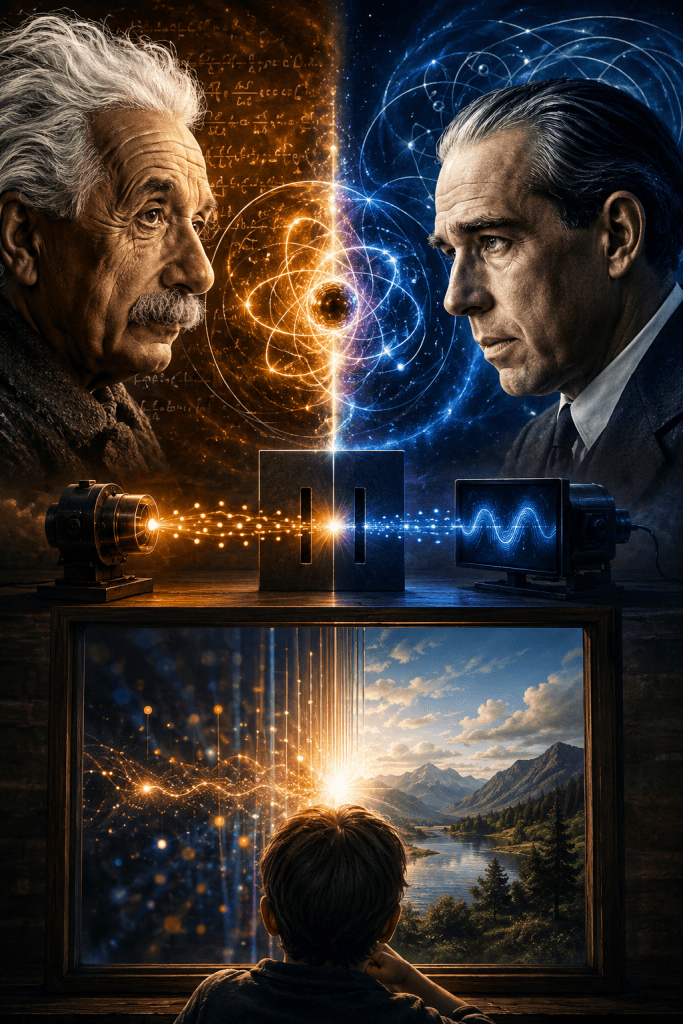
The year was 1927.
Quantum mechanics was still a young and deeply controversial theory.
Its mathematical predictions were proving extraordinarily successful, yet many of its implications seemed almost impossible to accept.
Among those who struggled with its conclusions was Albert Einstein.
Einstein had helped lay the foundations of quantum theory himself, yet he remained convinced that nature possessed an underlying order independent of measurement.
To him, the strange uncertainties appearing in quantum mechanics reflected an incomplete description of reality rather than reality itself.
Niels Bohr saw the situation differently.
He believed the quantum world required an entirely new way of thinking.
Instead of assuming that physical properties always existed in well-defined states before measurement, Bohr argued that certain aspects of reality could only be meaningfully described through the interactions used to observe them.
The disagreement was never merely about mathematics.
It was about the nature of reality itself.
Did particles possess definite properties whether anyone measured them or not?
Or were some properties inseparable from the physical processes through which they became known?
Neither physicist could settle the question through philosophy alone.
The answer would ultimately depend on experiment.
The difficulty was that the necessary technology simply did not exist.
Einstein’s Elegant Challenge
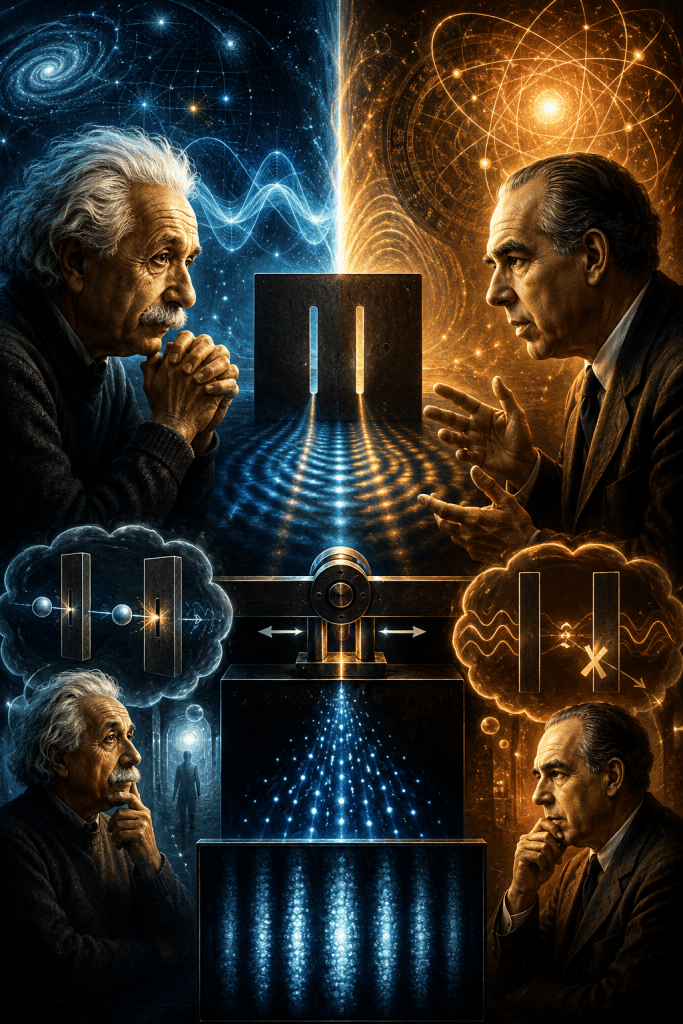
To understand the debate, it helps to revisit one of the most famous experiments in all of physics.
The double-slit experiment appears deceptively simple.
Imagine shining individual particles of light—or photons—toward a barrier containing two narrow openings.
If the photons behaved like tiny particles traveling through one slit or the other, we would expect them to produce two distinct bands on a detector beyond the barrier.
Instead, something extraordinary happens.
When no attempt is made to determine which slit each photon passes through, the detector records an interference pattern—a series of alternating bright and dark bands that reveal wave-like behavior.
It is as though each photon explores multiple possibilities before arriving at a single outcome.
Einstein admired the elegance of the mathematics but questioned its interpretation.
He proposed a clever modification.
Suppose one of the slits could move ever so slightly.
If a photon passed through that opening, it would transfer a tiny amount of momentum to the movable slit, causing it to recoil.
By measuring that recoil, one could determine which path the photon had taken.
Einstein believed this would reveal something important.
If physicists could identify the particle’s path while still observing the interference pattern, then quantum mechanics would be incomplete.
Reality, he argued, must exist independently of observation.
Bohr’s Response
Bohr immediately recognized the significance of Einstein’s proposal.
He did not dispute the ingenuity of the thought experiment.
Instead, he argued that it overlooked something fundamental.
Measuring the recoil of the movable slit would require an interaction with the system.
That interaction would inevitably alter the conditions necessary for the interference pattern to appear.
The two outcomes could not coexist.
Either the experiment would reveal which path the photon had taken…
Or it would preserve the wave-like interference pattern.
Not both.
This idea became one of the cornerstones of quantum mechanics.
Bohr called it complementarity.
Certain properties, he argued, are not simultaneously accessible because the experimental arrangements required to measure them are fundamentally different.
The issue was never about imperfect instruments.
It was about the structure of quantum reality itself.
For decades, physicists debated the implications.
The mathematics strongly supported Bohr’s interpretation.
Yet Einstein’s challenge remained deeply compelling because no experiment had directly tested his specific proposal.
The discussion lingered somewhere between theory and philosophy.
From Thought Experiment to Laboratory
Nearly a century later, technology finally caught up with imagination.
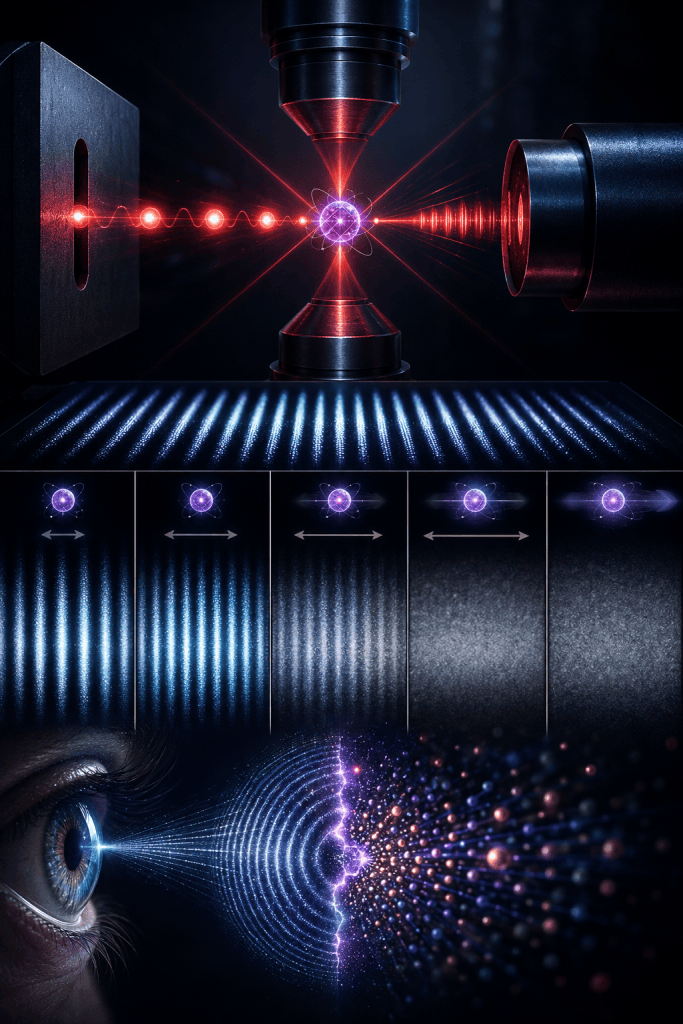
Researchers developed an experiment capable of recreating Einstein’s proposal with astonishing precision.
Instead of using a heavy mechanical slit, they employed a single rubidium atom held almost motionless within carefully controlled laser fields.
The atom served as an extraordinarily light, movable scatterer.
Individual photons interacted with it one at a time.
If a photon transferred momentum to the atom, the atom recoiled ever so slightly—just as Einstein had envisioned.
By adjusting how tightly the atom was confined, researchers could control how much information became available about the photon’s path.
In effect, they transformed a famous thought experiment into a real one.
The outcome was remarkably clear.
When little or no path information could be obtained, the familiar interference pattern remained.
As more information became available about which path the photon had taken, the interference pattern gradually weakened.
Eventually, it disappeared altogether.
The transition was smooth, measurable, and entirely consistent with Bohr’s prediction.
Einstein’s challenge had finally been answered—not through argument, but through observation.
What Does “Observation” Really Mean?
This experiment also helps clarify one of the most misunderstood ideas in quantum physics.
In everyday conversation, observation usually means simply looking at something.
A person watches a bird fly across the sky.
An astronomer studies a distant galaxy through a telescope.
Nothing about the act of seeing seems to alter what is being observed.
Quantum physics uses the word more precisely.
Observation is not merely looking.
It refers to a physical interaction through which information about a system becomes available.
That interaction may involve photons, atoms, detectors, or other measuring devices.
The essential point is not that human consciousness magically changes reality.
It is that interactions capable of recording information become part of the physical process itself.
This distinction is subtle.
It is also one of the reasons quantum mechanics continues to challenge our intuition nearly a century after its birth.
Information Changes the Picture

The experiment revealed something even more fascinating than the outcome Einstein and Bohr had debated.
It showed why the interference pattern disappeared.
At first glance, it might seem natural to assume that the photon simply “bumped into” the atom, disturbing its path and destroying the wave-like pattern.
That explanation, however, turns out to be incomplete.
The deeper insight lies in information.
As the photon interacted with the rubidium atom, the two became quantum entangled. Their properties could no longer be described independently. Information about the photon’s path became encoded in the motion of the atom, linking the behavior of both particles within a single quantum system.
The more clearly that path information became available, the less pronounced the interference pattern became.
Eventually, when the path could be determined with certainty, the interference vanished altogether.
The relationship was not abrupt.
It unfolded gradually, revealing a precise balance between the amount of information that could be obtained and the degree of wave-like behavior that remained.
This was not merely a philosophical idea.
It was a measurable physical relationship.
For nearly a century, physicists had debated whether observation or disturbance explained the disappearance of interference.
The experiment demonstrated that what mattered most was not simply physical contact.
It was whether information about the system had become available through the interaction.
That distinction has profound implications for our understanding of quantum mechanics.
From the Quantum World to Everyday Reality
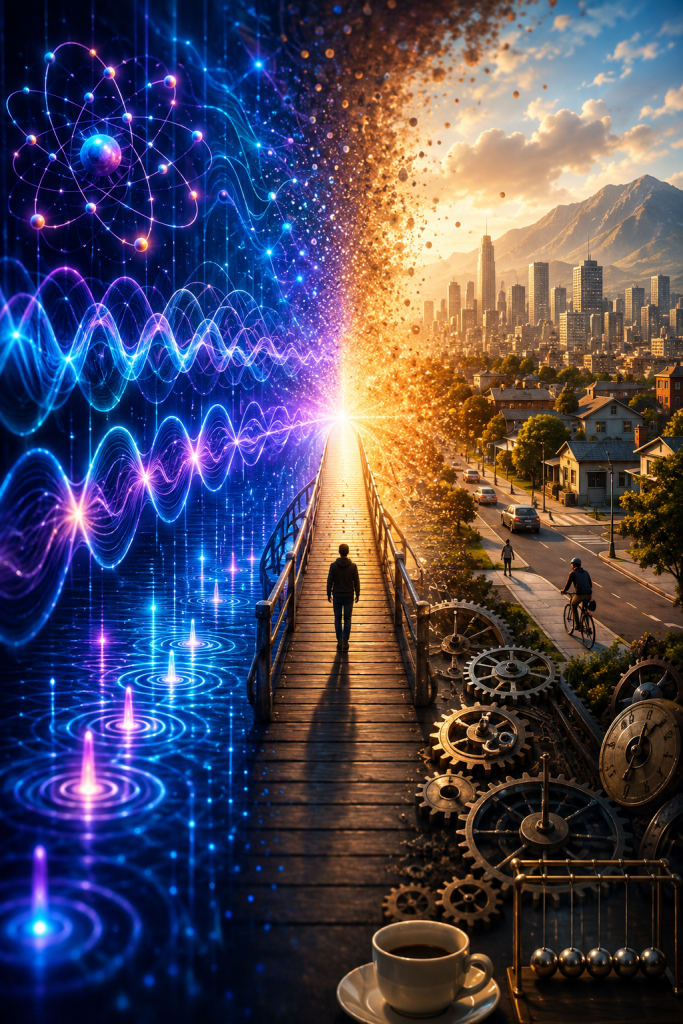
If the quantum world behaves this way, an obvious question follows.
Why don’t we notice these strange effects in everyday life?
Why don’t people, trees, or planets exist in similarly uncertain states?
The answer lies in a process known as decoherence.
Quantum systems are extraordinarily delicate.
Every interaction with the surrounding environment—light, heat, air molecules, or countless other influences—causes information to spread beyond the system itself.
As that information disperses, the fragile relationships responsible for quantum behavior rapidly disappear.
The system begins to behave according to the familiar rules of classical physics.
This is why the macroscopic world appears so stable.
The strange possibilities described by quantum mechanics have not vanished.
They have simply become overwhelmed by the countless interactions taking place every moment.
In this sense, the everyday world emerges naturally from the quantum one.
Not because quantum mechanics stops applying, but because coherence becomes increasingly difficult to preserve as systems grow larger and more complex.
Rather than existing as two separate realities, the quantum and classical worlds are connected through the continual exchange of information.
What Physics Invites Us to Consider
One of the greatest strengths of science is its ability to answer specific questions while revealing entirely new ones.
The experiment did not prove that consciousness creates reality.
Nor did it suggest that human thought alone determines physical outcomes.
Those are claims that extend well beyond the evidence.
What the experiment did demonstrate is something both more modest and more profound.
At the quantum level, interactions that record information are not external to reality.
They become part of the physical processes unfolding within it.
That realization invites a broader philosophical question.
If information plays such a fundamental role in the behavior of physical systems, what role does it play in the way conscious beings experience the world?
Physics can describe the transfer of information with remarkable precision.
Human experience asks how that information becomes understanding.
How it becomes memory.
How it becomes meaning.
Those questions belong to different disciplines, yet they are connected by a shared curiosity about how reality is known.
From Information to Experience

Every day, our minds perform a kind of organization that no laboratory instrument can fully describe.
Thousands of sensations reach us every second.
Most are forgotten almost immediately.
A few become memories.
Some grow into defining moments that shape the stories we tell about ourselves.
The physical events occur only once.
Their significance continues to evolve.
A childhood conversation may seem ordinary for years before taking on new meaning in adulthood.
A scientific discovery may begin as an abstract idea before gradually changing how an entire civilization understands the universe.
Experience is not simply a sequence of events.
It is an ongoing process of organizing, interpreting, and relating those events.
This is where another conversation naturally begins.
Humans Actuators of Time explores the possibility that while physics investigates how information becomes part of physical processes, human awareness transforms information into lived experience through memory, anticipation, attention, and meaning.
The book does not suggest that consciousness rewrites the laws of physics.
Instead, it asks what those laws might reveal about beings who continuously organize change into the experience we call time.
Participation Rather Than Detachment
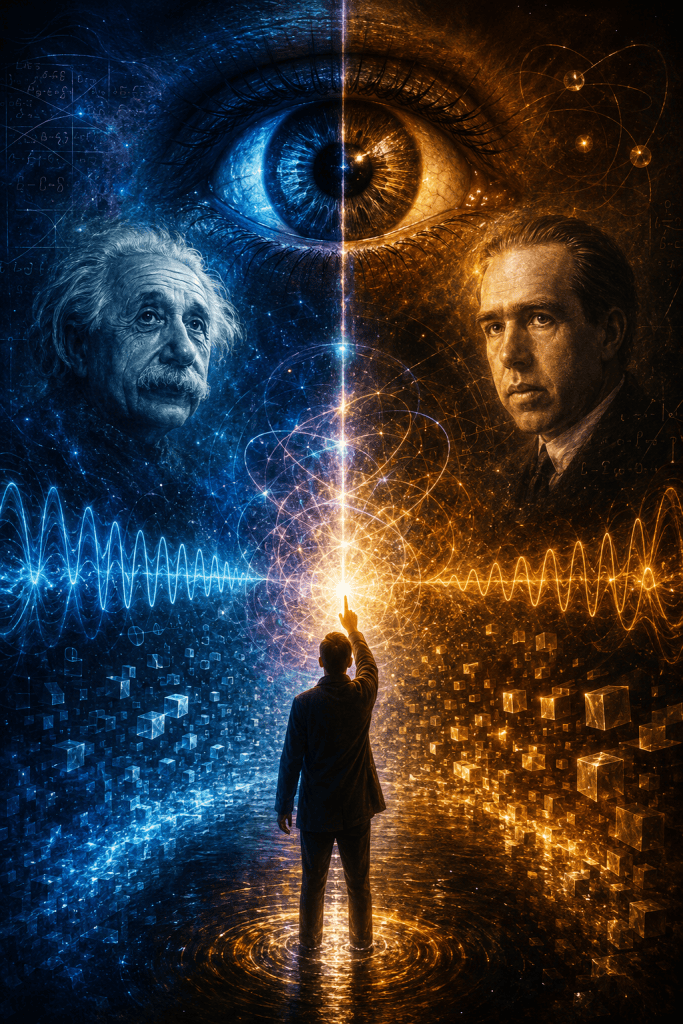
For much of history, people imagined themselves as observers standing apart from the universe.
Nature existed “out there.”
Human beings simply studied it.
Modern science paints a richer picture.
Relativity showed that measurements of space and time depend upon relationships between observers and events.
Quantum physics revealed that measurement involves physical interactions rather than detached observation.
Neither discovery places humanity at the center of the universe.
Instead, both remind us that knowledge is often relational.
We come to understand reality through interaction with it.
That may be one of the most enduring lessons of modern physics.
The universe is not less objective because interactions matter.
It is more interconnected than earlier generations imagined.
A Quiet Convergence
Nearly one hundred years ago, Einstein and Bohr asked a question that seemed impossible to answer.
Could reality be observed without changing it?
For decades, the debate remained suspended between theory, philosophy, and technological limitation.
Today, experiments have provided a remarkably clear answer.
Not every mystery has been solved.
Quantum mechanics continues to challenge our understanding in ways that will likely inspire new questions for generations to come.
But one important insight has emerged.
Knowing and interacting are not always separate acts.
Information is not merely a record of reality.
It can become part of the processes through which reality unfolds.
Perhaps that is the deeper significance of the experiment.
Not that the universe has become stranger than we imagined.
But that it has become more deeply connected.
The closer we examine the foundations of nature, the more relationships seem to matter.
Between particles.
Between information and measurement.
Between observer and observed.
And perhaps, at the human scale, between experience, understanding, and meaning.
The universe does not ask us to stand outside it.
It invites us to explore it from within.

From the Publisher
Some scientific discoveries answer longstanding questions.
Others reveal that the questions themselves were more subtle than we first imagined.
The experiment explored in this essay belongs to the second category.
For nearly a century, physicists debated whether observation merely revealed reality or whether the act of measurement played a more fundamental role. What finally resolved the discussion was not a philosophical argument, but an elegant experiment that clarified the relationship between interaction, information, and the quantum world.
This is one reason JJ Simon’s work continues to resonate with readers interested in both science and philosophy.
Rather than treating modern physics as a collection of isolated discoveries, he explores how these ideas gradually reshape our understanding of perception, memory, meaning, and human experience.
As this series continues into the famous double-slit experiment and other foundational questions in quantum mechanics, a consistent theme keeps emerging.
The universe often proves more relational than our intuition first suggests.
And the deeper we explore those relationships, the more we discover that understanding reality is not simply about finding answers.
It is about learning to ask better questions.
Continue the Exploration
If this essay sparked new questions about time, consciousness, and the nature of reality, you may also enjoy other essays in the Time, Consciousness, and New Science blog series or JJ Simon’s companion video reflections.
The JJ Simon — Consciousness, Reality & Deep Thought playlist expands on many of the themes explored throughout these essays, combining philosophy, science, psychology, and visual storytelling into short, thought-provoking experiences designed to inspire deeper reflection.
Whether you’re encountering these ideas for the first time or continuing your exploration of Humans Actuators of Time, the videos offer another way to engage with questions that challenge our assumptions about time, perception, meaning, and human experience.
Watch the playlist here:

Leave a comment