
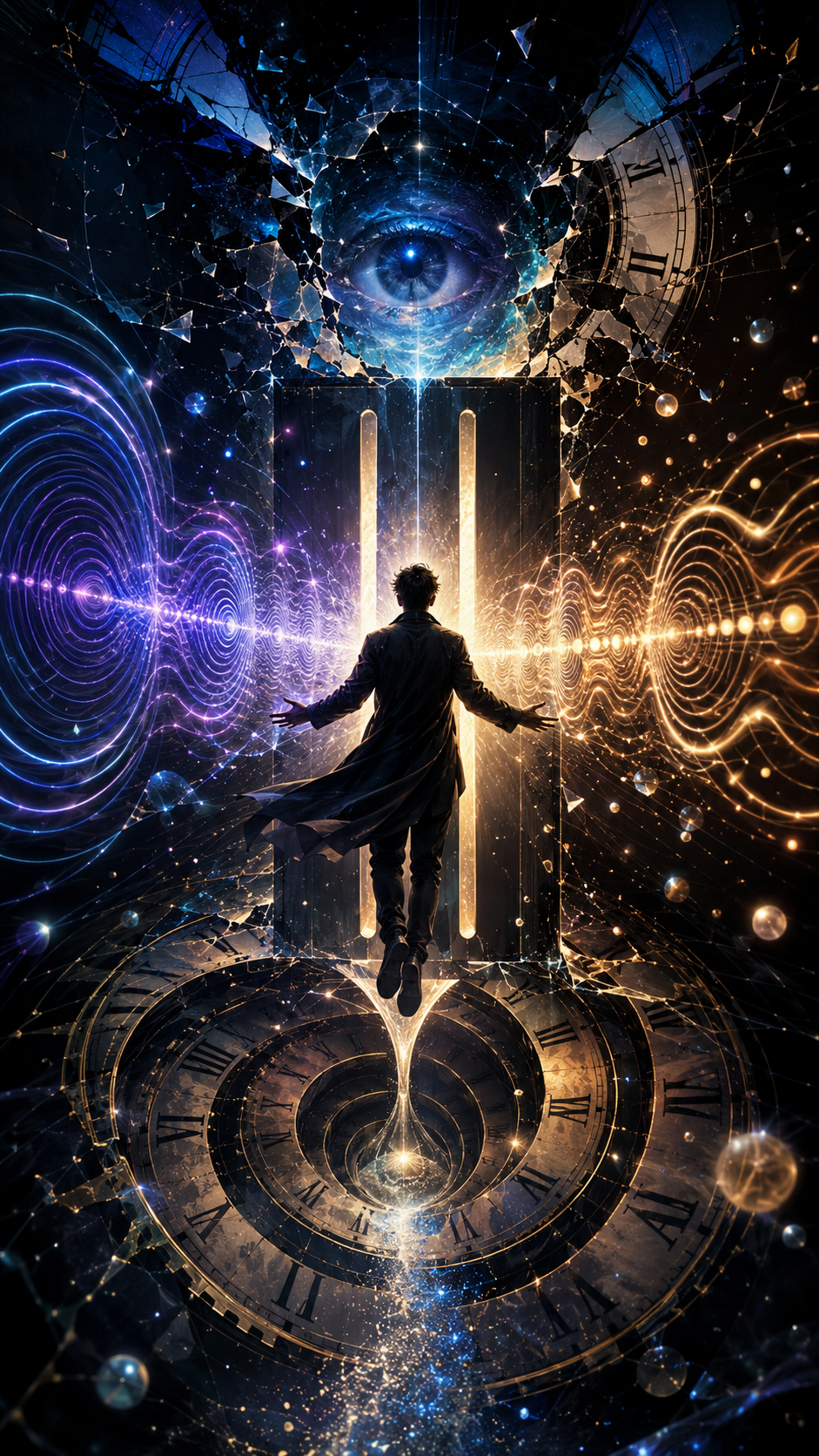
When Observation Becomes Participation — and Why This Changes How We Understand Time Itself
Series: Time, Consciousness, and New Science
By JJ Simon — Perspectives with JJ Simon
author of Humans Actuators of Time
Reading Time: approx. 13 minutes
Few scientific experiments have inspired as much fascination—or as much misunderstanding—as the double-slit experiment.
It appears deceptively simple. A source emits tiny particles of light or matter toward a barrier containing two narrow openings, while a screen behind the barrier records where those particles arrive.
At first glance, it seems like the sort of demonstration that should confirm what we already know about the physical world.
Instead, it quietly overturns some of our deepest assumptions about reality.
The experiment asks questions that extend far beyond physics classrooms.
Can something exist in multiple possibilities at once?
When does a possibility become a definite event?
What role does observation actually play?
And if reality is not fully settled until interaction occurs, what might that suggest about the way we experience time itself?
These are not questions with simple answers.
Yet they continue to shape modern physics nearly a century after the experiment first revealed that nature behaves in ways our everyday intuition struggles to comprehend.
The double-slit experiment does not merely challenge our understanding of particles.
It invites us to reconsider what it means for anything to become real.
The Experiment That Changed Physics
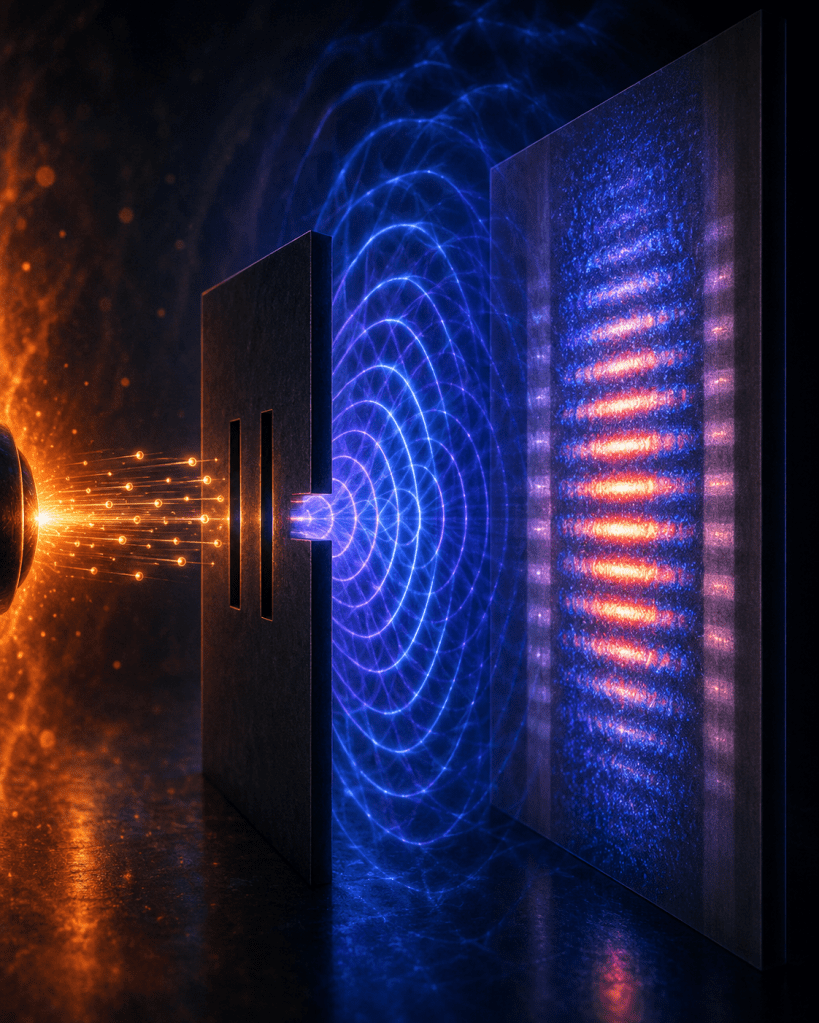
The beauty of the double-slit experiment lies in its simplicity.
Imagine firing individual electrons—or photons—toward a barrier containing two narrow slits.
If these particles behaved like tiny bullets, common sense tells us exactly what should happen.
Particles passing through the left slit would create one band on the screen.
Particles passing through the right slit would create another.
Two slits.
Two bands.
That prediction seems almost unavoidable.
Yet nature has another story to tell.
Instead of producing two distinct bands, the particles gradually form an intricate pattern of alternating light and dark regions known as an interference pattern—the unmistakable signature of waves overlapping one another.
Even more surprising is what happens when the particles are sent one at a time.
There is no stream of particles interacting with each other.
Each particle travels independently.
And yet, as thousands of individual events accumulate, the same wave-like interference pattern slowly emerges.
It is as though each particle somehow behaves like a spread of possibilities rather than following a single, predetermined path.
This result remains one of the most astonishing discoveries in all of science.
Not because it violates mathematics.
But because it challenges the picture of reality that human intuition has spent a lifetime constructing.
Why the Results Were So Unexpected
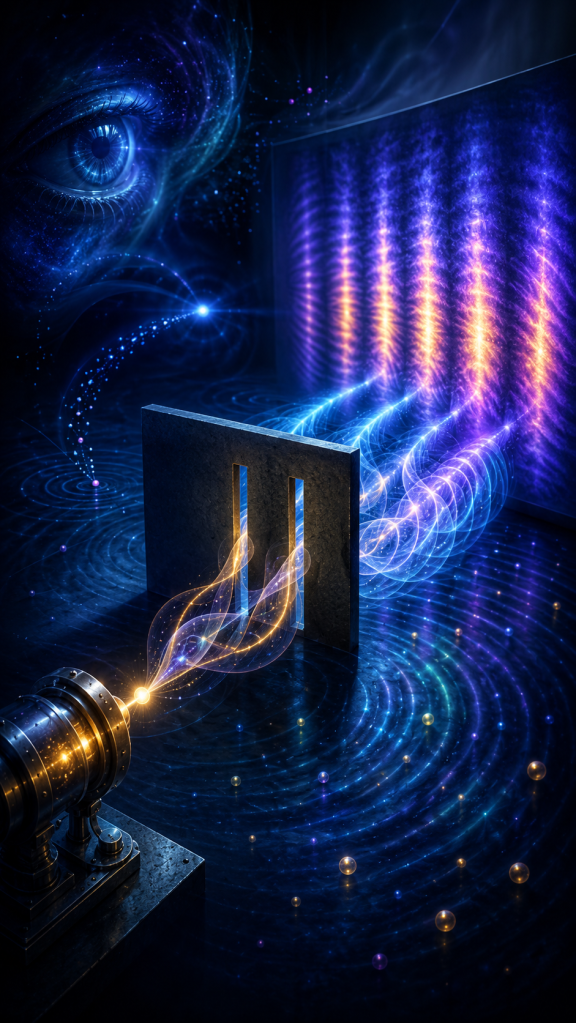
For centuries, classical physics encouraged us to think of the world in clear, predictable terms.
Objects occupy definite positions.
Causes produce effects.
Events unfold in an orderly sequence.
The universe resembles an intricate machine whose future follows naturally from its present.
The double-slit experiment refuses to fit comfortably within that picture.
Instead of behaving exclusively like particles or exclusively like waves, quantum objects display characteristics of both, depending on how they are investigated.
This is known as wave-particle duality, although the phrase itself can be misleading.
It does not mean that particles simply switch back and forth between two familiar identities.
Rather, quantum systems are described mathematically in ways that resist the categories developed from everyday experience.
The language we use—particles, waves, trajectories—is often an approximation rather than a complete description.
This is one reason the experiment has remained so influential.
It reminds us that reality is under no obligation to conform to human expectations.
Sometimes our most cherished intuitions must give way to better explanations.
Observation Is Participation
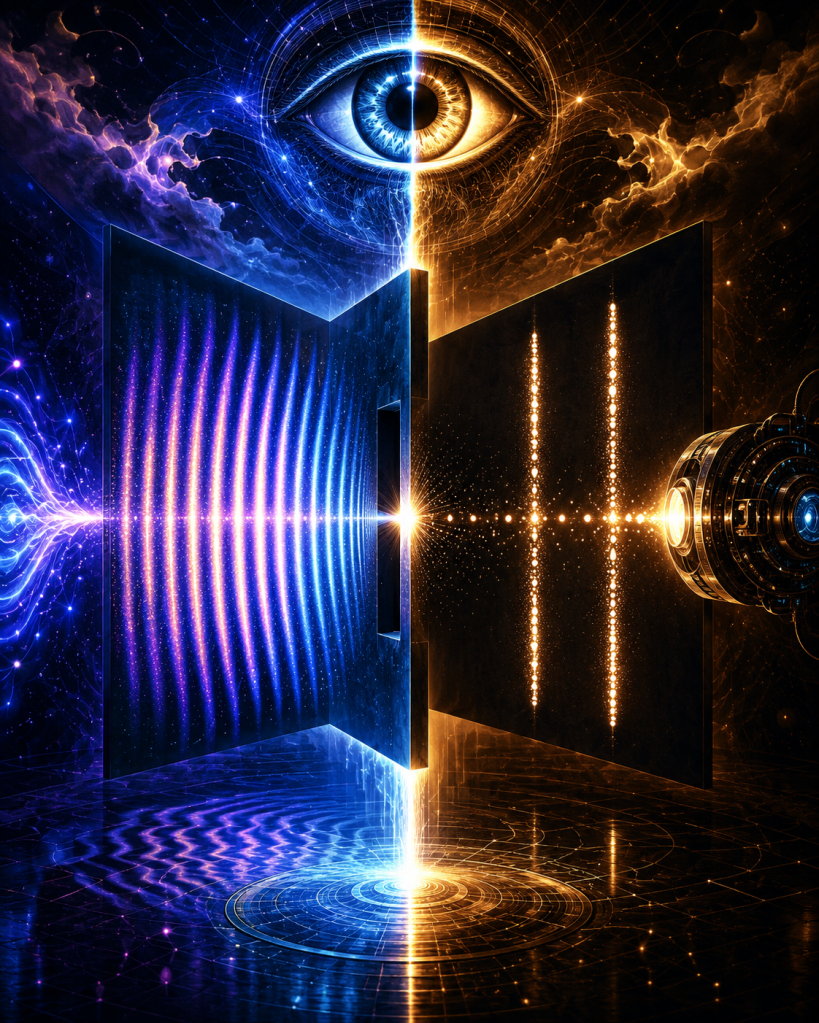
The experiment becomes even more remarkable when scientists attempt to determine which slit each particle passes through.
A detector is placed near the openings.
Its purpose is straightforward: identify the particle’s path.
The result, however, is anything but ordinary.
The interference pattern disappears.
Instead of producing the familiar series of alternating bands, the particles now behave in a way that resembles the classical expectation.
Two slits.
Two bands.
What changed?
Not the barrier.
Not the particles themselves.
What changed was the interaction required to obtain information about the particle’s path.
This point is often misunderstood.
Popular culture sometimes suggests that human consciousness somehow forces reality to change simply by looking at it.
Modern physics does not support that conclusion.
The essential feature is not awareness alone.
It is measurement.
Any measurement capable of revealing information about a quantum system necessarily involves a physical interaction with that system.
That interaction becomes part of the experiment.
Observation, in quantum physics, is therefore not passive.
It is participatory.
Reality Before Measurement
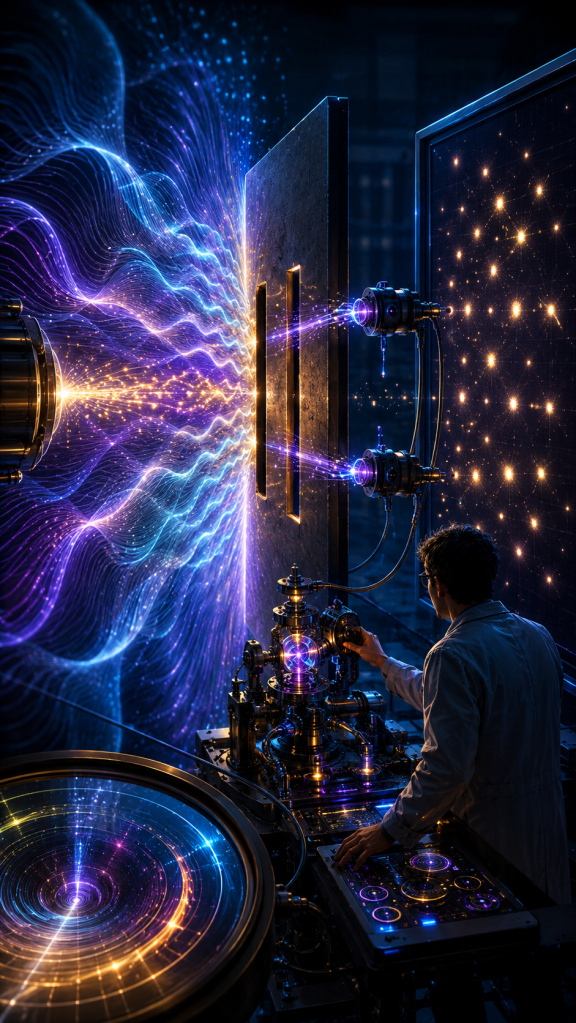
What, then, exists before a measurement takes place?
This is where quantum mechanics becomes both fascinating and deeply philosophical.
Within the traditional Copenhagen interpretation, the quantum state is described as a superposition—a mathematical representation containing multiple possible outcomes.
Only through measurement does one of those possibilities become the definite result we observe.
Other interpretations of quantum mechanics describe this process differently.
Some suggest that every possible outcome continues along separate branches.
Others describe reality as fundamentally relational, with physical properties emerging through interactions between systems.
Although these interpretations disagree about what the mathematics ultimately means, they share an important conclusion.
Measurement occupies a central place in quantum theory.
It is impossible to understand quantum behavior without understanding the relationships through which information becomes available.
Rather than depicting reality as a collection of isolated objects possessing every property independently, quantum physics increasingly presents a universe built upon interactions.
The deeper scientists investigate, the more those relationships appear to matter.
Why Physicists Still Return to the Double-Slit Experiment
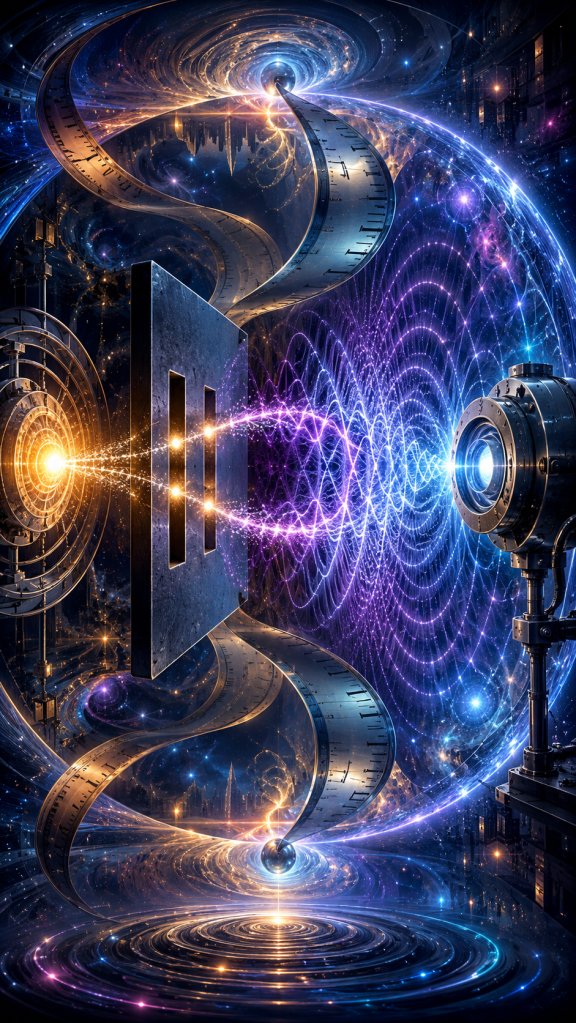
One might assume that an experiment first conceived nearly a century ago would now belong primarily to the history of science.
Instead, the opposite is true.
The double-slit experiment continues to inspire new research because it touches one of the deepest questions in physics:
How does the quantum world give rise to the reality we experience every day?
Modern versions of the experiment are far more sophisticated than the original demonstrations.
Researchers now perform variations using increasingly complex particles, molecules, superconducting circuits, and carefully controlled quantum systems.
Each new experiment probes the delicate boundary between quantum behavior and the familiar classical world.
These investigations have practical consequences as well.
Advances in quantum computing, quantum communication, and quantum information theory all depend upon understanding how quantum systems preserve—or lose—the remarkable properties revealed by experiments like this one.
The double-slit experiment is no longer merely an illustration found in textbooks.
It remains an active doorway into some of the most important scientific questions of the twenty-first century.
Delayed Choice and the Nature of Time
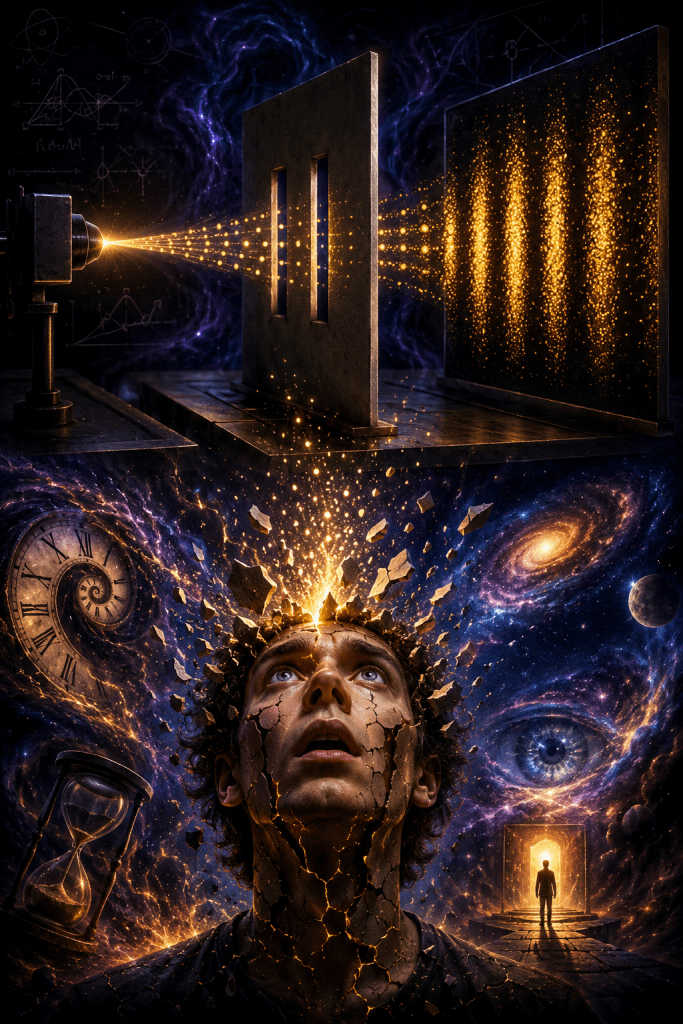
If the double-slit experiment already stretches our intuition, later variations stretch it even further.
Among the most intriguing are delayed-choice experiments, first proposed by the physicist John Archibald Wheeler.
Their design asks an unsettling question.
What happens if the decision about how to measure a particle is made after it has already passed through the slits?
At first glance, the implication seems impossible.
It can sound as though a decision made in the present somehow changes what happened in the past.
That is not how physicists generally interpret these experiments.
No evidence suggests that the past is rewritten or that information travels backward through time.
Instead, delayed-choice experiments challenge a different assumption: that quantum systems possess fully defined properties before measurement in the same way that everyday objects appear to.
The outcome depends on the complete experimental arrangement—including how information is ultimately obtained.
Rather than asking us to imagine the future altering the past, these experiments invite us to reconsider when certain physical properties become well-defined.
That distinction may appear subtle, yet it changes the conversation entirely.
Instead of presenting reality as a sequence of fully settled events waiting to be uncovered, quantum mechanics suggests that interactions play an essential role in determining which outcomes become part of the observable world.
For many people, this is the moment when the discussion shifts from fascinating physics to profound philosophy.
Not because science abandons evidence.
But because evidence itself begins to challenge assumptions that once seemed unquestionable.
From Physics to Perspective
The double-slit experiment does not tell us how to live.
It does not answer questions about consciousness, purpose, or meaning.
Physics is not designed to do those things.
Its remarkable strength lies elsewhere.
It reveals patterns within nature, describes them with extraordinary precision, and allows those descriptions to be tested through experiment.
Yet every great scientific discovery also leaves us with questions that extend beyond measurement.
If reality is fundamentally relational…
If information matters…
If interactions help determine what becomes physically meaningful…
Then it is natural to wonder whether similar principles might help illuminate aspects of human experience.
Not because quantum mechanics directly explains psychology or philosophy.
But because both disciplines are ultimately concerned with relationships.
Physics examines relationships between physical systems.
Human experience explores relationships between memory, perception, expectation, and meaning.
They ask different questions.
Occasionally, they illuminate one another.
From Information to Experience
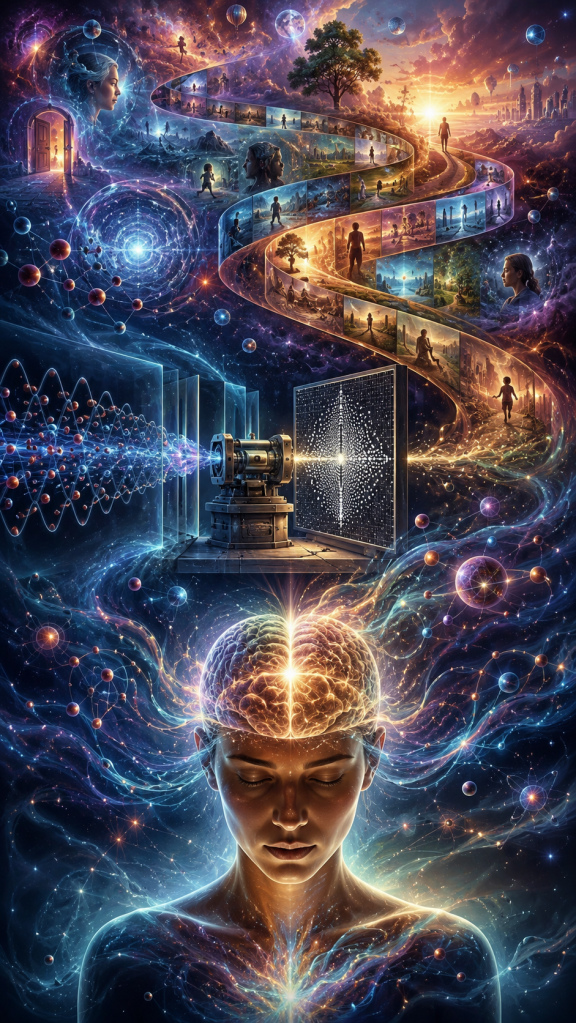
This is where Humans Actuators of Time enters the conversation.
The book does not propose that human consciousness collapses quantum wave functions or overrides the laws of physics.
Its focus is different.
It begins where physics naturally leaves off.
Quantum mechanics describes how measurable interactions produce definite physical outcomes.
Human beings do something equally remarkable at another scale.
We transform those outcomes into experience.
Memory organizes change into a coherent past.
Expectation allows us to imagine possible futures.
Attention determines which moments become significant.
Meaning connects isolated events into the continuous narrative we recognize as a life.
Physics explains how information becomes available.
Human experience transforms information into understanding.
Seen this way, the relationship between physics and philosophy is not one of competition but of complementarity.
One investigates the structure of reality.
The other explores what living within that reality feels like.
A Different Way of Thinking About Time
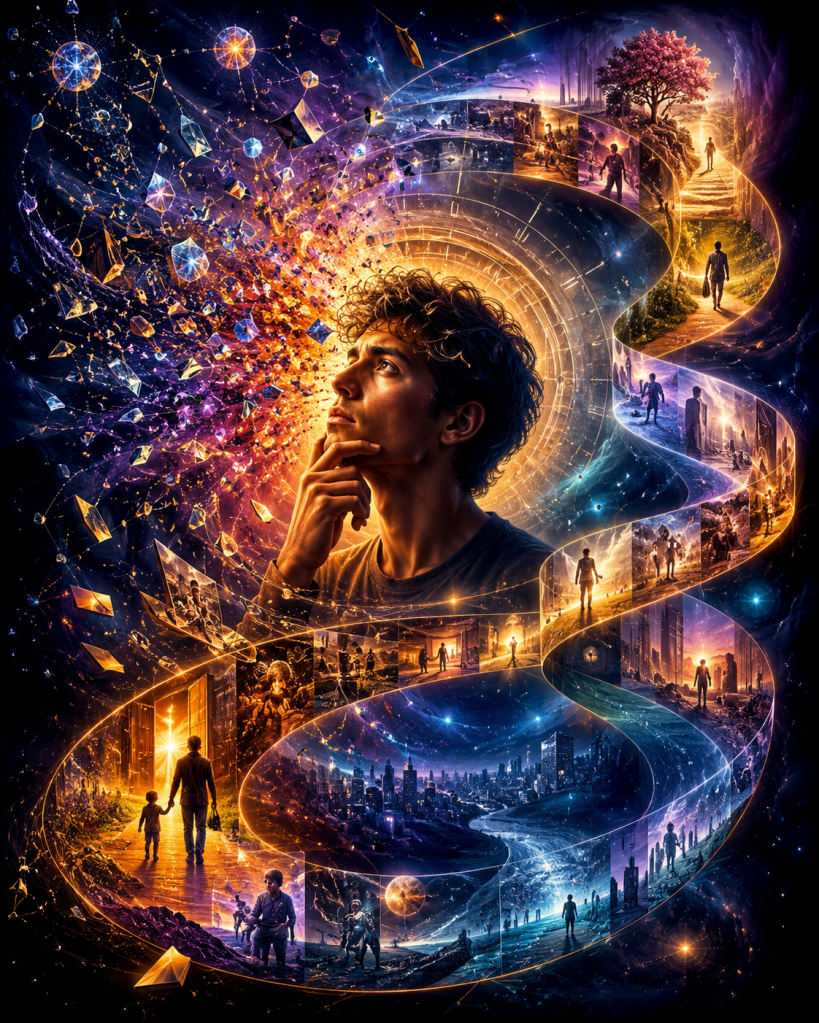
These reflections naturally lead back to one of the central questions explored throughout this series.
What if time is not best understood as a universal river carrying everything forward at the same pace?
Modern physics increasingly describes reality in terms of relationships, interactions, and information rather than a single cosmic clock.
The double-slit experiment reinforces that perspective.
What becomes definite depends upon interaction.
What becomes meaningful depends upon interpretation.
At the human scale, we do not simply experience events.
We remember them.
We compare them.
We anticipate what might come next.
We weave them together into stories that give our lives continuity.
Perhaps this is why lived time feels so different from clock time.
A clock measures intervals.
Human beings organize experience.
The two are related, but they are not identical.
If physics reveals how the universe records change, consciousness reveals how change becomes a lived history.
A Quiet Convergence
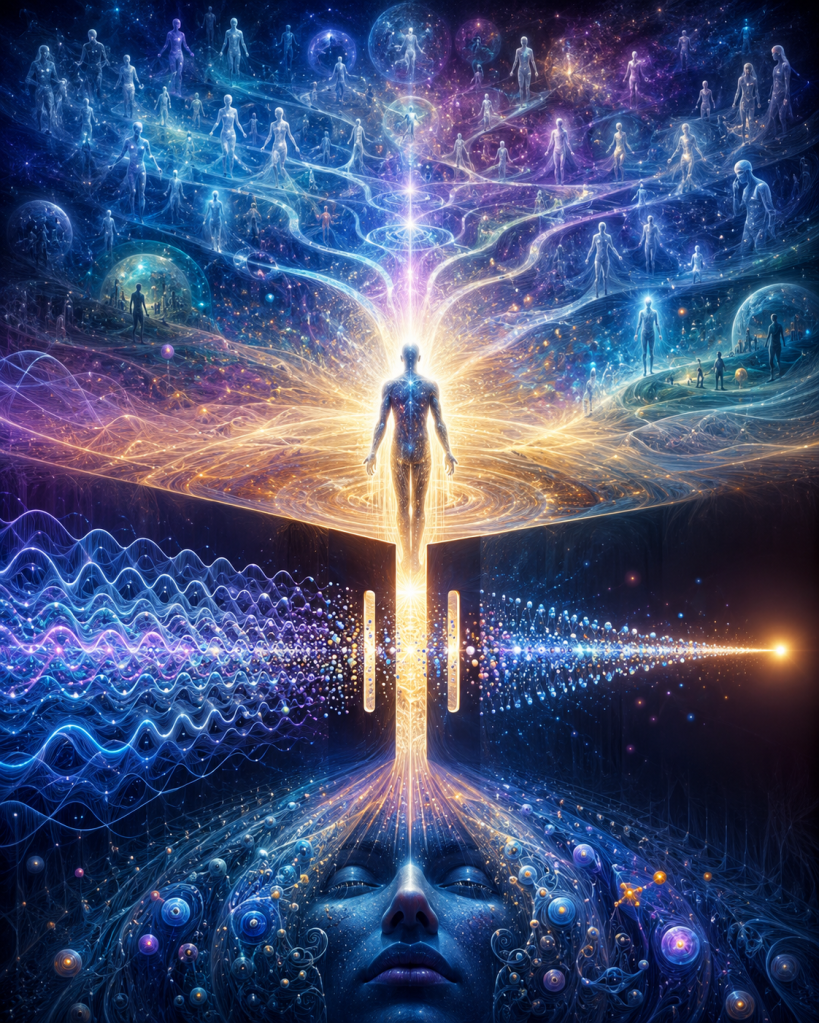
Nearly a century after it first puzzled physicists, the double-slit experiment continues to invite new questions.
Not because it has failed to provide answers.
But because every answer seems to reveal a deeper layer beneath it.
The experiment reminds us that the universe is often less like a machine operating according to familiar expectations and more like a network of relationships unfolding through interaction.
Measurement matters.
Information matters.
Context matters.
The deeper science explores reality, the less convincing the image of detached observation becomes.
Instead, we discover participation.
Not mystical participation.
Not the idea that human thought alone creates the universe.
Rather, the recognition that understanding always emerges through relationships—between systems, between observers and measurements, between information and interpretation.
Perhaps that is the experiment’s most enduring lesson.
Reality may not simply wait to be seen.
It becomes knowable through the interactions that allow the universe to reveal itself.
And while physics continues to uncover how those interactions shape the physical world, human experience transforms them into memory, meaning, and the unfolding story we call time.
From the Publisher
Few scientific experiments have generated as much discussion as the double-slit experiment—not simply because of what it reveals about quantum physics, but because of the questions it raises about the nature of reality itself.
For generations, it has challenged assumptions that once seemed beyond doubt, inviting both scientists and philosophers to rethink what it means to observe, to measure, and to know.
This is one reason JJ Simon’s work continues to resonate with readers who enjoy exploring the space where scientific discovery meets human experience.
Rather than treating quantum physics as a source of mystical conclusions, he approaches it as an invitation to think more deeply about perception, memory, meaning, and the ways we organize our experience of the world.
As this series moves beyond the foundations of quantum mechanics and into broader questions about consciousness and reality, one theme continues to emerge:
The universe may be far more relational than it first appears.
And understanding those relationships may ultimately reveal as much about ourselves as it does about the cosmos.
Continue the Exploration
If this essay sparked new questions about time, consciousness, and the nature of reality, you may also enjoy other essays in the Time, Consciousness, and New Science blog series or JJ Simon’s companion video reflections.
The JJ Simon — Consciousness, Reality & Deep Thought playlist expands on many of the themes explored throughout these essays, combining philosophy, science, psychology, and visual storytelling into short, thought-provoking experiences designed to inspire deeper reflection.
Whether you’re encountering these ideas for the first time or continuing your exploration of Humans Actuators of Time, the videos offer another way to engage with questions that challenge our assumptions about time, perception, meaning, and human experience.
Watch the playlist here:

Leave a comment