
How Awareness, Memory, and Information Could Explain Why Time Moves Forward
Series: Time, Consciousness, and New Science
By JJ Simon — Perspectives with JJ Simon
author of Humans Actuators of Time
Reading Time: approx. 13 minutes
There is a question that has lingered in both science and philosophy for centuries, hiding in plain sight within the ordinary rhythm of everyday life.
Why does time seem to move in only one direction?
We remember yesterday but never tomorrow.
We watch children become adults, but never the reverse.
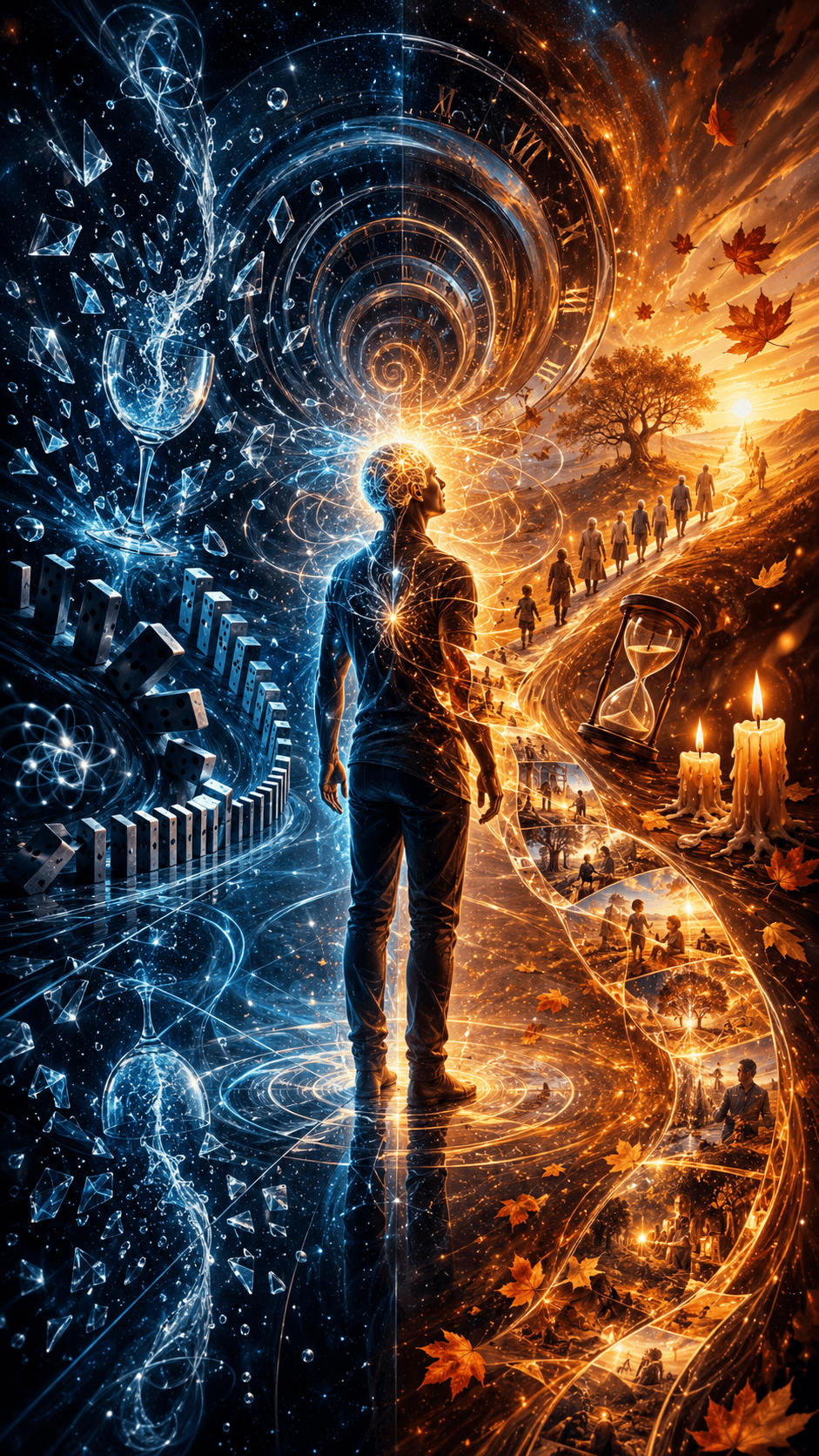
A glass can fall from a table and shatter across the floor, yet no one has ever watched the fragments spontaneously leap back together.
Everything about our experience suggests that time has a preferred direction. Life unfolds from past to future with such consistency that we rarely stop to question it.
Yet modern physics tells a surprisingly different story.
At the deepest level, many of the equations that describe the universe make little distinction between forward and backward time. Reverse the mathematics, and they often remain just as valid. The microscopic laws governing particles and forces do not seem to contain an inherent preference for yesterday over tomorrow.
Somewhere between the elegant symmetry of physics and the unmistakable asymmetry of human experience, something changes.
Understanding where that change occurs may reveal not only why time appears to flow, but also why conscious beings experience the universe so differently from the equations that describe it.
The Puzzle of Time’s Direction
The mystery known as the arrow of time is not really about clocks.
It is about direction.
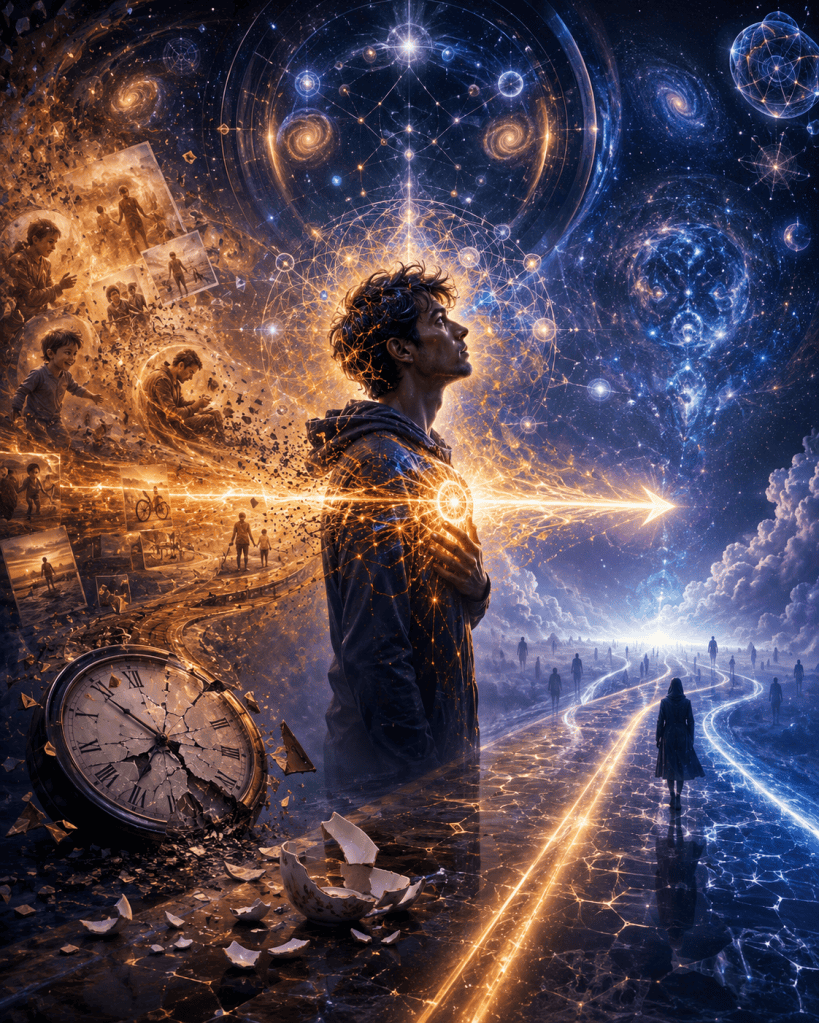
A clock can measure duration, but it cannot explain why events seem to unfold in only one order. It cannot tell us why memories point toward the past, why causes precede effects, or why we instinctively distinguish what has already happened from what has not.
This distinction feels so obvious that it is easy to assume it must be built into the fabric of reality itself.
But the more physicists investigate the foundations of nature, the less obvious that assumption becomes.
Imagine watching a recording of two billiard balls colliding. If the video were played backward, it might be difficult to tell which version was correct. At the microscopic level, many interactions appear equally plausible whether viewed forward or in reverse.
Now imagine watching a shattered vase reassemble itself from thousands of scattered fragments.
Immediately, something feels wrong.
The mathematics governing individual particles may be reversible, but the world we inhabit clearly is not.
The question is why.
What bridges the gap between reversible physical laws and irreversible lived experience?
Why Physics Doesn’t Prefer a Direction

One of the most surprising discoveries in modern physics is that many of its fundamental laws are time-symmetric.
Whether describing gravity, electromagnetism, or many quantum interactions, the underlying equations often function perfectly well regardless of which direction time is assumed to move.
This does not mean that everything in nature can literally run backward.
Rather, it means the laws themselves do not specify which direction should count as “forward.”
If all you possessed were the equations—and no experience of the universe—you might have no obvious reason to distinguish past from future.
For generations, this realization puzzled physicists.
If the universe’s deepest rules are largely indifferent to temporal direction, why does reality appear so decisively one-way?
Why do stars age?
Why do living organisms grow older?
Why do memories accumulate instead of disappearing?
Clearly something introduces asymmetry into a universe whose fundamental mathematics often remains beautifully balanced.
That search leads naturally to one of the most important ideas in all of physics.
Entropy.
Entropy and the Thermodynamic Arrow

The traditional scientific explanation for time’s direction comes from the Second Law of Thermodynamics.
Simply stated, entropy tends to increase.
Although entropy is often described as “disorder,” that shorthand can be misleading. A better way to think about it is as the number of possible arrangements available to a system.
Highly ordered states have relatively few possible arrangements.
Disordered states have many.
Nature naturally moves toward the overwhelmingly larger number of possible configurations.
This is why cream mixes into coffee instead of separating itself again.
Why smoke disperses rather than returning neatly to a chimney.
Why an ice cube melts in a warm room but never spontaneously reforms.
None of these events violate the fundamental equations of physics.
They simply reflect what is statistically most likely.
Entropy gives physical processes a preferred direction.
The universe continually evolves from less probable arrangements toward more probable ones.
This statistical tendency creates what physicists call the thermodynamic arrow of time.
For many scientific purposes, this explanation is remarkably successful.
It accounts for countless irreversible processes observed throughout nature.
Yet an important question remains.
Entropy explains why physical systems evolve in one direction.
It does not fully explain why conscious beings experience that direction.
Beyond Entropy: The Arrow Written in Information
Over the past several decades, another perspective has become increasingly influential.
Perhaps the arrow of time is not simply about disorder.
Perhaps it is equally about information.
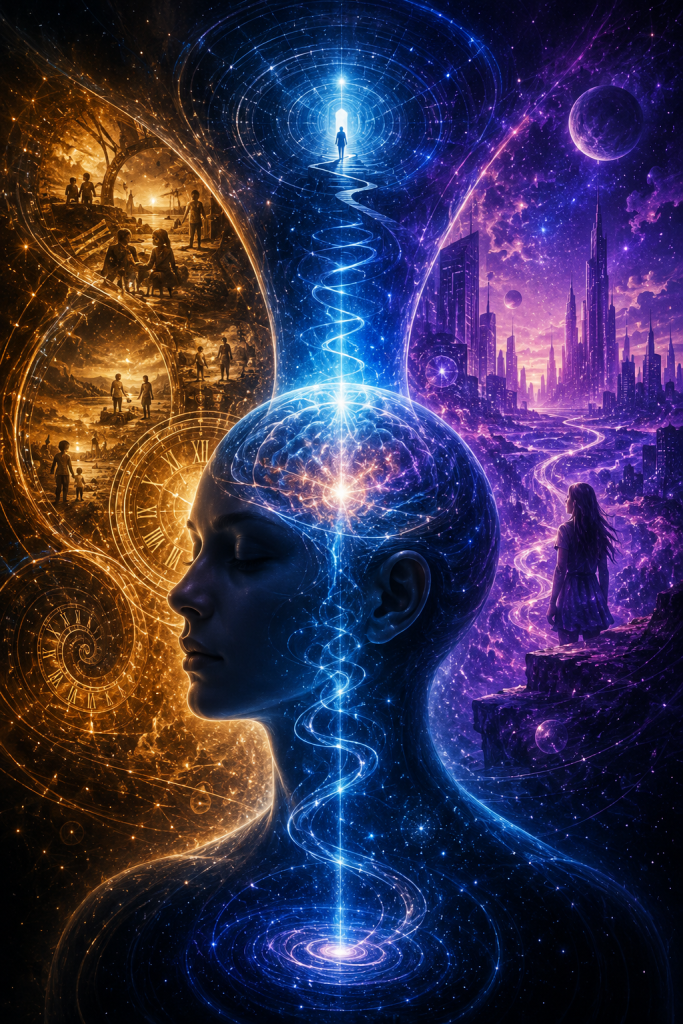
Every interaction within the universe leaves traces.
Light reflects from objects.
Atoms collide.
Particles become entangled.
Chemical reactions alter their surroundings.
Every event changes something else.
In doing so, it leaves behind information about what occurred.
These informational records accumulate continuously.
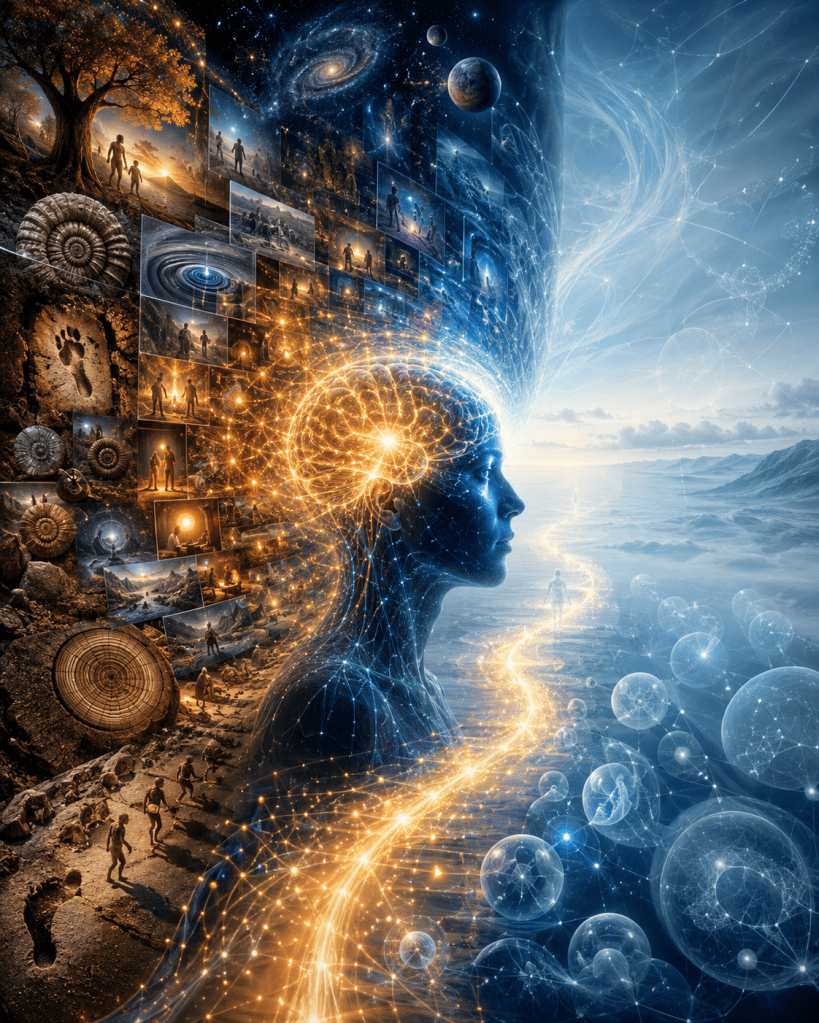
A footprint pressed into wet sand.
The rings inside an ancient tree.
Light arriving from a distant galaxy after traveling millions of years through space.
The neural connections formed after learning a new skill.
Each represents information carried forward from earlier events.
The past leaves records.
The future does not.
That simple observation introduces an entirely different way of thinking about temporal direction.
Perhaps time feels irreversible because information itself accumulates irreversibly.
Instead of imagining time as a river carrying events forward, we might think of reality as continuously writing its own history.
Every interaction adds another page.
None can simply be unwritten.
Memory: Where Physics Becomes Experience
This brings us to the place where physics meets consciousness.
Information alone is not enough.
A universe filled with records is not yet a universe filled with experience.
Some system must be capable of interpreting those records.
Human memory performs precisely this role.
Every memory represents information preserved from earlier interactions.
The conversation you had yesterday.
The face of someone you love.
The smell of rain after a summer storm.
The lesson learned through failure.
Each memory is a physical record encoded within an astonishingly complex biological system.
Without those records, the distinction between past and present would largely disappear.
The world would become a succession of disconnected moments with no continuity linking one experience to the next.
Memory does something extraordinary.
It transforms physical information into personal history.
And in doing so, it gives direction to experience itself.
The Psychological Arrow of Time
If entropy provides the physical direction of change, and information provides the records that preserve it, consciousness contributes something equally important.
It transforms those records into a lived experience.
Our awareness is not simply a passive camera recording reality frame by frame. The brain is constantly integrating memory, sensory input, and expectation into a seamless experience we call the present.
This process happens so effortlessly that we rarely notice it.
Yet it is one of the most remarkable achievements of consciousness.
Every moment, the brain compares incoming information with what it has already learned. It predicts what is likely to happen next, updates those predictions as new information arrives, and continually rewrites its understanding of the world.
The result is not merely awareness.
It is continuity.
Without this ongoing integration, life would feel like isolated flashes rather than a coherent journey.
Consciousness gives experience its narrative structure.
The Mystery of “Now”
One of the most intriguing consequences of modern physics is that it offers surprisingly little support for the idea of a universal present.
Einstein’s theory of relativity demonstrated that observers moving differently or experiencing different gravitational conditions can disagree about which distant events are happening “now.” There is no single cosmic clock keeping the same time for every observer.
From the perspective of physics, the present moment is not a universal feature built into the fabric of the universe.
Yet each of us experiences a vivid and unmistakable now.
How can both statements be true?
Neuroscience offers an intriguing possibility.
Rather than detecting an objective present, the brain appears to construct one. It continuously gathers sensory information, combines it with stored memories, and generates expectations about what comes next. This integration creates the feeling of an unfolding present even though the underlying physical processes are distributed across countless interactions.
In other words, the “now” we experience may be less like a point moving through time and more like an ongoing act of organization.
The present is where perception, memory, and anticipation meet.
From Information to Experience
This distinction is easy to overlook, yet it may be one of the most important in understanding time.
A rock records information.
The grooves worn by flowing water preserve a history of erosion.
Tree rings preserve years of changing climate.
Ancient starlight carries information across millions of years before reaching our telescopes.
None of these records, however, experience their own histories.
They preserve information.
They do not interpret it.
Consciousness does something fundamentally different.
It not only records change but also relates one event to another. It recognizes patterns, identifies causes, anticipates consequences, and places individual moments within an unfolding narrative.
Information becomes meaning.
Meaning becomes experience.
Experience becomes the temporal continuity we call a life.
Perhaps this is why time feels as though it moves.
Not because consciousness pushes the universe forward, but because awareness continually transforms accumulated information into an organized story.
A Different Perspective on the Arrow of Time

Taken together, these ideas suggest a richer picture than any single explanation provides.
Entropy gives physical processes a preferred statistical direction.
Information preserves the traces of those processes.
Consciousness transforms those traces into memory, expectation, and meaning.
Each layer builds upon the one before it.
None replaces the others.
This perspective avoids a false choice between physics and human experience. It does not suggest that consciousness creates the laws of nature, nor does it reduce our experience of time to mere illusion.
Instead, it recognizes that different questions require different kinds of explanations.
Physics explains why change occurs.
Information explains how change is preserved.
Consciousness explains how preserved change becomes lived experience.
The arrow of time may therefore be understood not as a single phenomenon, but as several interconnected processes operating across different levels of reality.
A Quiet Convergence

Many of the ideas explored throughout this series gradually point toward the same conclusion.
Relativity challenged the notion of a universal “now.”
Quantum physics suggested that relationships and interactions matter more than isolated objects.
Information theory revealed that every interaction leaves traces.
Neuroscience continues to show that our experience of time emerges through memory, perception, and prediction.
None of these discoveries, taken alone, fully explains why life feels as though it moves steadily from past to future.
Together, however, they begin to reveal a remarkable pattern.
The universe provides change.
Information preserves it.
Consciousness gives it continuity.
This perspective also offers a thoughtful way to understand the central ideas explored in Humans Actuators of Time. Rather than proposing that people create physical time itself, the book asks a different question: what role do conscious beings play in transforming change into meaningful experience? Through memory, attention, choice, and interpretation, we participate in organizing the events of our lives into the narratives that define who we are.
Whether future discoveries ultimately confirm or revise this picture remains an open question.
Science advances by continually refining its understanding.
Yet one insight already seems difficult to ignore.
The arrow of time may not belong exclusively to physics.
It may also emerge wherever change is remembered, interpreted, and woven into the continuous experience of a conscious life.
From the Publisher
Few scientific questions are as universally familiar—or as deeply mysterious—as the simple feeling that time moves forward.
Every person remembers the past, experiences the present, and imagines the future. Yet when physics examines the universe at its most fundamental level, that familiar flow becomes far less obvious.
What makes JJ Simon’s work distinctive is not that it attempts to replace scientific explanations, but that it explores what they might mean when viewed through the lens of human experience.
Entropy explains why physical systems evolve.
Information explains how those changes leave lasting traces.
But somewhere between those traces and the stories we tell about our lives lies another remarkable phenomenon: consciousness.
It is here that physics, neuroscience, and philosophy begin to overlap in unexpected ways.
Perhaps understanding time requires more than studying clocks or equations.
Perhaps it also requires understanding the beings who remember, anticipate, and find meaning within change itself.
As this series continues, the conversation moves even deeper into questions about consciousness, reality, and the foundations of existence—always with the same spirit of curiosity that has guided scientific discovery for centuries.
Continue the Exploration
If this essay sparked new questions about time, consciousness, and the nature of reality, you may also enjoy other essays in the Time, Consciousness, and New Science blog series or JJ Simon’s companion video reflections.
The JJ Simon — Consciousness, Reality & Deep Thought playlist expands on many of the themes explored throughout these essays, combining philosophy, science, psychology, and visual storytelling into short, thought-provoking experiences designed to inspire deeper reflection.
Whether you’re encountering these ideas for the first time or continuing your exploration of Humans Actuators of Time, the videos offer another way to engage with questions that challenge our assumptions about time, perception, meaning, and human experience.
Watch the playlist here:

Leave a comment