
Reading Time: approx. 4 minutes
Last week, we began October by considering how change can interrupt familiarity and make us notice things we had stopped seeing.
But some changes are easier to observe than others.
An ending rarely feels neutral.
When something we cared about comes to a close—a relationship, a job, a plan, a season of life, even a version of ourselves—we often feel pressure to decide what the ending means.
Did it work?
Was it worth it?
Did I make the wrong choice?
Did I fail?
Sometimes those questions are useful. But perhaps an ending does not always need to become a verdict on everything that came before it.
We Often Judge by the Final Scene
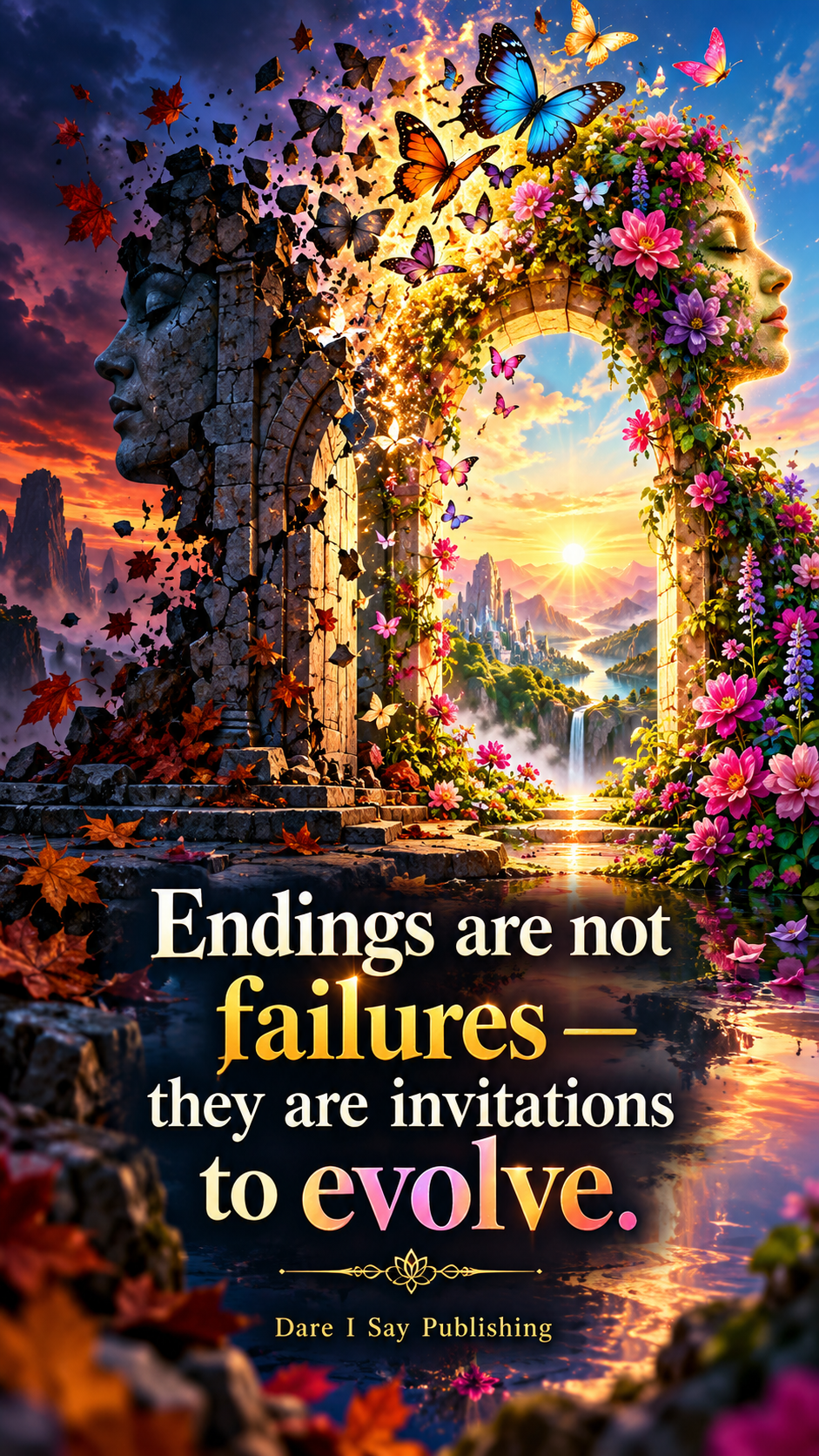
“Endings are not failures—they are invitations to evolve.”
There is something tempting about evaluating an experience by how it ended.
A relationship that lasts may be called successful, while one that ends may be called a failure. A career change can make the years spent on a previous path feel wasted. A goal we eventually release may cause us to question why we pursued it at all.
But life is rarely that tidy.
Something can end and still have mattered.
A friendship may have been meaningful even if two people eventually grow apart. A project may teach us something even if it never becomes what we imagined. A direction that no longer fits may still have carried us somewhere important.
The ending is part of the story.
It is not necessarily the measure of the whole story.
Completion and Failure Are Not the Same Thing
Of course, some things do fail.
Plans can be poorly chosen. Relationships can become unhealthy. Decisions can have consequences we wish we had avoided.
Reframing endings does not mean refusing to learn from mistakes or pretending every loss was secretly wonderful.
It simply gives us more possibilities than “it continued, therefore it succeeded” and “it ended, therefore it failed.”
Some things are meant to be completed rather than preserved indefinitely.
Sometimes we change.
Sometimes circumstances change.
Sometimes continuing would require us to remain loyal to a version of life we no longer recognize as our own.
An ending may contain disappointment and still be appropriate.
It may contain grief and still create room for something different.
What We Carry Forward
Perhaps one of the more useful questions after an ending is not only:
Why did this end?
But also:
What remains because it happened?
Maybe we carry forward a skill.
A clearer boundary.
A memory.
A better understanding of what we value.
A lesson we would not have chosen to learn but now possess nonetheless.
Or perhaps what remains is simply the knowledge that something has run its course.
We do not have to transform every ending into an inspirational lesson. Sometimes acknowledging the loss is enough.
But we also do not have to let the fact that something ended erase everything it gave us while it was here.
A Question for You…
Have you ever looked back on something that ended and realized it was more meaningful than you initially gave it credit for?
How do you distinguish between something that truly failed and something that simply reached its natural end?
If you feel comfortable, share your thoughts in the comments below.
Your experience may offer someone else a perspective they haven’t considered yet.
Explore More Friday Inspiration
We also share short visual reflections through our growing collection of YouTube Shorts—brief, thought-provoking reminders designed to encourage reflection, perspective, and personal growth.
You can also explore our complete Friday Inspiration collection, where each week offers a fresh perspective on living with greater awareness, authenticity, and intention.
Read more Friday Inspiration posts
Final Thoughts
Endings can hurt precisely because something mattered.
But perhaps we do ourselves a disservice when we allow the final moment to rewrite everything that came before it.
An ending may close one version of the story without declaring the entire story a mistake.
And once we stop treating every ending as something that must be defeated, avoided, or reversed, another question begins to appear:
What might happen if we stopped gripping so tightly to what is already changing?
Next week, we will explore the difference between giving up and surrendering our need to control what comes next.
Leave a Reply