
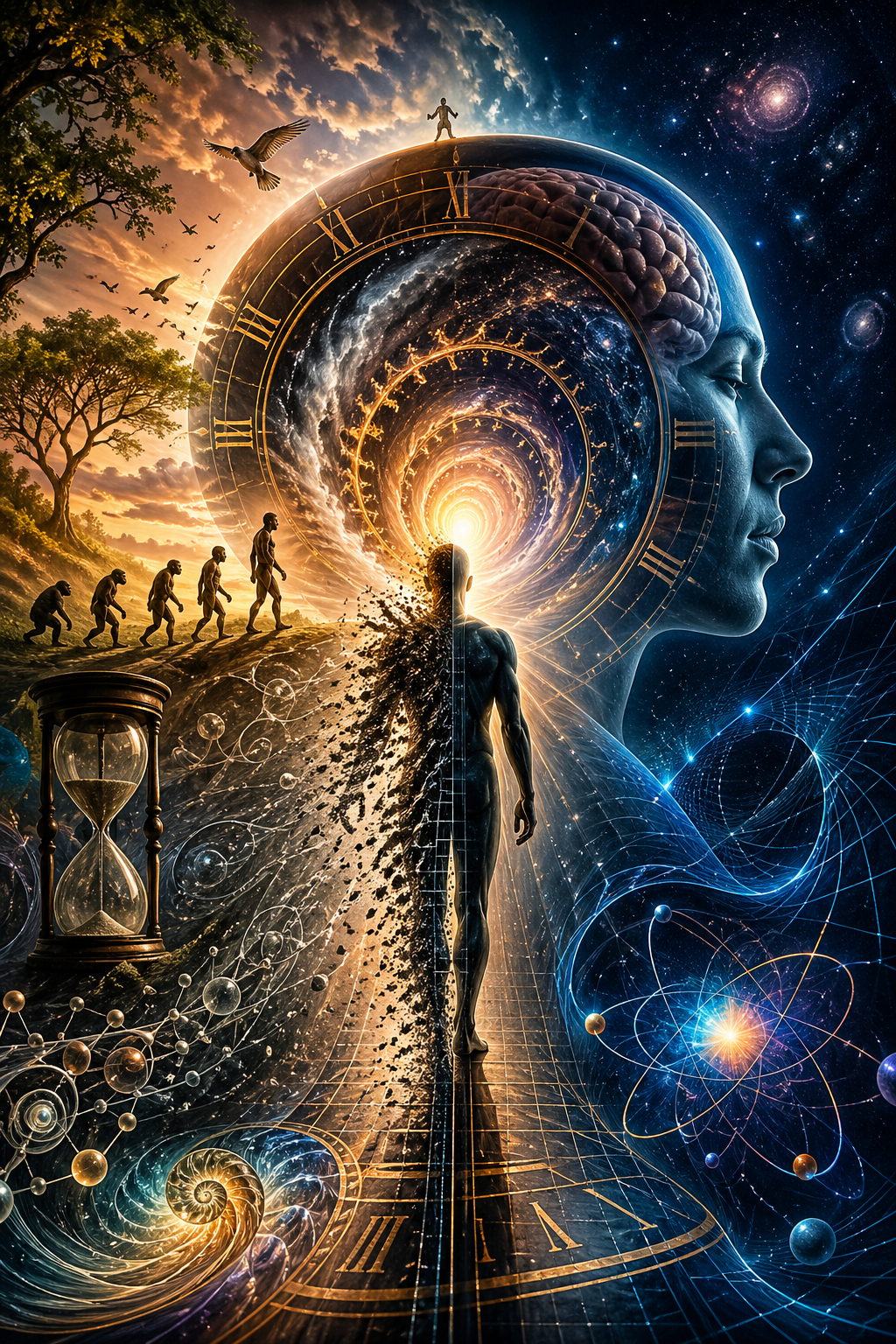
What Physics, Biology, and Human Experience Reveal About Time
Series: Time, Consciousness, and New Science
By JJ Simon — Perspectives with JJ Simon
author of Humans Actuators of Time
Reading Time: approx. 8 minutes
There are questions that feel philosophical.
And then there are questions that quietly destabilize everything you thought was certain.
This is one of them.
I remember the moment it first stopped me—not as a passing curiosity, but as a rupture in how I understood reality:
Does time actually exist at all?
Not “what time is it?”
Not “how much time do we have?”
But something far more unsettling:
Is time something real… or something we construct?
We live as if time is undeniable. We organize our lives around it. We measure it, plan with it, fear losing it. It feels constant, external, and unquestionable.
Yet when science begins to examine time closely, something unexpected happens:
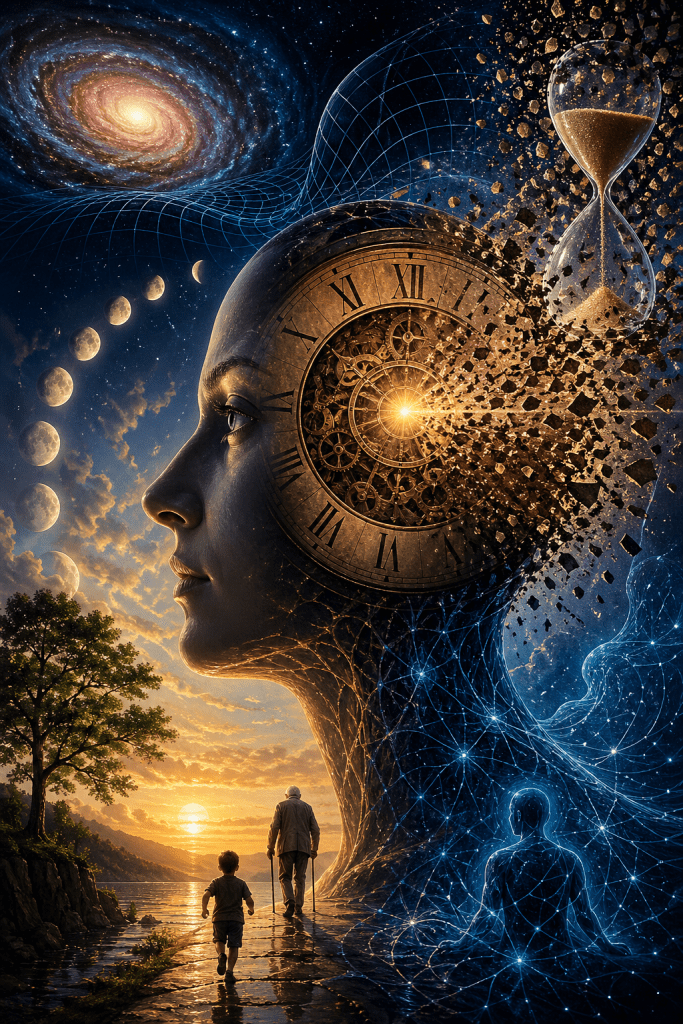
It begins to dissolve.
What emerges is not a clean answer, but a deeper, more precise realization:
Time is not a single thing.
It is layered—physical, biological, and psychological—and it only becomes fully meaningful when awareness encounters change.
This is where the ground begins to shift.
Time in Physics: A Dimension Without Flow
In everyday experience, time feels like movement.
A steady current carrying everything forward.
But physics does not describe time as something that flows.
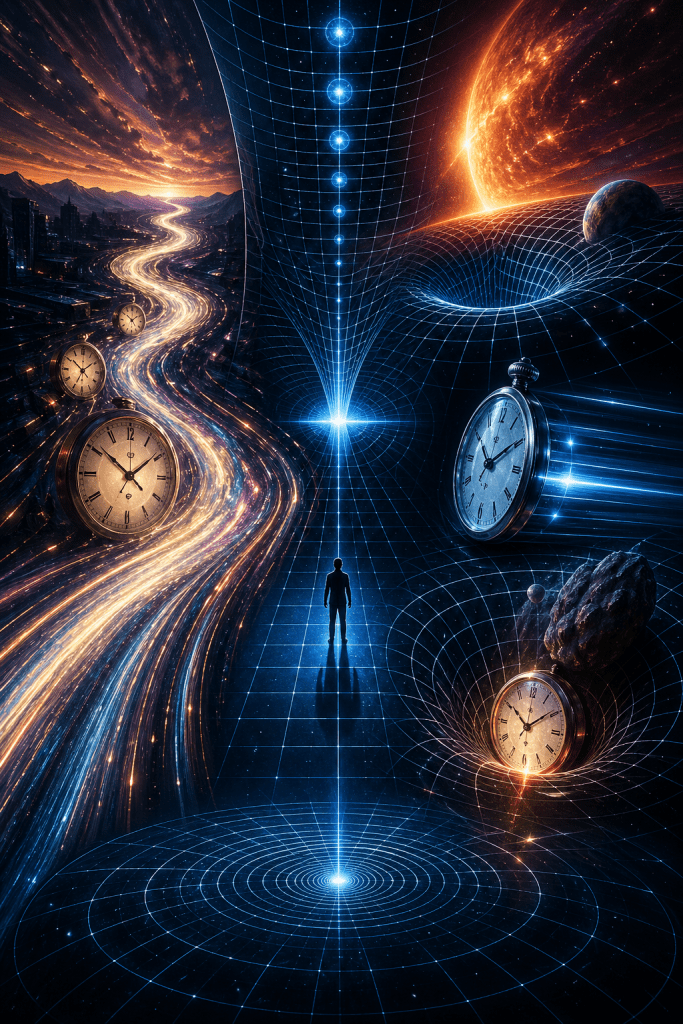
In the framework of Einstein’s Theory of Relativity, time is not a river—it is a dimension.
It exists alongside space, forming what physicists call spacetime: a four-dimensional structure in which events are positioned.
Within this structure:
- Time is not universal
- Its rate depends on motion and gravity
- Different observers can measure different durations between the same events
A clock traveling at high velocity ticks more slowly relative to one at rest. A clock near a massive object ticks more slowly than one farther away.
These are not perceptual quirks.
They are measurable, repeatable features of reality.
From this perspective, time does not “pass” in the way we feel it does.
It functions more like a coordinate—a way of organizing events.
Which raises an uncomfortable possibility:
What we experience as the flow of time may not exist at the fundamental level of reality.
Clocks Measure Change — They Do Not Explain Time
Clocks feel authoritative.
They give time precision, structure, and consistency.
But what do they actually measure?
Not time itself.
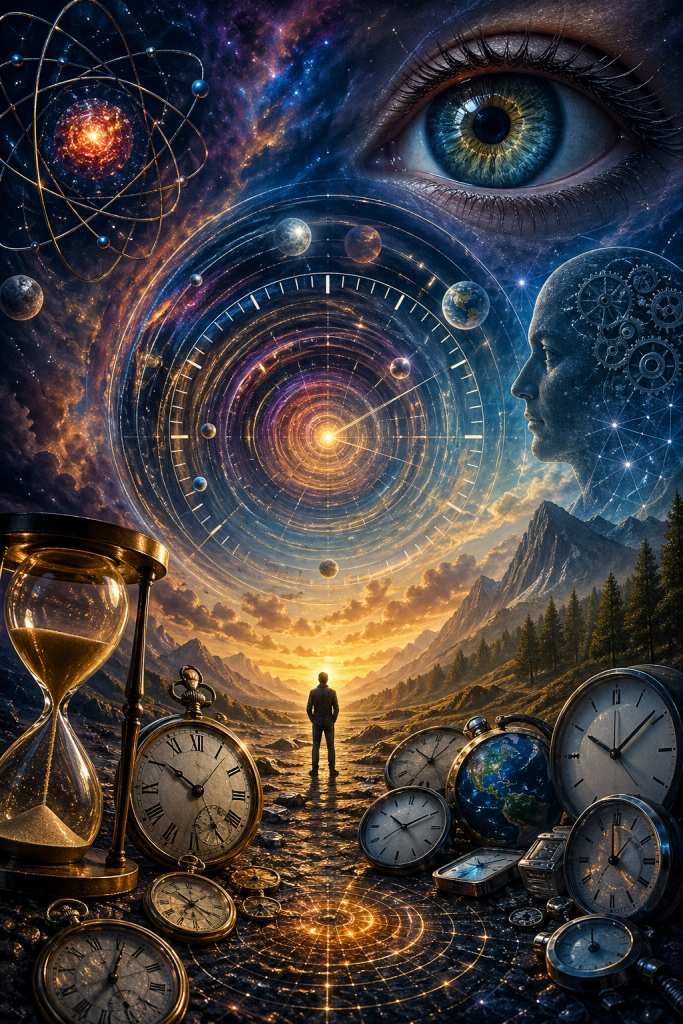
Clocks measure repetition.
- The vibration of atoms
- The oscillation of quartz crystals
- The rotation of the Earth
They count cycles and define intervals.
But they do not explain what time is.
A clock can tell you that something lasted five minutes.
It cannot tell you why those five minutes felt endless—or why they disappeared instantly.
Time does not emerge from clocks.
Clocks emerge from our need to standardize change.
And that distinction matters more than it first appears.
The Arrow of Time: Direction Without Experience
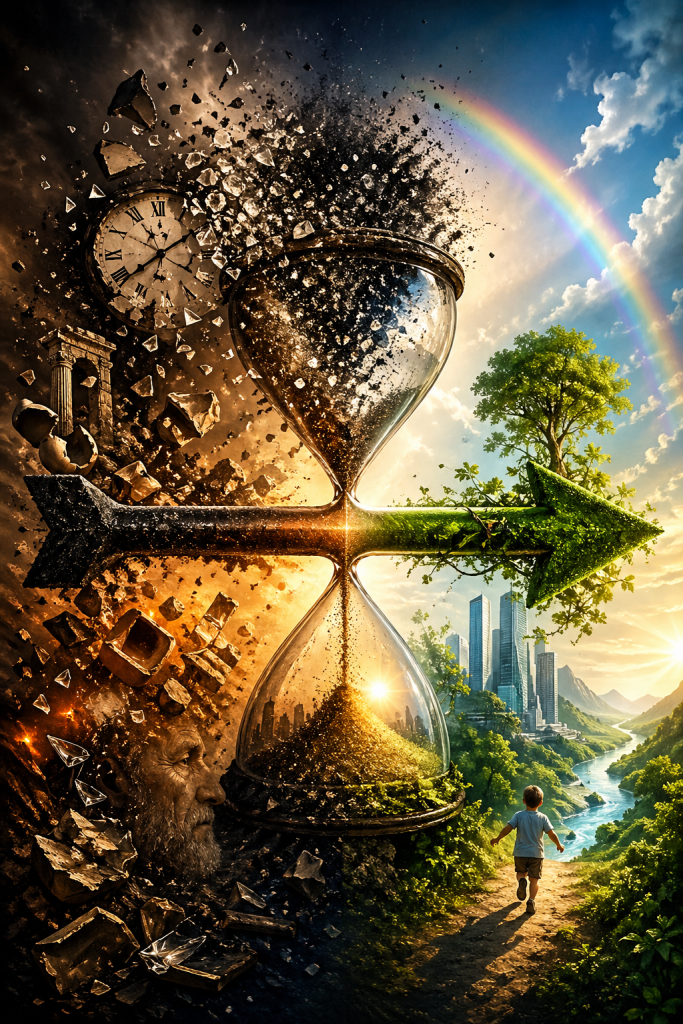
One of the most undeniable features of time is its direction.
We remember the past.
We do not remember the future.
Things fall apart, but they do not spontaneously reassemble.
This asymmetry is often explained through Entropy.
According to the second law of thermodynamics:
Closed systems tend toward more probable, disordered states.
This statistical tendency gives rise to what we call the arrow of time.
It explains why processes appear irreversible.
Why cause precedes effect.
Why the past feels fixed and the future open.
But there is a limit to what this explains.
Entropy accounts for direction.
It does not account for experience.
It does not explain why time feels like something.
Biological Time: The Body as a Temporal System

If physics describes time abstractly, biology brings it closer to experience.
Living systems do not simply exist in time.
They regulate themselves through it.
Biological time includes:
- Circadian rhythms that govern sleep and wake cycles
- Neural processes that encode and retrieve memory
- Attention systems that stretch or compress perceived duration
- Emotional states that distort temporal experience
A moment of danger can feel prolonged.
An hour of deep engagement can vanish without trace.
The clock records identical seconds.
The organism does not experience them equally.
This reveals something critical:
Time, as lived, is not purely external.
It is shaped by the structure and activity of living systems, and experienced internally.
The Present Moment: A Moving Construction
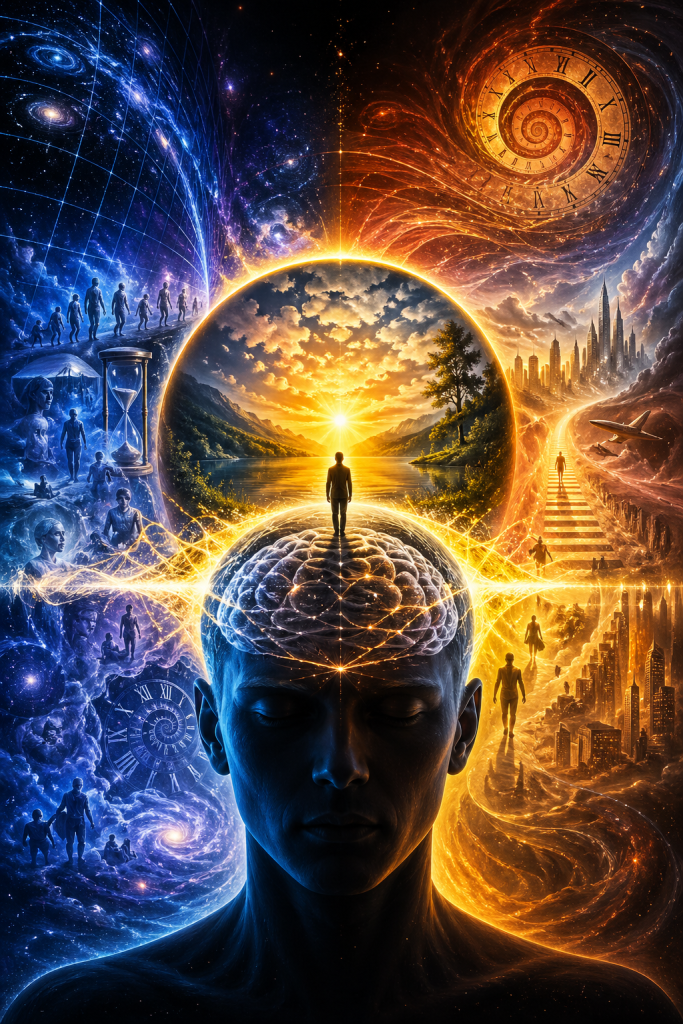
We tend to assume that the present moment is real in a fundamental sense.
That “now” is something objective.
Physics offers no such guarantee.
In spacetime, there is no privileged present.
Past, present, and future exist within the same structure.
Yet human experience is anchored entirely in now.
This “now” is not discovered.
It is constructed.
The brain continuously integrates:
- Incoming sensory information
- Stored memory
- Anticipation of what comes next
From this integration, it creates a moving window of awareness.
That window is what we call the present moment.
Without it, there would be no felt flow of time.
Only a static ordering of events.
Humans as Actuators of Time
This is where the inquiry becomes more than scientific.
It becomes personal.
One of the central insights explored in Humans Actuators of Time is this:
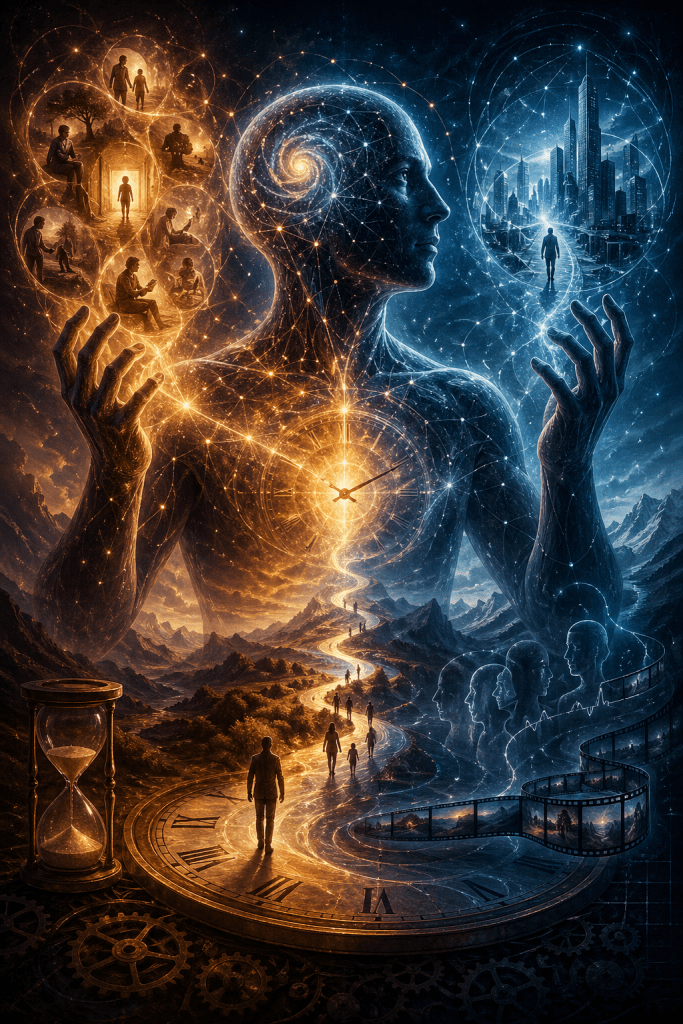
Human beings do not simply observe time.
They participate in bringing it into meaningful existence.
We do this constantly:
- We convert experience into memory
- We project ourselves into imagined futures
- We build narratives that connect what was, what is, and what might be
- We assign emotional significance to moments
Without these processes, time would remain a neutral structure.
An ordering of events without meaning.
Human awareness transforms it.
It gives time texture.
Depth.
Weight.
Story.
The Many Layers of Time
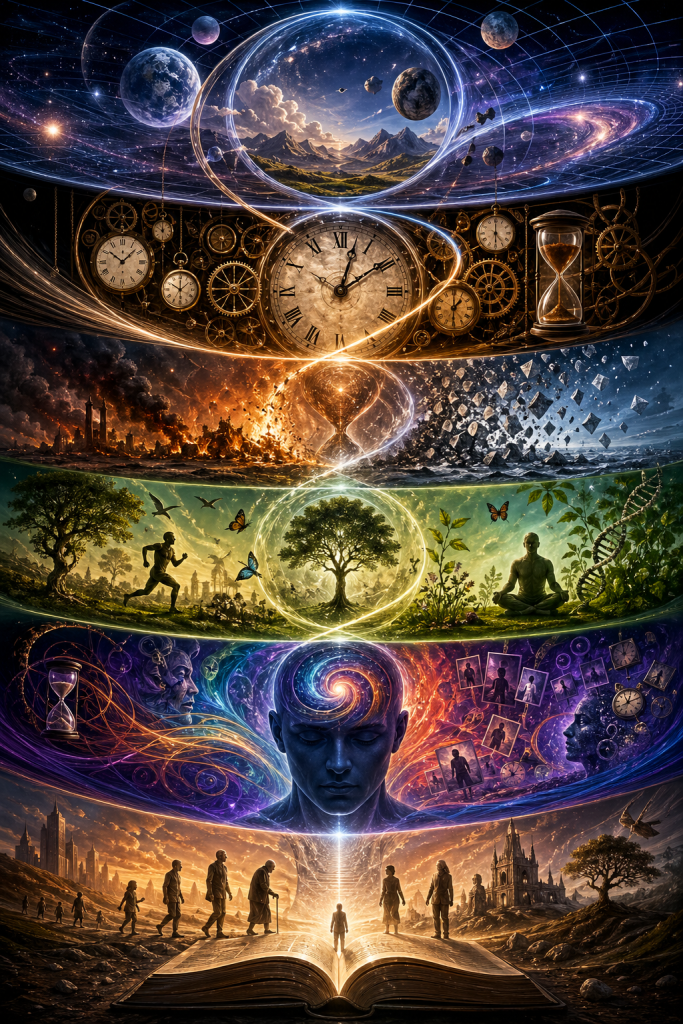
To understand time more clearly, it helps to stop treating it as a single phenomenon.
Instead, it can be seen as a convergence of layers:
- Physical time organizes events in spacetime
- Measured time standardizes intervals through clocks
- Directional time emerges from entropy and irreversibility
- Biological time regulates living systems
- Psychological time arises through perception and memory
- Narrative time develops through meaning and identity
Each of these is real.
Each captures a different aspect of what we call time.
None alone is sufficient.
Together, they reveal something far more complex than a simple flowing entity.
Why This Question Changes Everything
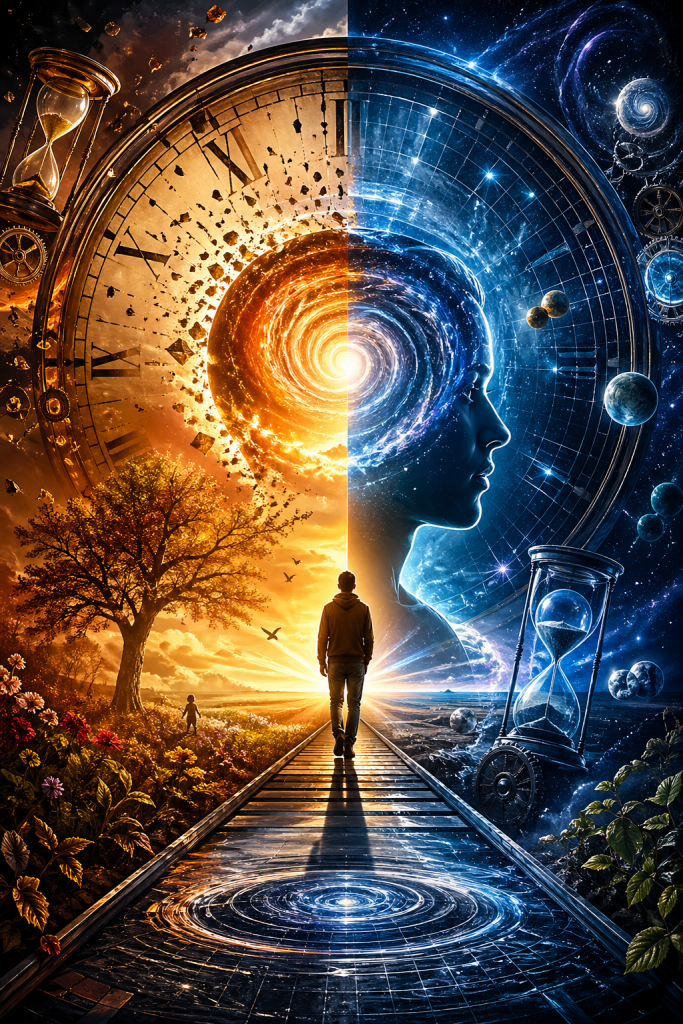
At first, asking whether time exists can seem abstract.
Even unnecessary.
But the implications are immediate.
If time is not a single, fundamental substance…
If it emerges from change, structure, and awareness…
Then our relationship to it is not what we assumed.
It suggests that:
- Time may not be something we move through
- It may be something that arises through interaction
- Measurement does not equal experience
- Awareness is not separate from time—it helps shape it
This is not a poetic interpretation.
It is a structural shift in understanding.
The Deeper Insight
So—does time actually exist?
The most honest answer is not yes or no.
It is layered.
In physics, time exists as a coordinate describing change.
In biology, it exists as rhythms sustaining life.
In consciousness, it exists as memory, anticipation, and narrative continuity.
Time is not a single substance moving independently of everything else.
It is a relationship.
Between events.
Between systems.
And between awareness and change.
Clocks record it.
Physics models it.
But human beings are where it becomes fully real.
And in that realization, something quietly profound emerges:
Time is not just something we live within.
It is something we continuously participate in creating.
Through what we remember.
Through what we expect.
Through what we choose to do next.
From the Publisher
There is a point in every serious inquiry where understanding stops expanding—and starts rearranging.
This is one of those points.
Does time actually exist? is not just a question about physics or philosophy. It is a threshold question—one that shifts how reality itself is organized in the mind.
What JJ Simon does here is subtle but decisive.
He does not remove time.
He removes the assumption that time is simple.
And in doing so, he returns something far more powerful to the reader:
Agency.
If time is not merely a force acting on you—but something that becomes meaningful through perception, memory, and choice—then your relationship to it is not fixed.
It is participatory.
This is where Dare I Say Publishing stands firmly behind this work.
Not because it offers easy answers.
But because it asks better questions—questions that expand awareness, challenge passive assumptions, and invite a deeper engagement with reality itself.
And once seen, this is not an idea that can be easily set aside.
Because the next time you check the time…
You may also begin to wonder:
What, exactly, are you measuring?


Leave a comment