
Reading Time: approx. 4 minutes
Last week, we looked at endings and the tendency to treat them as verdicts: if something ended, perhaps we failed.
But once we accept that an ending can simply be an ending, another challenge appears.
What happens when we cannot control what comes next?
Most of us have some instinct to manage uncertainty. We make plans, solve problems, gather information, and try to influence outcomes. There is nothing wrong with that. Agency matters.
The difficulty begins when effort turns into a demand that life unfold only one particular way.
That is where surrender can become useful—not as defeat, but as a different relationship with control.
Control and Agency Are Not the Same
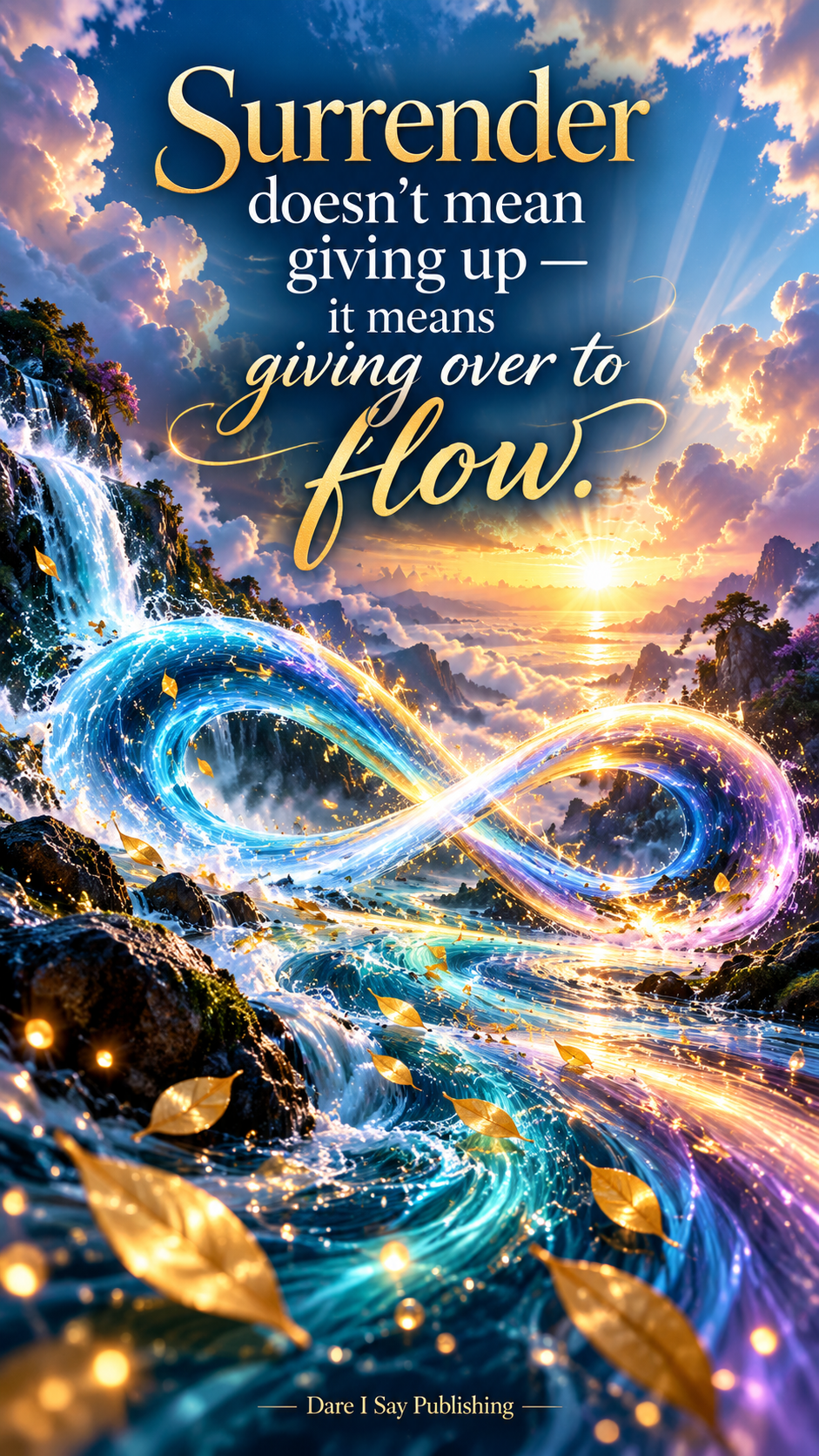
“Surrender doesn’t mean giving up — it means giving over to flow.”
Surrender is sometimes misunderstood as passivity.
If I stop trying to control this, am I giving up? Am I abandoning something that matters?
Not necessarily.
There is a difference between choosing our actions and controlling their results.
We can have an honest conversation without controlling how someone responds. We can prepare carefully for an opportunity without guaranteeing that it works out. We can care for a relationship without determining whether it lasts forever.
Our choices still matter. But they exist alongside circumstances, other people, timing, and things we simply cannot direct.
Surrender may begin with recognizing that boundary:
What is mine to do?
And what am I trying to force because uncertainty feels uncomfortable?
The Energy of Resistance
Sometimes we keep pushing not because a situation can still be changed, but because accepting its movement would require us to admit that something is no longer ours to hold.
We replay conversations. Search for one more explanation. Keep adjusting a plan that has already changed. Imagine the exact future we need in order to feel okay.
That resistance can feel like action.
Yet there are moments when all our effort is being spent trying to prevent reality from being what it already is.
Letting go does not erase disappointment, grief, or responsibility. It allows our energy to move away from fighting what cannot be undone and toward responding to what is actually here.
Moving With What Is
Perhaps surrender is less about doing nothing and more about becoming responsive.
Water does not stop moving when the landscape changes. It bends, gathers, slows, or finds another route.
Human lives are more complicated than rivers. But the image offers something worth considering:
Flexibility is not the absence of direction.
Sometimes it is what allows movement to continue.
We can release one outcome without releasing our values. We can stop controlling every detail without surrendering our ability to choose our next step.
Sometimes the more useful question is not:
How do I make this go back to the way I wanted?
It is:
What can I do with what is true now?
A Question for You…
Is there a difference in your own life between letting go of control and giving up?
When something cannot be changed, what helps you shift from resisting reality to deciding how you want to respond?
If you feel comfortable, share your thoughts in the comments below.
Your experience may offer someone else a perspective they haven’t considered yet.
Explore More Friday Inspiration
We also share short visual reflections through our growing collection of YouTube Shorts—brief, thought-provoking reminders designed to encourage reflection, perspective, and personal growth.
You can also explore our complete Friday Inspiration collection, where each week offers a fresh perspective on living with greater awareness, authenticity, and intention.
Read more Friday Inspiration posts
Final Thoughts
Surrender does not require us to stop caring.
It may simply mean caring without insisting that care gives us control.
We can still choose, act, repair, prepare, and begin again. But there are moments when the next step becomes clearer only after we stop spending all our strength trying to hold the previous one in place.
Next week, we move into what follows release: trust.
Once we release what we cannot control, can we trust ourselves through the uncertainty that remains?
Leave a Reply